

Hiring a Mudjacking Contractor for Sunken Concrete
A mudjacking contractor can raise an intact concrete slab that has sunk, often without tearing it out. Before hiring one, ask for an on-site assessment, a written estimate, proof of insurance, and clear answers about the material, cure time, and warranty. If the slab is badly cracked or crumbling, ask whether replacement is the safer choice.
Traditional mudjacking uses a cement-based slurry. Polyurethane foam injection is another leveling option. FoamWorks uses foam injection to repair sunken concrete for 30% to 50% less than full tear-out and replacement. Most repairs take a few hours, and the surface can be used almost immediately. We offer free estimates so you can compare your options.
I’m Trey McNamee, owner of FoamWorks Concrete Leveling, which brings over 30 years of combined industry experience to concrete repair. My two decades in building-materials marketing and product leadership help me explain what to ask a mudjacking contractor and how foam leveling compares.
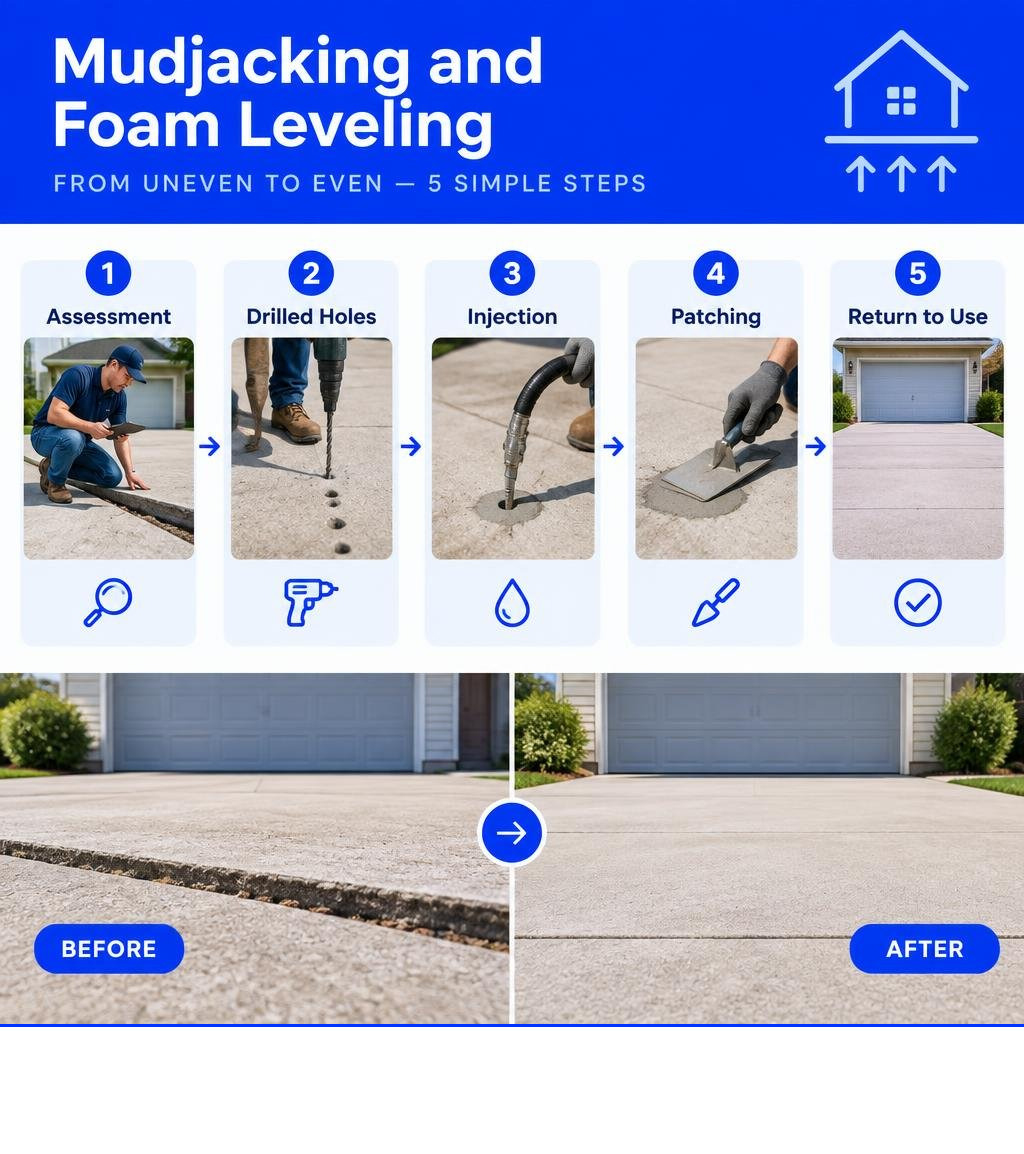
Mudjacking contractor vocab explained:
What Is Mudjacking and How Does Concrete Leveling Work?
When concrete slabs sink, the issue almost never starts with the concrete itself. Concrete is rigid, durable, and heavy. The ground underneath it, however, is prone to shifting, settling, and eroding. When the underlying soil moves or washes away, it leaves empty pockets called voids. Without uniform support, heavy concrete slabs inevitably drop.
Concrete leveling is the specialized process of lifting those sunken slabs back to their original grade by filling those empty voids beneath them.
Mudjacking—also known as slabjacking or pressure grouting—is the traditional mechanical method used for this repair. The contractor mixes a thick slurry consisting of water, topsoil or sand, and Portland cement. Using hydraulic pressure, the team pumps this dense mixture beneath the sunken slab. As the slurry flows into the sub-base voids, it accumulates, builds upward pressure, and gently pushes the heavy slab back into proper alignment with surrounding structures.
For decades, property owners used this method to avoid the massive expense and mess of demolition. Learning what mudjacking is and how concrete raising works helps clarify why raising an intact slab is almost always preferred over pouring fresh concrete. In addition, mudjacking for uneven concrete slabs remains a well-known method across residential neighborhoods to address tripping hazards quickly.
The Step-by-Step Concrete Raising Process
The mechanical process of lifting concrete follows a systematic series of steps regardless of whether a crew uses a heavy cement slurry or modern polyurethane foam.
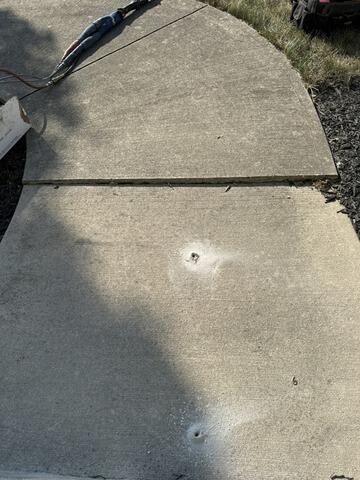
Here is how the physical raising process works from start to finish:
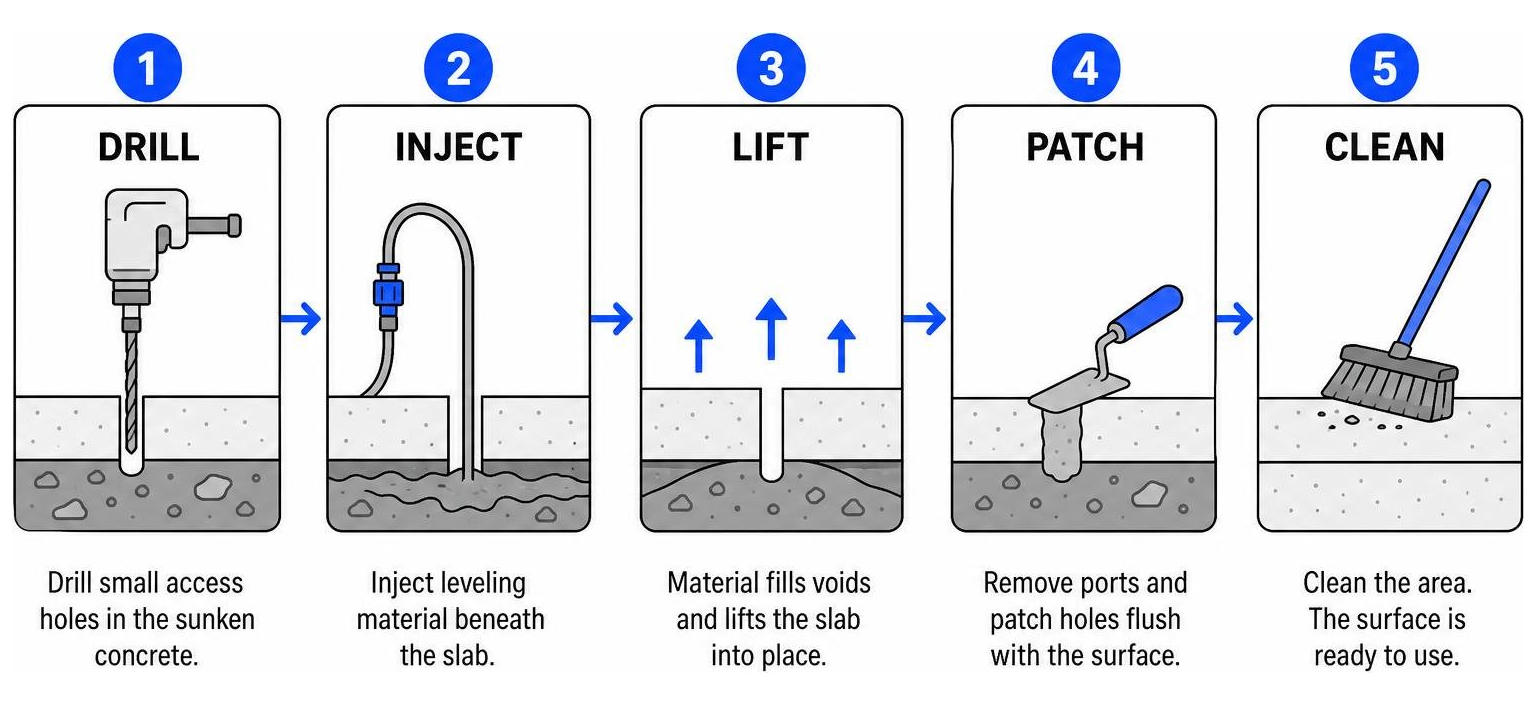
- Site Assessment and Mapping: The crew inspects the uneven concrete, measures pitch and grade using precision levels, and identifies hidden sub-surface voids and utility lines.
- Access Hole Drilling: Technicians drill a series of access holes strategically across the sunken section. For traditional mudjacking, these holes are typically 1.5 to 2 inches in diameter. For modern foam lifting, the holes are tiny—only 5/8-inch (about the size of a dime).
- Port Installation and Material Injection: Injection nozzles connect to the access ports. A hydraulic pump delivers the leveling material underneath the slab. As material enters the void, it expands or displaces air and water pockets.
- Controlled Slab Lifting: The technician monitors the slab continuously as the hydraulic or expansive pressure lifts it millimeter by millimeter back into alignment.
- Port Removal and Patching: Injection equipment is removed, and each drill hole is cleaned and patched flush with a high-strength color-matched cement mortar.
- Site Cleanup and Immediate Inspection: The work area is swept clean, washed down, and checked to ensure proper water runoff away from the home.
Traditional Slurry vs. High-Density Polyurethane Foam
While traditional mudjacking relying on a soil-and-cement slurry was the gold standard for over half a century, polyurethane foam lifting (often called polyjacking) has transformed the concrete repair industry.
The biggest drawback to traditional mudjacking slurry is its extreme weight. A cement slurry adds roughly 100 to 120 pounds per cubic foot of dead weight on top of soil that has already demonstrated it cannot support the original slab. Over time, that additional mass can cause underlying clay or loose fill to compress further, leading to re-settlement.
Polyurethane foam, by contrast, weighs only 2 to 4 pounds per cubic foot. It injects as a liquid, flows into micro-fissures and compact voids, and then expands up to 30 times its initial volume with tremendous lifting power. Foam cures via a chemical reaction rather than moisture evaporation, meaning it reaches full structural load capacity in under an hour without washing out during heavy rains.
Understanding mudjacking versus polyurethane foam pros and cons helps homeowners choose the right long-term fix. Exploring how polyurethane foam lifting works reveals why lighter, hydrophobic materials provide superior longevity against seasonal freeze-thaw cycles.
| Feature / Metric | Traditional Mudjacking Slurry | High-Density Polyurethane Foam |
|---|---|---|
| Drill Hole Diameter | Large (1.5″ to 2.0″) | Small / Discreet (5/8″ – dime-sized) |
| Material Weight | 100–120 lbs per cubic foot | 2–4 lbs per cubic foot |
| Cure Time to Full Load | 24 to 72 hours (1–3 days) | 15 to 60 minutes |
| Moisture Resistance | Susceptible to water washout | 100% waterproof / hydrophobic |
| Average Lifespan | 5 to 10 years | Decades / Lifetime structural stability |
| Landscape Disruption | Heavy equipment & pump trucks | Compact trailer & lightweight hoses |
Average Mudjacking and Concrete Leveling Costs
When evaluating your concrete repair budget, concrete leveling is universally recognized as the most economical path. Tearing out and replacing an existing concrete slab involves substantial demolition labor, hauling fees, landfill disposal costs, base re-compaction, framing, and new concrete delivery.
Leveling existing concrete typically costs less than half of what you would pay to demolish, remove, and re-pour concrete for the same surface area. When researching local options across reputable trade associations and verified trade contractor directory listings, you will find that leveling delivers substantial savings while preserving your landscaping and saving days of downtime.
Pricing Factors for Driveways, Walkways, and Patios
Every concrete repair project has unique characteristics that influence overall cost. A reputable contractor will evaluate several core criteria before presenting a final written quote:
- Total Square Footage and Lift Height: A slab that has settled half an inch requires substantially less void-fill material than a slab that has dropped 4 to 6 inches.
- Sub-Base Void Volume: Sometimes a slab has dropped only slightly, but soil washout underneath has created massive empty caverns that demand substantial material volume to fill and stabilize.
- Site Accessibility: Work areas located close to driveways allow fast equipment staging, whereas backyard patios, tiered garden steps, or tight pool decks requiring long hose runs can influence project setup times.
- Joint and Crack Sealing Needs: To prevent future water infiltration from washing out the newly injected sub-base, sealing active surface cracks and expansion joints is an essential add-on.
Concrete Leveling Costs by Project Type
Small concrete leveling repairs, such as addressing a single sunken sidewalk slab or front entry step, typically range between $500 and $1,500. Larger residential projects involving multi-slab driveways, extensive garage floors, or sprawling backyard patios generally range from $1,500 to $4,000 depending on total void volume and stabilization needs.
At FoamWorks Concrete Leveling, our polyurethane foam injection repairs sunken or uneven concrete for 30% to 50% less than full tear-out and replacement. Because our equipment does not require heavy excavation machinery, we eliminate the costly lawn repairs, debris hauling, and dumpster fees associated with standard repouring.
| Project Type | Typical Settlement Profile | Average Cost Range | Typical Duration & Cure Time |
|---|---|---|---|
| Front Walkway / Entry Sidewalk (1–3 Slabs) | Sunk 1″–2″ creating a step trip hazard | $500 – $1,200 | 1–2 hours (Ready immediately) |
| Porch / Front Step Landing | Pulled away from doorway threshold | $600 – $1,400 | 1–2 hours (Ready immediately) |
| Residential Patio (Standard 10’x12′ to 12’x15′) | Sloping backward toward foundation | $1,200 – $2,500 | 2–3 hours (Ready immediately) |
| Two-Car Garage Floor Slab | Settled in center or at vehicle entry lip | $1,500 – $3,200 | 3–4 hours (Drive on same day) |
| Multi-Section Concrete Driveway | 3 to 6 sunken slabs with vehicle bump | $1,500 – $4,000 | Half-day (Drive on within 1 hour) |
| In-Ground Pool Deck Surround | Uneven slabs creating sharp stub-toe edges | $1,800 – $3,800 | Half-day (Walk on immediately) |
Common Causes of Concrete Settlement and Sinking
Concrete is exceptionally durable under compressive force, but it possesses very little tensile flexibility. If the soil supporting it gives way, gravity will pull the slab down until it finds a solid resting point, often snapping or tilting along weak points in the process.

Understanding why your concrete driveway is sinking allows you to address the root drainage or environmental triggers so the problem does not repeat itself.
Soil Compaction, Washouts, and Clay Soil Shrinkage
There are three primary natural and human-made culprits behind sinking concrete:
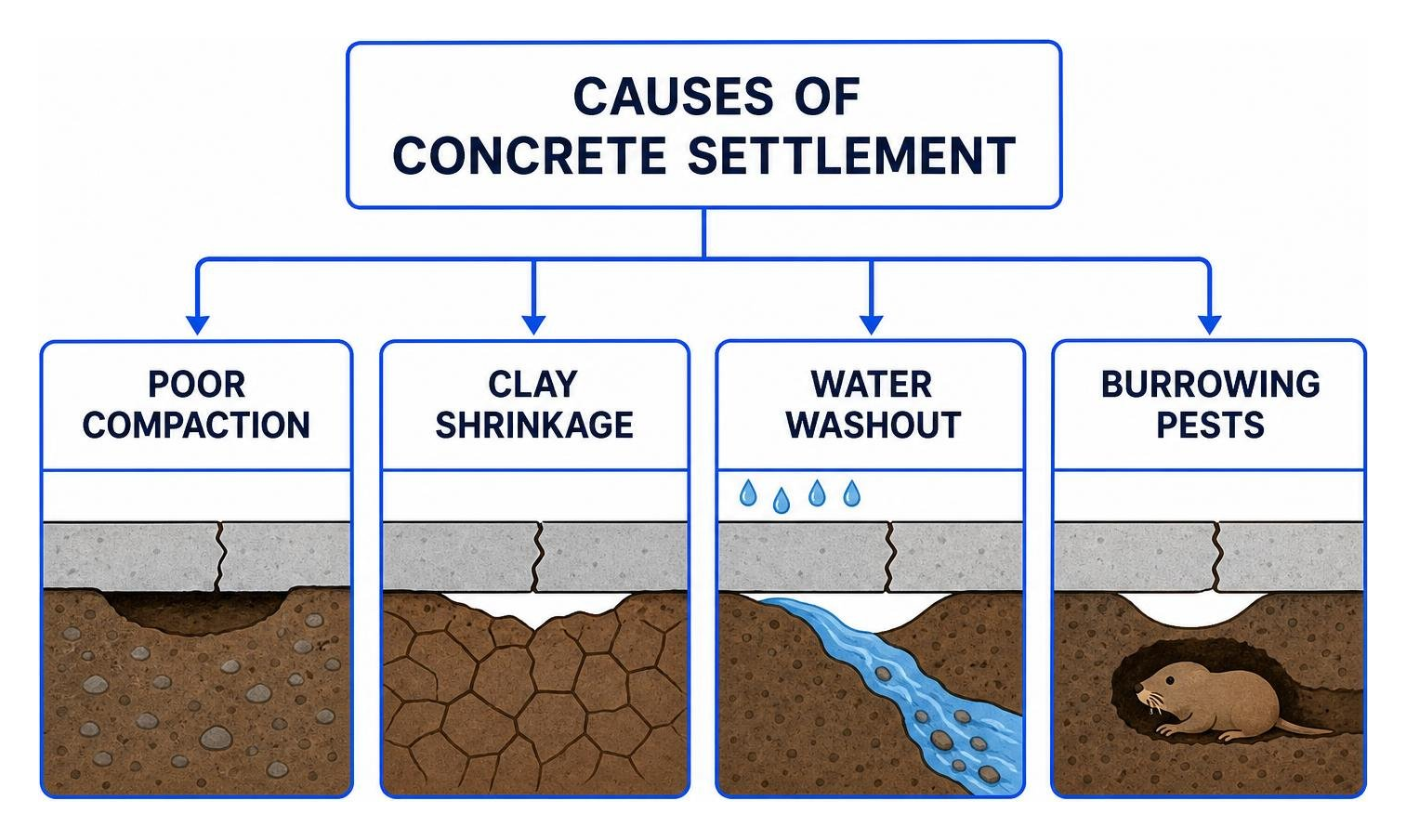
- Poor Initial Sub-Base Compaction: During original home construction, soil excavated for foundations and utility trenches is backfilled around the home. If builders do not mechanically compact this soil in dense layers before pouring driveways, walkways, and patios, the loose dirt naturally consolidates under slab weight over 2 to 7 years, creating voids.
- Clay Soil Shrink-Swell Dynamics: Soils with high clay content act like giant sponges. In wet spring conditions, clay absorbs water and expands. During hot, dry summer stretches, clay soils lose moisture and shrink significantly, pulling away from the underside of the concrete and removing critical load support.
- Water Washout and Downspout Runoff: Roof downspouts that empty directly next to concrete walkways, leaking irrigation lines, and unsealed surface cracks funnel water underneath slabs. Rushing rainwater erodes sand and fine gravel bases, washing them away into municipal drains or surrounding yards.
- Burrowing Animals and Tree Roots: Rodents like moles, chipmunks, and groundhogs frequently tunnel beneath warm concrete slabs, hollowing out structural base material. Similarly, dying tree root systems rot away over time, leaving large underground cavities.
Recognizing the signs your concrete slab is settling early—such as standing water puddles after rain, doors rubbing against garage floors, or gaps forming beneath exterior siding—allows for fast, low-cost remediation before slabs break into unsalvageable fragments.
Trip Hazard Liability and Building Code Regulations
Uneven concrete is not simply an aesthetic nuisance; it represents a major personal injury and financial liability risk.
Under standard premises liability law, property owners have a legal duty of care to maintain safe walking surfaces for visitors, delivery drivers, and pedestrians. Building codes and Americans with Disabilities Act (ADA) guidelines strictly regulate surface continuity. On exterior walkways and steps, any vertical displacement or change in level greater than 1/4 inch is classified as an actionable trip hazard.
Furthermore, local building codes mandate that the maximum step riser height for exterior stairs and steps is 7 3/4 inches, with a maximum allowable slope variance of just 2 degrees. When a sidewalk slab sinks adjacent to your front porch step, it can easily push that total step riser height over 8 or 9 inches. If a delivery driver or guest trips over an out-of-code step or an uneven sidewalk joint on your property, you could be held fully liable for their medical expenses and damages. Hiring a professional to raise those slabs eliminates safety liabilities in an afternoon.
How to Hire the Right Mudjacking Contractor for Your Project
Choosing the right contractor ensures your concrete is lifted smoothly without cracking, your landscape remains undamaged, and the repair lasts for years to come. Because concrete lifting requires specialized machinery and deep knowledge of local soil mechanics, you should carefully evaluate your service provider.
Look for contractors who specialize specifically in concrete leveling rather than general handymen who treat void filling as an occasional side job. A dedicated specialist carries proper commercial liability insurance, maintains state and municipal contractor licenses, and provides transparent, itemized written estimates following an in-person physical inspection.
Essential Questions to Ask a Mudjacking Contractor
Before signing any work authorization or putting down a deposit, ask prospective contractors these straightforward questions:
- What specific material do you use to lift the concrete? (Ask whether they use heavy cement/mud slurry or lightweight, closed-cell expanding polyurethane foam).
- What size holes will you drill into my concrete? (Traditional mudjacking requires large 1.5- to 2-inch holes, while polyurethane foam uses tiny 5/8-inch ports that blend cleanly after patching).
- How long before we can walk and drive on the repaired surface? (Slurry requires 1 to 3 full days of drying time; polyurethane cures to 90%+ structural strength within 15 to 30 minutes).
- What type of warranty do you provide on the lift? (Ask for a plainly stated, written warranty covering both material breakdown and re-settlement).
- How do you address underlying water and drainage issues? (The contractor should provide guidance on redirecting downspouts and sealing active joints).
Red Flags to Avoid When Choosing a Mudjacking Contractor
Be cautious if you encounter any of the following warning signs during your contractor evaluation:
- Verbal-Only Quotes or Lack of Detailed Scope: Avoid any contractor who refuses to provide a comprehensive, itemized written estimate outlining hole patching, cleanup, and warranty coverage.
- No Proof of General Liability and Worker’s Compensation Insurance: If an uninsured worker is injured on your driveway, you could face homeowner liability claims. Always demand a current certificate of insurance.
- Ignoring Sub-Base Voids and Soil Conditions: A contractor who simply promises to “jack it up” without diagnosing why the soil failed in the first place is setting you up for repeat settlement.
- High-Pressure “Today-Only” Sales Tactics: Professional leveling companies provide clear diagnostic estimates with adequate time for you to review your options.
Frequently Asked Questions about Concrete Mudjacking
How long does mudjacking last compared to polyjacking?
Traditional mudjacking typically provides a reliable fix for 5 to 10 years. Because the cement slurry is composed of natural soils and sand, it remains vulnerable to water erosion, burrowing insects, and freeze-thaw degradation over time. Additionally, the extreme weight of the dried slurry can cause weak underlying soils to settle again.
By comparison, polyurethane foam leveling (polyjacking) is engineered to last for decades. Closed-cell polyurethane is completely hydrophobic—it does not absorb moisture, will not wash away during torrential downpours, and does not degrade in the soil. To understand the lifespans of different repair methods, see our guide on how long mudjacking lasts.
How long do I have to wait to use my concrete after mudjacking?
With traditional mudjacking using cement slurry, you must wait 24 to 72 hours (1 to 3 full days) for the water in the mixture to evaporate and the cement to cure before parking heavy vehicles on the surface. Walking on it may be permitted after several hours, but heavy loads placed too early can cause the wet slurry to shift.
With high-density polyurethane foam injection, you can walk on the concrete immediately and drive heavy passenger vehicles or trucks over the lifted slab in as little as 15 to 30 minutes after completion.
Can mudjacking fix severely cracked or crumbling concrete?
Mudjacking and polyurethane foam lifting are designed to raise intact, structurally sound concrete slabs that have settled. If a slab has a few clean, linear cracks, technicians can lift each section into alignment and seal the cracks with flexible silicone or polyurethane sealant.
However, if your concrete is severely crumbling, spalling into loose gravel, or broken into dozens of small, spiderwebbed pieces (often called “alligator cracking”), concrete leveling cannot restore its structural integrity. In those advanced stages of deterioration, full demolition and slab replacement is the necessary choice. A trustworthy contractor will always be honest about whether your concrete is a viable candidate for leveling.
Conclusion
Sunken, uneven concrete driveways, walkways, and patios create unsightly trip hazards, lower curb appeal, and threaten property safety. However, tearing out and replacing sunken slabs is an expensive, noisy, and disruptive process that often damages your surrounding lawn and landscaping.
Concrete leveling provides a proven, cost-effective alternative that restores your surfaces to their original elevation at a fraction of the cost. While traditional mudjacking has helped property owners for decades, modern high-density polyurethane foam injection offers smaller injection holes, instant cure times, waterproof stability, and long-lasting durability without adding unnecessary weight to fragile soils.
At FoamWorks Concrete Leveling, we specialize in fast, clean, and permanent foam injection lifting, crack repair, and joint sealing backed by over 30 years of combined industry experience and a lifetime warranty. We proudly serve homeowners and businesses across Northwest Ohio, Southeast Michigan, and Northeast Indiana.
Contact us today to schedule your free estimate and learn how our professional concrete leveling services can safely restore your sunken concrete for 30% to 50% less than replacement.