

Understanding Concrete Leveling Mudjacking and How It Works
Concrete leveling mudjacking is a mechanical repair technique that raises sunken concrete slabs back to their original elevation by injecting a dense slurry under the slab using hydraulic displacement. Understanding what is mudjacking and how concrete raising works starts with this process of pumping material into subterranean voids to exert upward force and restore structural support.
Concrete settling commonly occurs due to soil consolidation, washouts, and underground void formation. When the supporting ground erodes, the overhead slab drops, leading to trip hazards, water pooling, and structural strain. As injected slurry flows beneath the slab, it packs empty pockets and gently elevates the concrete.
This controlled pressure distribution allows technicians to lift heavy slabs incrementally. By targeting specific injection points, operators stabilize the underlying base and restore the surface without causing stress fractures in the concrete.
Step-by-Step Concrete Leveling Mudjacking Process
The traditional mudjacking process follows an established series of mechanical steps:
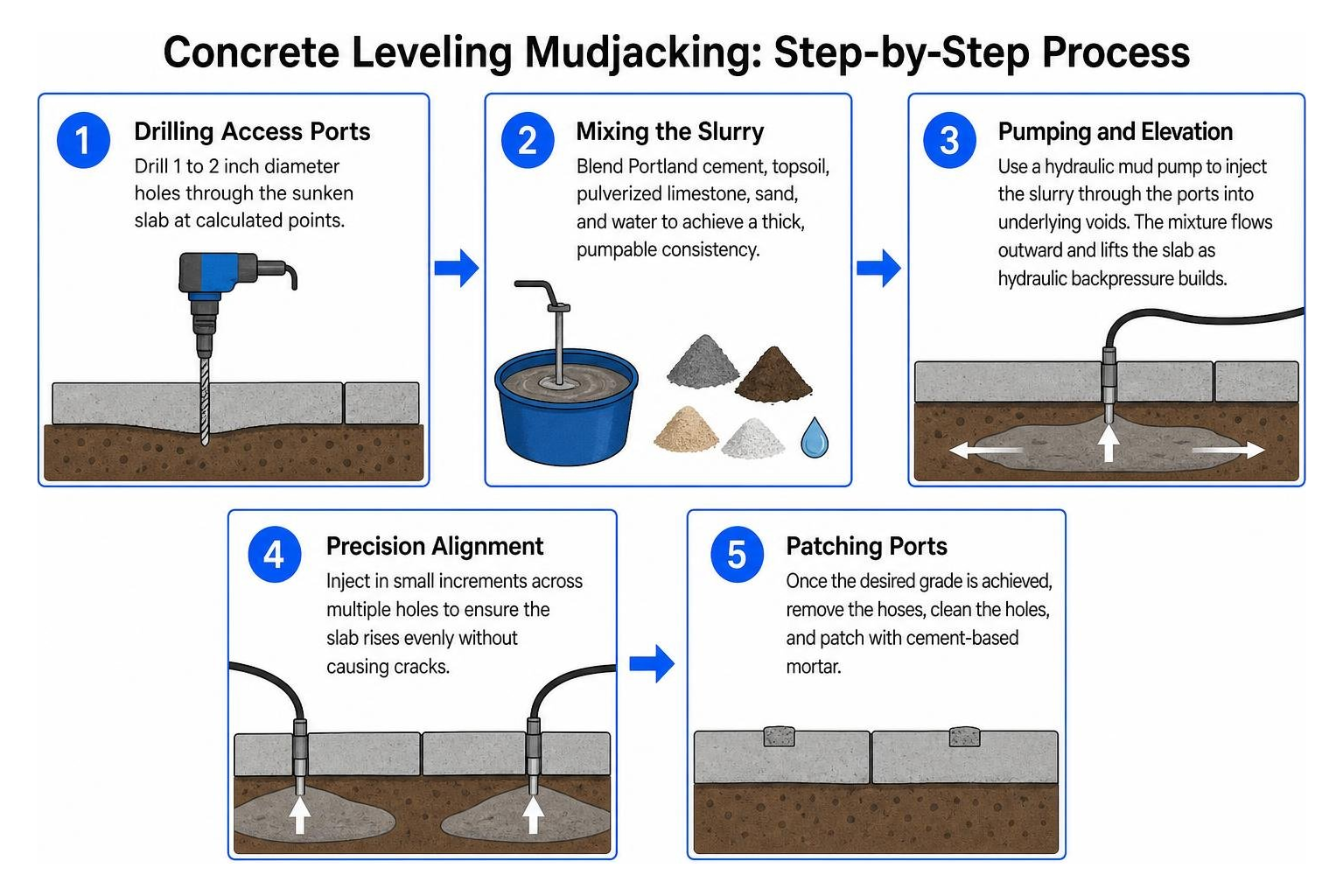
- Drilling Access Ports: The crew drills holes measuring 1 to 2 inches in diameter through the sunken slab at calculated structural points.
- Mixing the Slurry: A blend of Portland cement, topsoil, pulverized limestone, sand, and water is mixed on-site to achieve a thick, pumpable consistency.
- Pumping and Elevation: A specialized hydraulic mud pump injects the slurry through the ports into the underlying voids. The mixture flows outward until hydraulic backpressure lifts the slab.
- Precision Alignment: Injections are made in small increments across multiple holes to ensure the slab rises evenly without cracking.
- Patching Ports: After achieving the desired grade, the injection hoses are removed, and technicians clean the drilled openings and pack them with a cement-based patching mortar.
The primary equipment and tools required to execute mudjacking include:
- Heavy-duty rotary hammer drills with large masonry bits (1 to 2 inches)
- Hydraulic mud pumps capable of generating steady displacement pressure
- On-site mixer units for preparing the raw slurry ingredients
- Flexible, high-pressure delivery hoses and tapered injection nozzles
- Leveling instruments, straight edges, and laser levels for precise height monitoring
- Masonry trowels and cleanout tools for port finishing
Suitable Surfaces for Mudjacking Repair
Most unreinforced and light-duty exterior concrete flats can be raised effectively. Common applications include:
- Sunken residential driveways experiencing settlement near garage transitions
- Uneven sidewalks, walkways, and entry steps that present municipal trip hazards
- Outdoor concrete patios that have pitched backward toward home foundations
- Pool decks suffering from soil settlement around pool walls
- Garage floors, interior basement slabs, and warehouse storage flats
For properties dealing with uneven structural surfaces, addressing these issues through prompt concrete repair prevents further deterioration and eliminates hazardous elevation changes.
Mudjacking vs. Polyurethane Foam Lifting
While mudjacking has been used for decades, modern concrete raising frequently relies on expanding polyurethane foam injection. Understanding the physical differences between these methods helps property owners determine which approach fits their property best.
Mudjacking relies on a heavy, earth-based slurry weighing roughly 100 to 140 pounds per cubic foot. Polyurethane foam, by comparison, expands beneath the slab as a lightweight closed-cell polymer weighing only 2 to 4 pounds per cubic foot. Because the foam expands chemically rather than relying strictly on hydraulic bulk, it fills hairline voids and stabilizes loose soil without adding significant downward load to already compromised ground.
For a deeper look into how expandable polymers operate, explore Rise and Shine: What is polyurethane concrete leveling to see the mechanical differences firsthand.
| Feature / Metric | Traditional Mudjacking | Polyurethane Foam Lifting |
|---|---|---|
| Drill Hole Size | 1 to 2 inches (soda can top diameter) | 5/8 inch (dime-sized) |
| Material Weight | 100–140 lbs per cubic foot | 2–4 lbs per cubic foot |
| Cure Time to Full Use | 24 to 48 hours | 15 to 30 minutes |
| Moisture Resistance | Susceptible to water erosion and washout | 100% waterproof; hydrophobic barrier |
| Subsoil Load Impact | Adds significant weight to unstable soil | Adds negligible weight; prevents re-settling |
| Equipment Footprint | Large trucks, mixers, heavy hoses | Compact trailer or box truck system |
Regional Alternatives to Traditional Mudjacking
Across our service territory in Northwest Ohio, Southeast Michigan, and Northeast Indiana, local soil characteristics present unique challenges for concrete slabs. Dense clay soils expand during wet seasons and shrink significantly during summer droughts, while seasonal freeze-thaw cycles create subterranean movement.
In regions prone to severe ground shifting, heavy mudjacking slurry can occasionally overburden soft subgrades. Homeowners looking for a modern alternative in Wood County can explore our concrete mudjacking alternative in Waterville OH.
Similarly, for properties in Allen County managing expansive clay bases, review our concrete mudjacking alternative in Lima OH. Coastal and lakeshore communities along Lake Erie face sandy or saturated subsoils, making our concrete mudjacking alternative in Oak Harbor OH a dependable solution.
Key Benefits and Cost Savings Over Demolition
Tearing out settled concrete and pouring new slabs is noisy, disruptive, and expensive. Mudjacking and foam leveling provide practical alternatives that protect both your budget and your property.
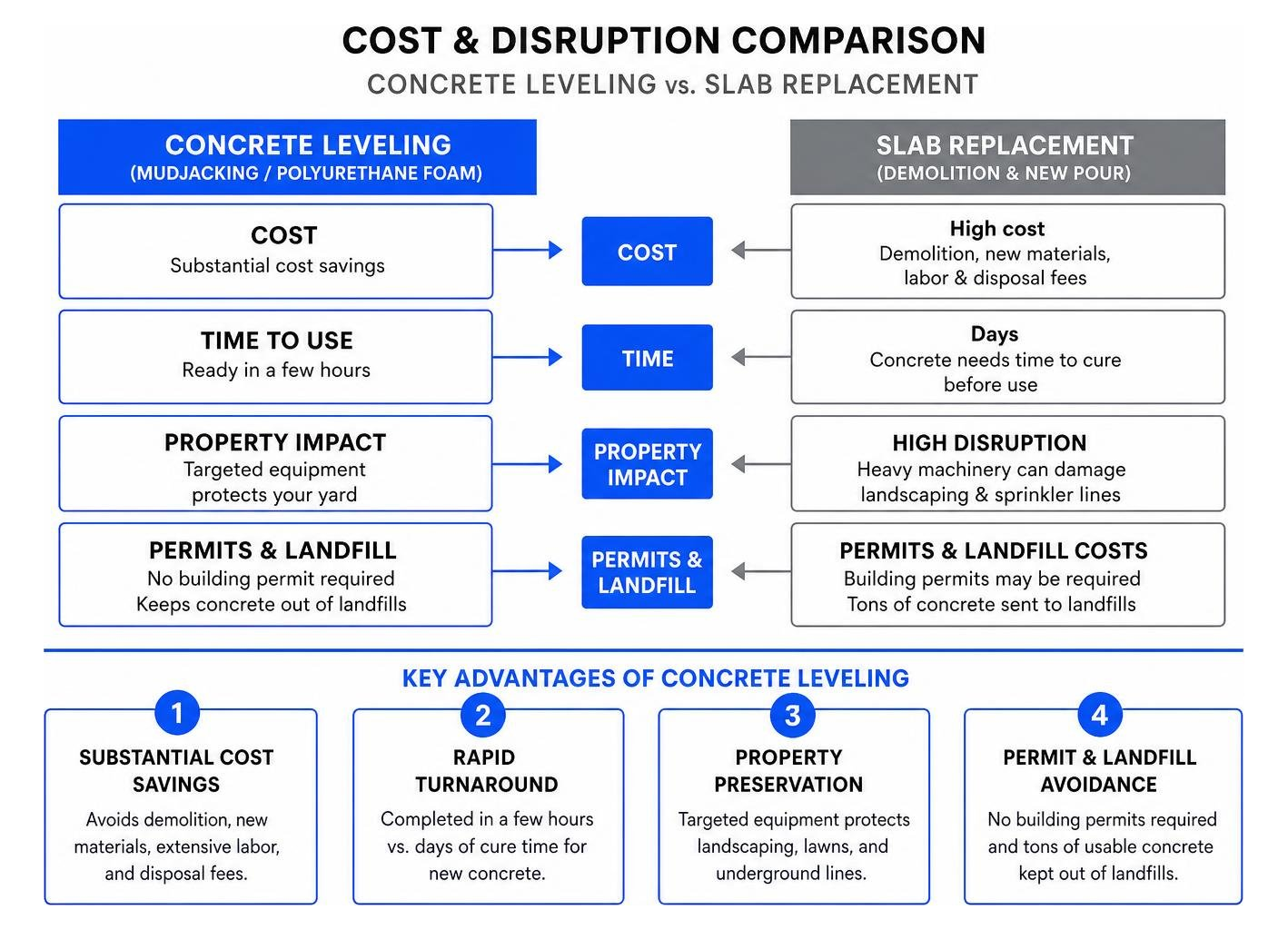
Key advantages of concrete raising include:
- Substantial Cost Savings: Concrete raising bypasses the extensive labor, heavy excavation, framing, and disposal fees tied to new pours.
- Rapid Turnaround: While fresh concrete requires days to cure before vehicle traffic is permitted, leveling can be completed in a few hours.
- Property Preservation: Heavy demolition machinery can tear up landscaping, rut lawns, and damage adjacent sprinkler lines. Slab jacking relies on targeted equipment that protects your yard.
- Permit and Landfill Avoidance: Lifting avoids municipal building permit requirements and keeps tons of usable masonry rubble out of local landfills.
To learn more about the financial and environmental benefits of raising settled slabs, check out Don’t Replace It, Raise It: Modern Solutions for Concrete Sinking Repair.
When to Choose Concrete Leveling Mudjacking Over Replacement
Lifting is ideal when the concrete slab remains structurally sound despite being out of alignment. If a slab has dropped several inches but exhibits minimal surface cracking or spalling, leveling is the most cost-effective path forward.
However, if a slab is shattered into small, disconnected fragments (“alligator cracking”) or the surface layer has deteriorated down to the coarse aggregate, replacement may be necessary. Reviewing the details of concrete repair: mudjacking helps determine whether your slab is an ideal candidate for lifting or if structural reconstruction is required.
Longevity, Durability, and Potential Drawbacks
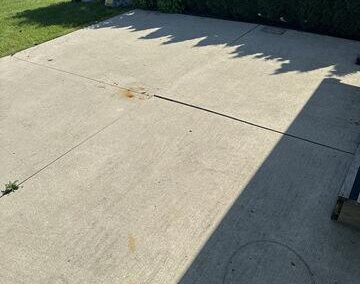
When asking how long does mudjacking last for sinking concrete slabs, the answer depends heavily on soil dynamics and moisture control. A properly executed mudjacking repair can perform well for several years, provided the underlying earth remains stable.
However, property owners should consider a few inherent drawbacks associated with traditional slurry-based lifting:
- Material Weight: Adding hundreds of pounds of wet mortar underneath a slab that sank due to weak soil can cause the underlying ground to compress further over time.
- Erosion Vulnerability: Because mudjacking slurry is composed of natural sand, soil, and cement, unsealed subterranean water flow or downspout runoff can gradually wash the material away.
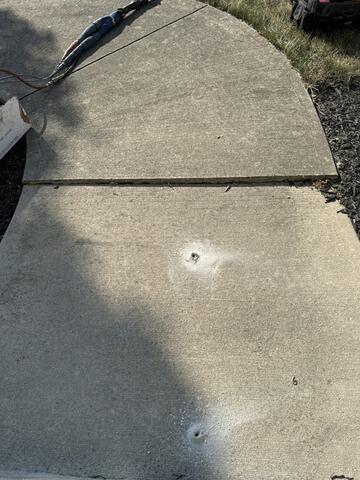
- Visual Footprint: The 1- to 2-inch drill holes required for mudjacking nozzles leave larger round patches across the slab surface compared to the smaller 5/8-inch holes used in modern foam lifting.
- Moisture Management: To protect longevity, property owners must redirect downspouts away from the slab, seal open joints, and maintain proper yard drainage.
Frequently Asked Questions About Concrete Mudjacking
Is mudjacking a permanent fix for sinking concrete?
Mudjacking can provide long-lasting support, but it is not always a permanent fix. Its lifespan depends entirely on the stability of the subgrade and how well water runoff is managed. If roof downspouts discharge directly along the slab edge or subterranean voids wash out from poor drainage, the slab may settle again over time. Managing surface water is key to maximizing repair lifespan.
How much money does mudjacking save compared to slab replacement?
At FoamWorks Concrete Leveling, we use polyurethane foam injection to repair sunken or uneven concrete for 30% to 50% less than full tear-out and replacement, helping homeowners save significantly on repair costs. Most repairs are completed in just a few hours, and the surface can be used almost immediately. Because there’s no need for heavy excavation, the process also reduces landscape damage, labor costs, debris removal, and disposal fees that come with replacing concrete. We provide free estimates to see how much you can save.
How long does a typical mudjacking project take to complete?
A standard residential mudjacking or foam leveling job is usually completed in just 1 to 3 hours. Slurry mudjacking injections take only a few minutes per hole, though traditional slurry requires 24 hours of curing before handling heavy vehicle loads. High-density polyurethane foam cures within 15 to 30 minutes, allowing immediate use.
Conclusion
Uneven walkways, sunken driveways, and sloping patios are more than an eyesore—they are safety hazards and drainage headaches. Raising your concrete restores structural balance, eliminates trip liabilities, and protects your investment without the expense and mess of demolition.
Whether you choose traditional mudjacking or modern polyurethane foam lifting, stabilizing the underlying void space is essential. At FoamWorks Concrete Leveling, our family-owned team brings over 30 years of combined industry experience to every project throughout Northwest Ohio, Southeast Michigan, and Northeast Indiana. If you are ready to fix sunken slabs, schedule a site evaluation for professional concrete leveling and get your surfaces back on solid ground.