

Understanding the Basics: What Is Mudjacking?
When exploring concrete repair, you will encounter terms like slabjacking, pressure grouting, and concrete leveling. So, what is mudjacking in technical terms? At its core, mudjacking is a traditional method of Concrete Repair – Mudjacking designed to restore sunken slabs without full replacement.
According to standards outlined by Mudjacking – InterNACHI®, mudjacking uses a liquid slurry mixture to hydropress settled concrete upward. This process addresses structural settling around driveways, walkways, entry stoops, garage floors, and interior slabs. By restoring these surfaces to an even grade, property owners eliminate dangerous trip hazards and prevent water from pooling against home foundations.
Historically, homeowners had to break up and pour new concrete whenever slabs sank. Traditional mudjacking replaced that costly demolition process with a hydraulic pressure system that pumps heavy cementitious mortar directly beneath the affected slab.
What Causes Concrete Slabs to Sink and Settle?
Concrete is rigid and unyielding, but the dirt beneath it is dynamic. Over time, changes in the soil sub-base weaken the support system holding up your heavy concrete slabs. Why Is My Concrete Driveway Sinking? is a question we field every single day. Understanding Concrete Repair – Causes comes down to four primary environmental factors:
- Poor Initial Subgrade Compaction: When homes or driveways are constructed, dirt is excavated and backfilled. If contractors do not properly compact this loose soil, gravity and time cause the ground to consolidate, leaving empty voids under heavy concrete.
- Soil Erosion from Water Runoff: Rainwater from misdirected roof downspouts, melting snow, or natural grade slopes washes away fine soil particles underneath concrete pads.
- Seasonal Moisture Fluctuations: Clay-heavy soils expand significantly when saturated with water and shrink during dry summer spells. This constant swelling and shrinking cycle creates uneven voids under concrete.
- Tree Roots and Natural Freeze-Thaw Cycles: Growing tree roots displace underlying soil, while trapped groundwater freezes and expands during harsh winter months, causing ongoing subsoil shifting.
When soil drops away or washes out, unsupported concrete eventually cracks under its own immense weight or tilts steeply into the underlying void.
The Step-by-Step Mudjacking Process
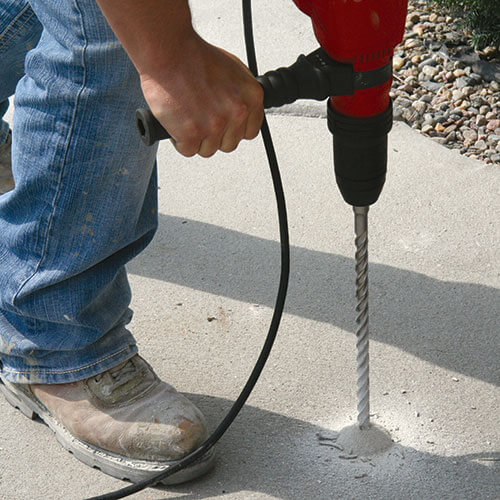
Understanding what is mudjacking requires looking at how contractors raise a heavy concrete slab. The process relies on basic hydraulic principles to push concrete back into place.
As detailed in the 570.5 Mudjacking (Slab Jacking) by MoDOT Maintenance – Engineering Policy Guide, proper procedure must be followed to avoid cracking the concrete during elevation adjustments.
Injection Hole Drilling and Preparation
Before pumping slurry, crews prepare the sunken slab by drilling strategic access ports through the concrete:
- Hole Size: Traditional mudjacking requires drilling large holes, typically 1.5 to 2.625 inches in diameter, using heavy masonry core drills.
- Grid Pattern Spacing: Holes are placed in a grid pattern to distribute hydraulic lifting force evenly across the slab.
- Subgrade Inspection: Technicians ensure the drill bits fully penetrate the concrete slab to access the underlying soil subgrade without damaging underground utilities.
Slurry Injection and Controlled Lifting
Once injection ports are open, a heavy-duty hydraulic pump forces slurry beneath the concrete pad:
- Void Filling: The slurry first flows into all empty pockets and eroded subgrade channels beneath the concrete.
- Incremental Lifting: Once voids are filled, pressure builds up under the slab. The pump operator lifts the slab incrementally—raising it no more than 1/4 inch per pass to avoid structural cracking.
- Elevation Monitoring: Technicians monitor alignment using string lines and levels until the slab matches adjacent structures.
- Patching and Finishing: Injection hoses are disconnected, and the large drilled holes are plugged with a stiff mortar mix.
Mudjacking Slurry Materials vs. Modern Alternatives
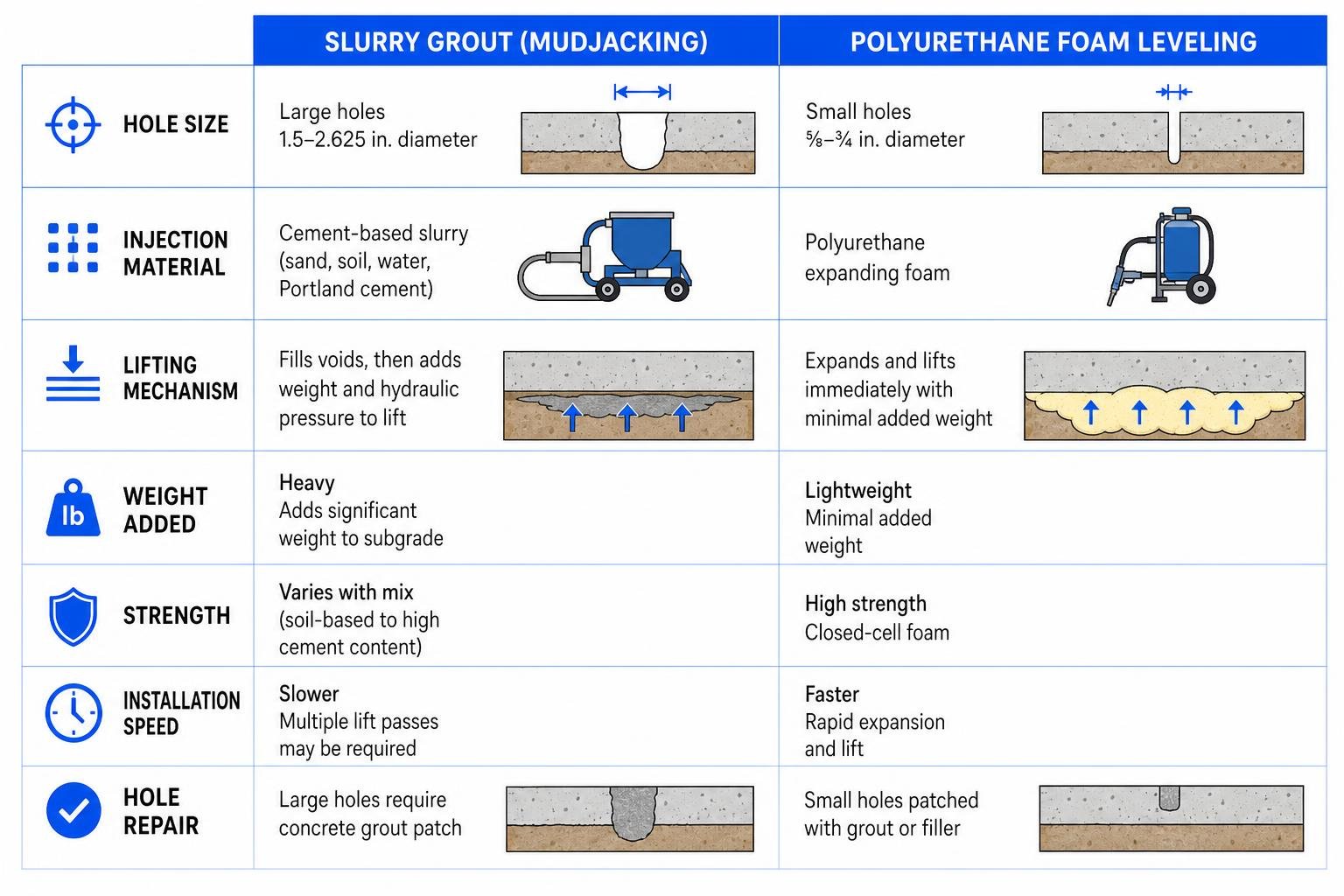
The performance of concrete lifting depends heavily on the material injected beneath the slab. A complete understanding of Concrete leveling involves comparing traditional slurry with modern alternatives.
Traditional mudjacking slurry typically consists of local topsoil, sand, water, and Portland cement. Soil-based slurry mixes yield compressive strengths ranging from 200 to 240 psi (around 34,560 lbs of lifting support per square foot). Adding higher concentrations of Portland cement can increase compressive strength up to 6,000 psi. However, these heavy cementitious mixes add substantial weight to unstable subsoil.
What Is Mudjacking Compared to Polyurethane Foam Leveling?
Modern concrete raising has shifted toward closed-cell polyurethane expanding foam, such as Concrete Leveling – PolyLevel Injection. Instead of relying on high-volume hydraulic pressure to push heavy mud under a slab, polyurethane foam relies on an expansive chemical reaction that takes place beneath the surface.
| Feature / Metric | Traditional Cementitious Mudjacking | Modern Polyurethane Foam Leveling |
|---|---|---|
| Material Weight | 100 to 120 lbs per cubic foot | 3 to 5 lbs per cubic foot |
| Drill Hole Size | 1.5″ to 2.625″ (size of a soda can top) | 3/8″ to 5/8″ (size of a penny) |
| Cure Time to Traffic | 24 to 48 hours for vehicle traffic | 15 to 30 minutes for full load |
| Water Resistance | Can wash away if erosion persists | 100% Hydrophobic (will never wash away) |
| Compressive Strength | High (240 to 6,000+ psi) | High structural density (up to 14,000 lbs/sq ft) |
| Aesthetics | Large patched concrete circles | Minimal, barely noticeable drill patches |
Advantages, Costs, and Limitations of Mudjacking
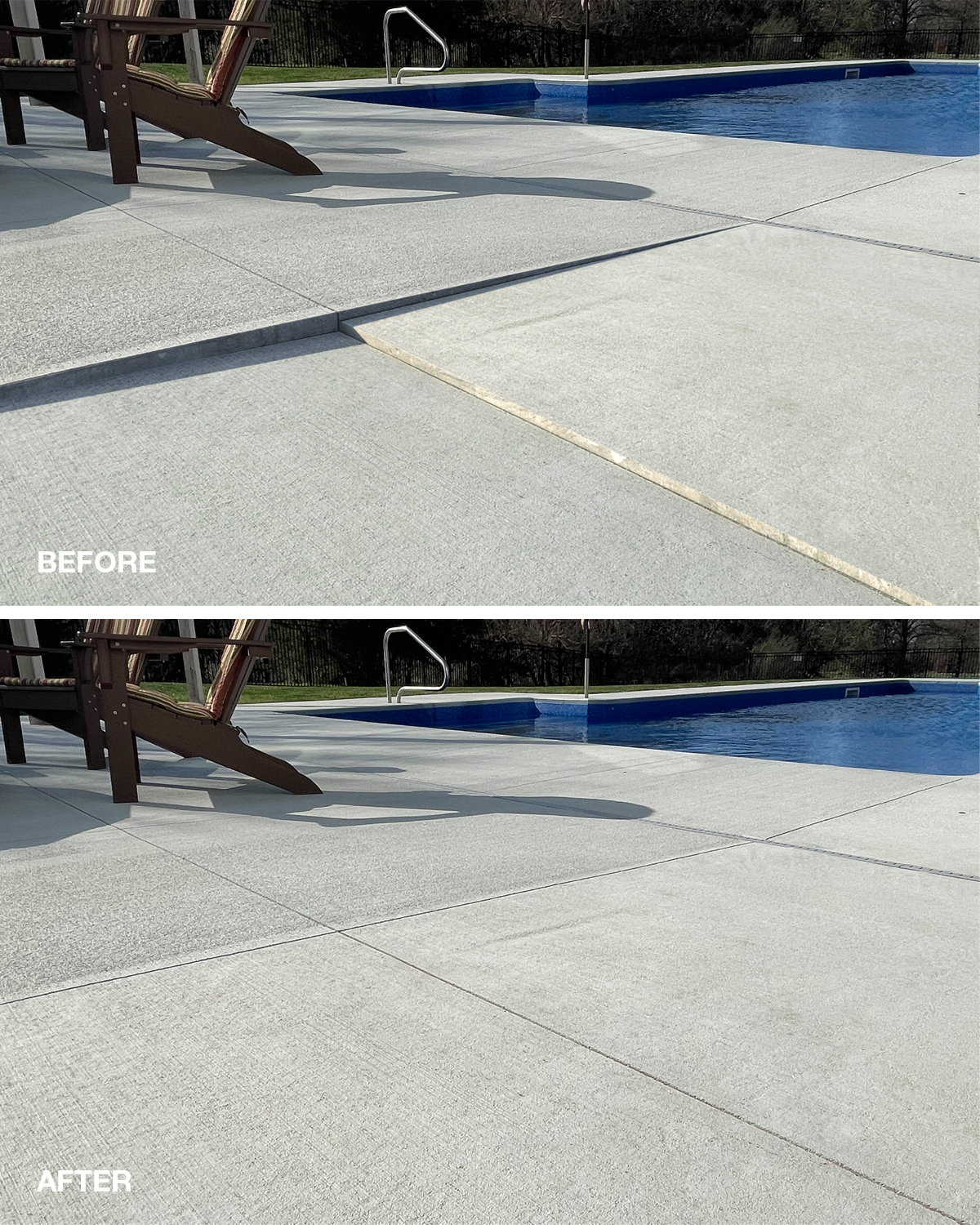
When reviewing concrete repair options, homeowners generally weigh three factors: cost, longevity, and site disruption.
What Is Mudjacking Cost and Limitations?
Mudjacking typically costs roughly half as much as complete concrete replacement. For example, lifting a small 5×4-foot walk section via mudjacking might start around $60 to $150, whereas full tear-out and replacement can cost hundreds more due to excavation fees and labor.
However, traditional mudjacking has clear limitations where it should not be used:
- Severely Spalling or Fractured Slabs: Slabs broken into multiple small fragments cannot be lifted cleanly. They will continue to crumble under hydraulic pressure.
- Excessive Weight on Unstable Soils: Mudjacking slurry adds roughly 100 pounds per cubic foot to subsoils that have already settled. This added weight can cause subsoil settlement to recur over time.
- Heavy Load-Bearing Foundation Walls: Mudjacking is generally unsuitable for lifting heavy load-bearing foundation footings or exterior brick walls.
- Active Sinkholes or Swampy Subgrade: If underlying soil drains continuously into an open void or water table, liquid slurry will wash away before it can cure.
Why DIY Mudjacking Is Not Recommended
Some homeowners consider renting equipment to attempt DIY concrete lifting. However, concrete leveling requires specialized training, heavy equipment, and knowledge of soil dynamics:
- Structural Failure: Pumping material too quickly or unevenly can snap concrete slabs, turning a simple repair into a complete replacement job.
- Underground Utility Risks: Drilling through slabs without identifying buried gas lines, electrical conduits, or water pipes creates safety hazards.
- High-Pressure Blowouts: Hydraulic pumps operate under immense pressure. Equipment failure or clogged lines can trigger slurry blowouts.
Frequently Asked Questions About Concrete Raising
How long does a mudjacking repair last?
A mudjacking repair can last anywhere from 2 to 10 years or more, depending on underlying soil stability and site drainage. Because traditional slurry adds substantial weight to subsoil, ongoing erosion or poor downspout drainage can cause the soil beneath the slurry to settle again over time. Controlling roof runoff and sealing open joints improves repair longevity.
How much does mudjacking cost compared to replacing concrete?
Mudjacking typically costs 30% to 50% less than full concrete demolition and replacement. While small lifting jobs might start around a few hundred dollars, full concrete replacement requires heavy excavation, hauling fees, long curing times, and potential landscaping repairs.
At FoamWorks Concrete Leveling, our polyurethane foam injection repairs save property owners 30% to 50% compared to full replacement, with free estimates available across Northwest Ohio, Southeast Michigan, and Northeast Indiana.
How quickly can concrete be used after leveling?
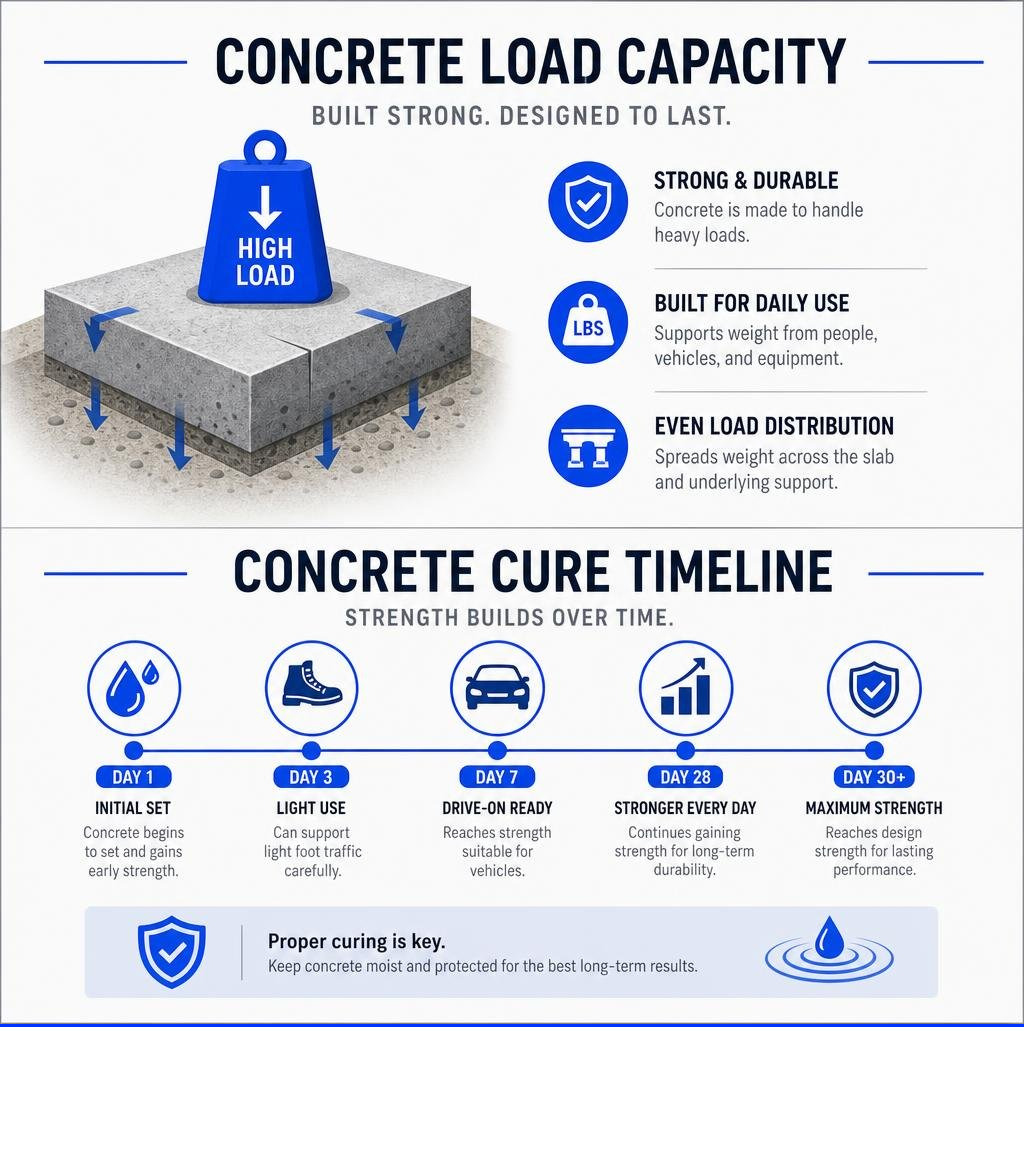
With traditional mudjacking, foot traffic is generally permitted within hours, but heavy vehicular parking requires waiting 24 to 48 hours for slurry curing.
By contrast, polyurethane foam cures via chemical reaction in 15 to 30 minutes, allowing driveways and parking pads to accept vehicle loads almost immediately.
Conclusion
Understanding what is mudjacking gives property owners the knowledge needed to address sunken, hazardous concrete without paying for expensive and messy full replacement. While traditional cement-based mudjacking has served as a reliable concrete raising method for decades, modern polyurethane foam injection offers lighter structural support, smaller injection holes, hydrophobic durability, and significantly faster cure times.
At FoamWorks Concrete Leveling, our family-owned team brings over 30 years of hands-on experience servicing residential and commercial property owners across Northwest Ohio, Southeast Michigan, and Northeast Indiana—including communities like Toledo, OH, Fort Wayne, IN, Ann Arbor, MI, and Monroe, MI.
We back our advanced polyurethane foam leveling, crack repair, and joint sealing services with a robust lifetime warranty and an unwavering commitment to 100% customer satisfaction. Protecting your concrete investment with modern leveling techniques prevents further structural damage and preserves your property value.
If sunken driveways, sidewalks, pool decks, or patios are creating dangerous trip hazards on your property, skip the mess and hassle of full demolition. Explore our Concrete Leveling Services or contact FoamWorks Concrete Leveling today to schedule your free, no-obligation estimate!