

The Science: How Does Polyurethane Foam Lifting Work Beneath Slabs?
Polyurethane foam lifting works by injecting a high-density, two-part liquid polymer beneath a settled slab, where it rapidly expands to fill subsurface voids, densify weak base soil, and exert powerful upward hydraulic pressure to raise the concrete back to its original grade. Sinking concrete is rarely a problem with the concrete itself; rather, it is caused by the subgrade shifting, washing out, or compacting over time. Polyurethane foam injection is one of the most reliable modern solutions for concrete sinking repair because it targets the root cause of the failure: the unstable soil and voids beneath the slab.
The material used in this process is a high-density, closed-cell polyurethane polymer. Injected as a liquid blend, it spreads easily into subterranean gaps before undergoing a rapid chemical change. As it solidifies, the closed-cell matrix creates a rigid, impervious structure that will not break down, wash away, or absorb groundwater.
Chemical Expansion: How Does Polyurethane Foam Lifting Work at a Molecular Level?
The transformation from a low-viscosity liquid into a rigid structural polymer relies on a precise two-component chemical reaction. The two primary ingredients—an isocyanate component (commonly methylene diphenyl diisocyanate, or Part A) and a specially formulated polyol resin blend (Part B)—are kept in separate heated tanks until injection.
When these components are mixed inside the tip of the injection gun, two simultaneous reactions occur:
- Polymerization (Gelling): The isocyanate groups react with the hydroxyl groups of the polyol blend to form long-chain polyurethane polymers, building a sturdy structural network.
- Gas Generation (Blowing): Isocyanate molecules react with trace water or specialized blowing agents within the polyol, generating carbon dioxide ($CO_2$) gas bubbles.
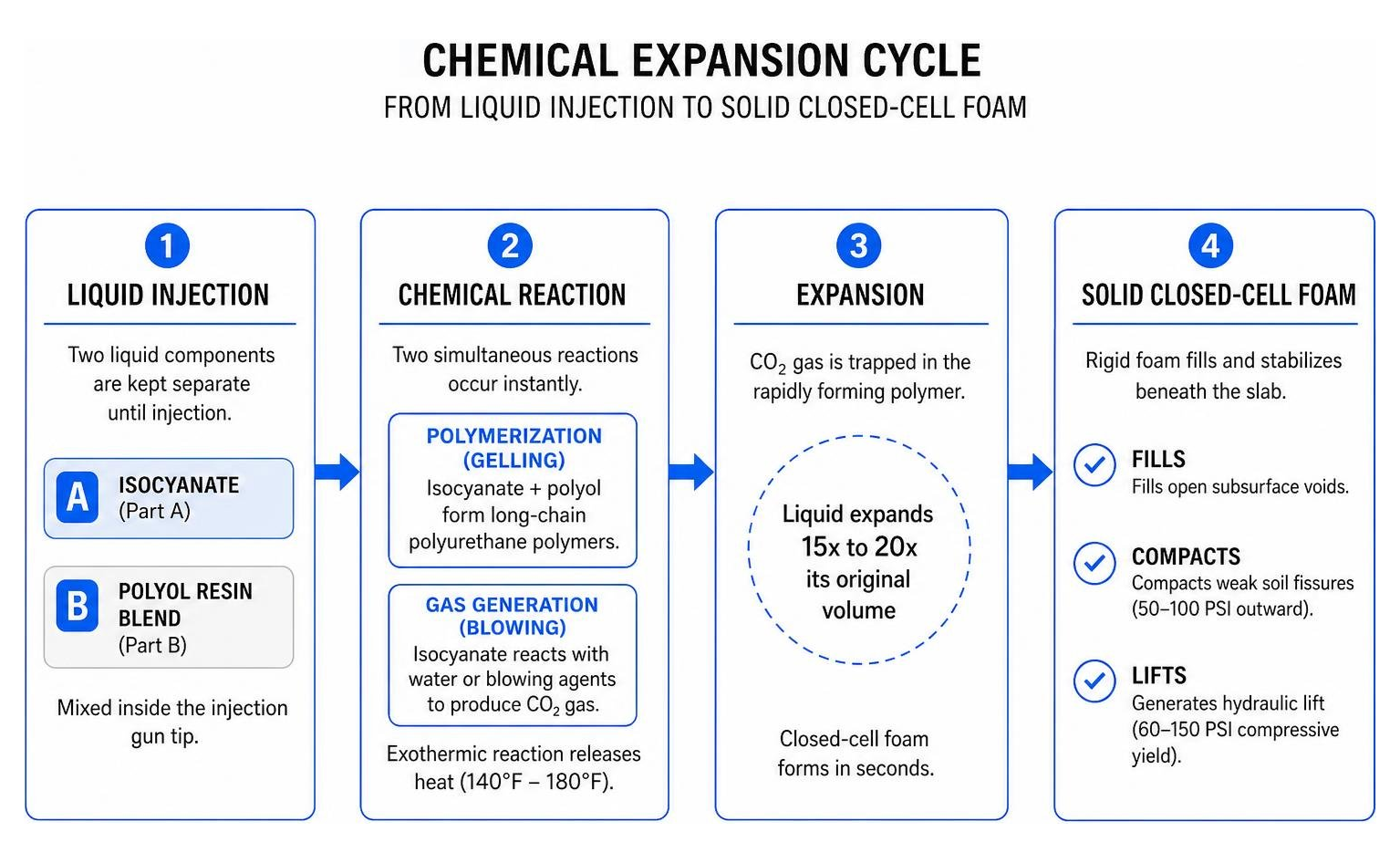
Trapped inside the rapidly solidifying polymer, the expanding carbon dioxide gas forces the liquid to balloon between 15 and 20 times its original volume within seconds. This reaction is exothermic, releasing thermal energy and reaching internal peak temperatures between 140°F and 180°F.
Because the liquid is confined under the slab, this rapid expansion creates powerful hydraulic upward force. Once the expanding foam meets resistance from the compacted base beneath it, it directs its energy upward, generating enough continuous force to raise thousands of pounds of reinforced concrete.
Soil Densification: How Does Polyurethane Foam Lifting Work to Stabilize Subgrade?
A common question property owners ask is: why concrete driveways sink in the first place? In many cases, uncompacted fill dirt, poor base drainage, or burrowing pests leave open channels under the concrete.
Before lifting a single inch of concrete, expanding polyurethane foam first seeks the path of least resistance. The liquid flows into underground fissures, animal burrows, and air pockets. As the foam expands, it exerts an outward radial pressure of 50 to 100 PSI against the surrounding dirt.
This outward pressure spreads through weak soil zones in a web-like, “tree-root” pattern. The expansion crushes loose soil particles together, pushing out residual air pockets and consolidating the subbase. Once the surrounding earth is fully densified and cannot compress any further, the subgrade acts as a stable foundation, directing all remaining expansion upward to raise the sunken slab.
Hydrophobic vs. Hydrophilic Foams in Moist Soil
Subsurface moisture is one of the most critical factors in concrete settlement. Depending on the chemical formulation, polyurethane foams are classified as either hydrophilic or hydrophobic:
- Hydrophilic Foams: These formulations attract and absorb moisture during the reaction phase. While useful for sealing non-structural water leaks in below-grade concrete joints, hydrophilic foams are vulnerable to volumetric shrinkage if the surrounding soil dries out later.
- Hydrophobic Foams: These formulations actively repel water during mixing, expansion, and curing.
For structural concrete leveling, professional contractors use hydrophobic closed-cell foams. Because they do not absorb moisture, hydrophobic foams maintain their structural integrity and density regardless of soil moisture fluctuations. They displace trapped standing water beneath slabs, will not wash out during seasonal downpours, and remain dimensionally stable in high water tables.
Step-by-Step Polyurethane Foam Injection Process
Polyurethane polyurethane concrete leveling is a clean, non-invasive method that fixes settled concrete quickly without damaging your surrounding landscape.
The process follows a systematic workflow to restore slab elevation accurately:
Site Assessment and Precision Port Drilling
Before any equipment is started, technicians evaluate the slab’s settlement pattern, soil conditions, and structural joints. Using precision optical gauges or ground-penetrating tools, we identify where the largest subgrade voids are located.
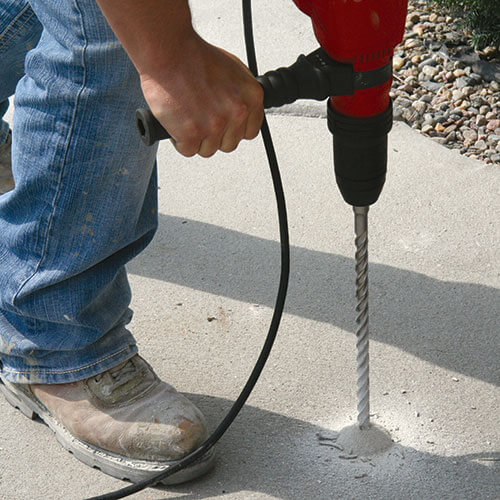
Next, technicians drill small 5/8-inch injection ports (about the diameter of a penny) through the slab. These ports are mapped across the concrete in a balanced 3- to 6-foot grid pattern, focusing on the lowest points of the dip:
- Drill holes are positioned safely away from slab edges to prevent stress cracking.
- Integrated depth gauges and scanning equipment prevent damage to embedded rebar or radiant heating lines.
- Drill attachments with vacuum dust extraction capture concrete powder at the source, keeping work areas clean.
Controlled Multi-Stage Injection and Laser Elevation Tracking
Once the injection ports are drilled, mechanical injection ports are secured inside the holes. The chemical components are preheated within an enclosed mobile rig to 110°F–130°F, ensuring optimal chemical reactivity and expansion consistency.
A high-pressure proportioner delivers the liquid components through a heated hose line at dynamic injection pressures between 100 and 300 PSI, with typical flow rates of 2 to 8 lbs/min. The process is carried out in controlled stages:
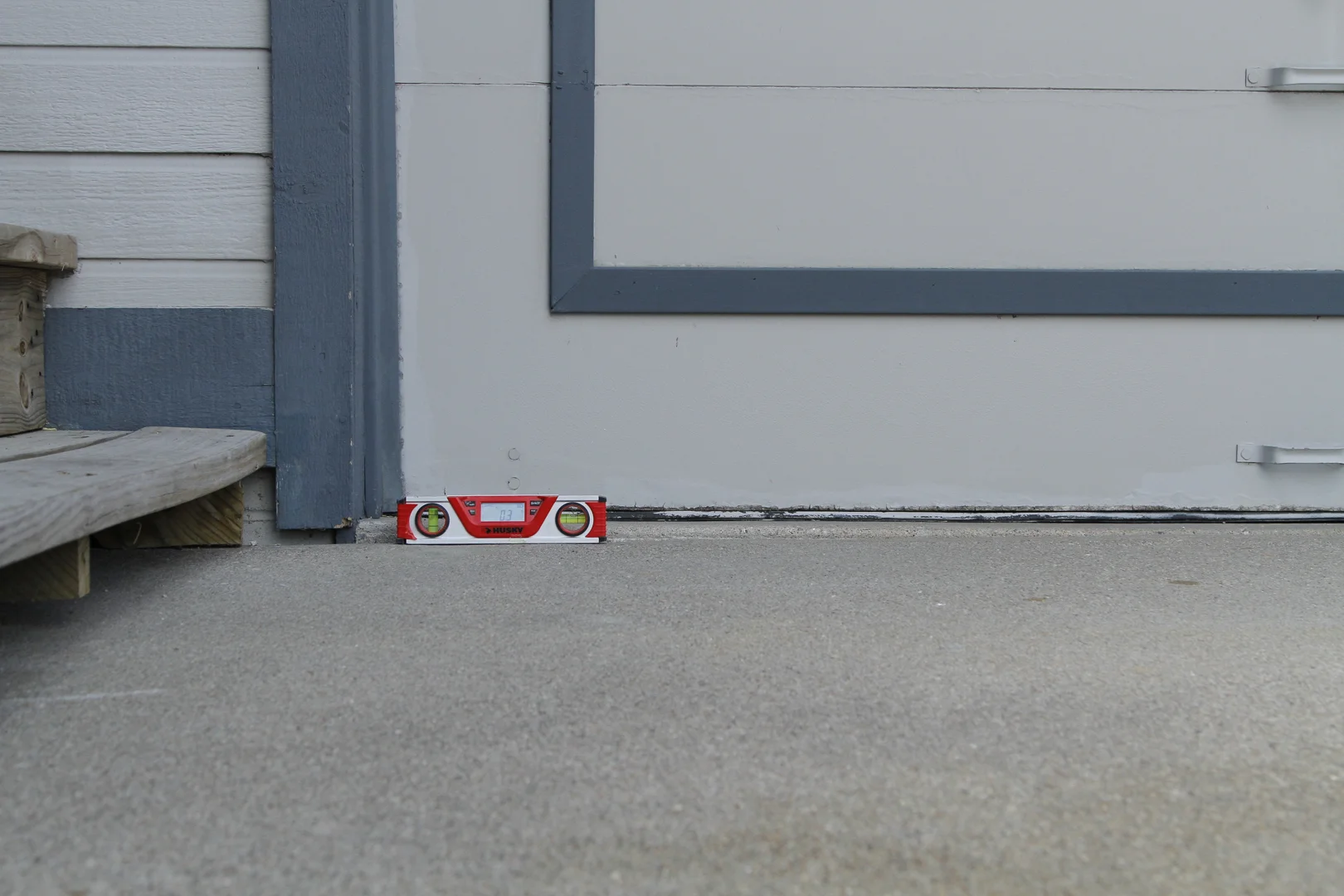
- Laser Setup: A high-precision continuous laser level is positioned over the target slab to track minute elevation adjustments down to 1/16-inch increments.
- Sequential Bursts: Technicians inject the foam in small, controlled pulses. Short bursts prevent localized over-pressurization and allow the operator to gauge how much foam is migrating into open subgrade voids.
- Elevation Monitoring: As the expanding foam stabilizes the base and starts lifting the slab, the laser receiver tracks upward movement in real time. Injection stops instantly once the concrete hits the target elevation, consistently achieving tight 1/8-inch level tolerances across matching joints.
Port Sealing and Structural Load Restoration
Once the slab is brought flush with surrounding slabs, the injection ports are removed. Any residual foam at the surface is trimmed flush.
Technicians fill the 5/8-inch drill holes with a heavy-duty, non-shrink, color-matched mortar patch. Because closed-cell polyurethane cures via chemical polymerization rather than moisture evaporation, initial hardening happens in just 15 to 30 minutes. Once patched, the concrete is ready to support regular foot and vehicle traffic with virtually no downtime.
Structural Load Capacity and Durability of Polyurethane Foam Lifting
Some property owners wonder if lightweight foam can truly support the weight of heavy vehicles. In practice, professional-grade polyurethane foam provides exceptional strength and long-term durability.
Weight, Density, and Structural Load Capacity
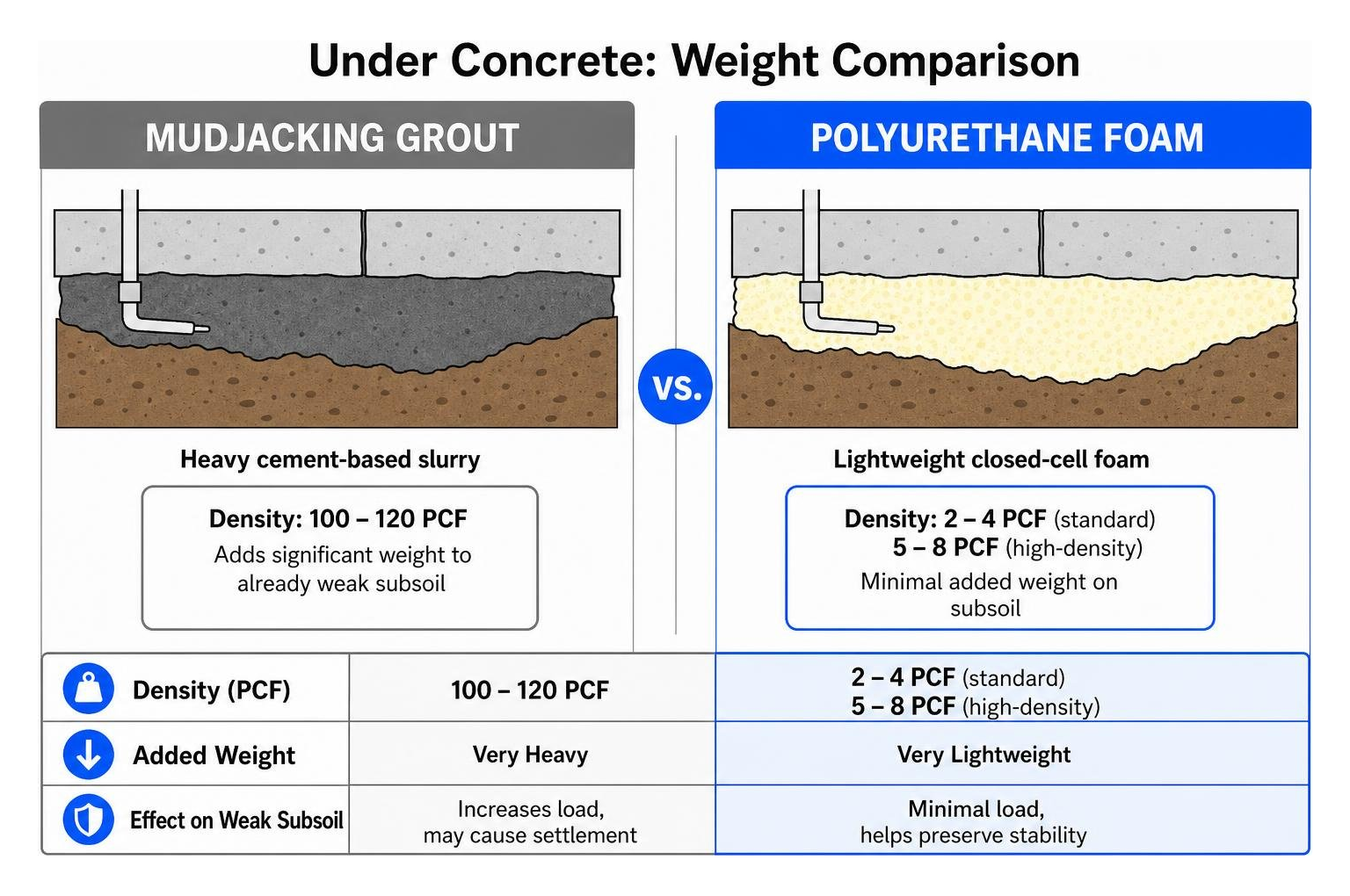
A primary advantage of polyurethane foam is its exceptional strength-to-weight ratio. Traditional mudjacking slurry weighs between 100 and 120 pounds per cubic foot (PCF), and fresh concrete weighs roughly 150 PCF. Adding tons of heavy cement grout directly on top of already failing, weak subsoil frequently leads to secondary settlement down the road.
In contrast, structural polyurethane foam weighs only 2 to 4 PCF for residential applications, with specialized heavy-load commercial blends ranging from 5 to 8 PCF. Despite its lightweight profile, cured foam delivers an unconfined compressive strength of 60 to 150 PSI—easily supporting 8,500 to 21,500+ pounds per square foot.
Furthermore, polyurethane benefits from the confined space effect. When foam expands inside a sealed underground cavity between compacted earth and concrete, its density and compressive strength rise dramatically. Studies demonstrate that tight subterranean confinement increases the effective compressive strength of structural foam by up to 31% at 25% confinement, and up to 79% under 75% confinement. This structural rigidity allows leveled driveways to easily handle pickup trucks, heavy SUVs, and loaded commercial delivery vans.
Long-Term Durability and Environmental Resistance
Once cured, high-density closed-cell polyurethane foam is chemically inert and highly durable:
- 50+ Year Expected Lifespan: Because it contains no organic materials, closed-cell foam does not rot, decay, or break down over time.
- Moisture & Washout Resistance: Hydrophobic foam repels groundwater, acting as a permanent barrier that stops future soil erosion under the slab.
- Chemical & Pest Immunity: Cured polyurethane is impervious to road de-icing salts, spilled motor oil, gasoline, fertilizers, subsoil microbes, and burrowing insects.
- Zero Subgrade Leaching: The fully reacted polymer is non-toxic and will not leach chemicals into nearby garden beds or groundwater tables.
Polyurethane Foam Lifting vs. Traditional Mudjacking
Homeowners comparing concrete repair methods often weigh modern polyurethane foam against traditional mudjacking. While both methods raise sunken slabs, their materials, installation methods, and long-term results are very different.
- Drill Hole Impact: Mudjacking requires drilling large 1.5- to 2-inch holes through your concrete to accommodate thick cement and soil slurry. These large holes can weaken the slab’s structural integrity and leave visible patches. Polyurethane uses 5/8-inch ports that blend smoothly into the surrounding surface.
- Base Weight: Mudjacking pumps hundreds of pounds of wet grout under the slab. If the underlying soil settled because it could not support the slab’s weight, adding heavy grout can cause the subgrade to sink again. Polyurethane adds negligible weight to sensitive soils.
- Moisture Resilience: Mudjacking slurry contains natural topsoil, clay, and water, leaving it vulnerable to erosion from underground water flow and freeze-thaw cycles. Closed-cell polyurethane creates an impermeable, water-resistant seal that stays put.
Why DIY Foam Lifting Kits Fall Short for Concrete Repair
With canned spray foam widely available at hardware stores, some property owners consider tackling sunken slabs as a weekend DIY project. However, structural concrete lifting requires commercial plural-component chemistry and specialized hydraulic equipment.
Single-component retail spray foams cure by reacting with ambient air moisture. When injected under a dense concrete slab where air is scarce, canned foams expand unevenly, take hours to harden, and cure with large internal air pockets. These layered “pancake voids” easily crush under the weight of a car.
Additionally, DIY methods lack the continuous high pressure (100–300 PSI) and computer-monitored heating required to densify subsoil. Without precision laser leveling equipment, it is easy to over-lift a slab or create stress fractures along the joints. Professional hydraulic injection systems maintain an exact 1:1 chemical ratio and instant pressure cutoffs, guaranteeing a clean, long-lasting repair without damaging the concrete.
Frequently Asked Questions About Polyurethane Concrete Lifting
For more answers regarding concrete leveling options and costs, check out our comprehensive concrete leveling FAQ.
How long does polyurethane foam concrete lifting last?
Polyurethane foam lifting is designed as a permanent concrete repair with an expected service life of 50+ years. Because closed-cell polyurethane is waterproof and inert, it will not decompose, compress under heavy loads, or wash away. As long as external water drainage issues (such as misdirected downspouts) are addressed, the lifted concrete will remain stable for decades.
Can you DIY polyurethane foam concrete leveling?
We do not recommend DIY concrete leveling. Professional plural-component polyurethane systems require dedicated proportioning units, high-pressure heated transfer hoses, and specialized mechanical injection guns. Off-the-shelf single-component canned foams lack the compressive strength, hydraulic lift, and expansion properties needed to lift heavy slabs safely and evenly.
How soon can you drive on concrete after foam lifting?
Unlike fresh concrete which takes 28 days to cure, or mudjacking grout which requires 24 to 72 hours of drying time, polyurethane foam cures through an exothermic reaction within 15 to 30 minutes. Walkways and patios can be used immediately after our technicians complete the work, and driveways can handle passenger vehicles within one hour.
Restore Your Concrete with Professional Foam Injection
Sunken, uneven concrete creates unsightly trip hazards, pools water near foundations, and hurts your property’s curb appeal. Full slab replacement is expensive, disruptive, and leaves behind noticeable color differences between old and new concrete.
FoamWorks Concrete Leveling uses modern polyurethane foam injection to repair sunken or uneven concrete for 30% to 50% less than full tear-out and replacement, helping homeowners save significantly on repair costs. Most repairs are completed in just a few hours, and the surface can be used almost immediately. Because there is no need for heavy excavation, the process also reduces landscape damage, labor costs, debris removal, and disposal fees that come with replacing concrete.
We are a family-owned concrete repair contractor backed by more than 30 years of industry experience, a lifetime warranty, and a commitment to 100% customer satisfaction. We proudly serve homeowners and businesses across Northwest Ohio, Southeast Michigan, and Northeast Indiana—including Toledo, Ann Arbor, Fort Wayne, Findlay, Monroe, Adrian, and surrounding communities.
Ready to eliminate trip hazards and level your concrete for good? Contact us today to claim your free estimate and see how much you can save with professional foam injection leveling services.