

How Concrete Leveling Lifts a Sunken Slab
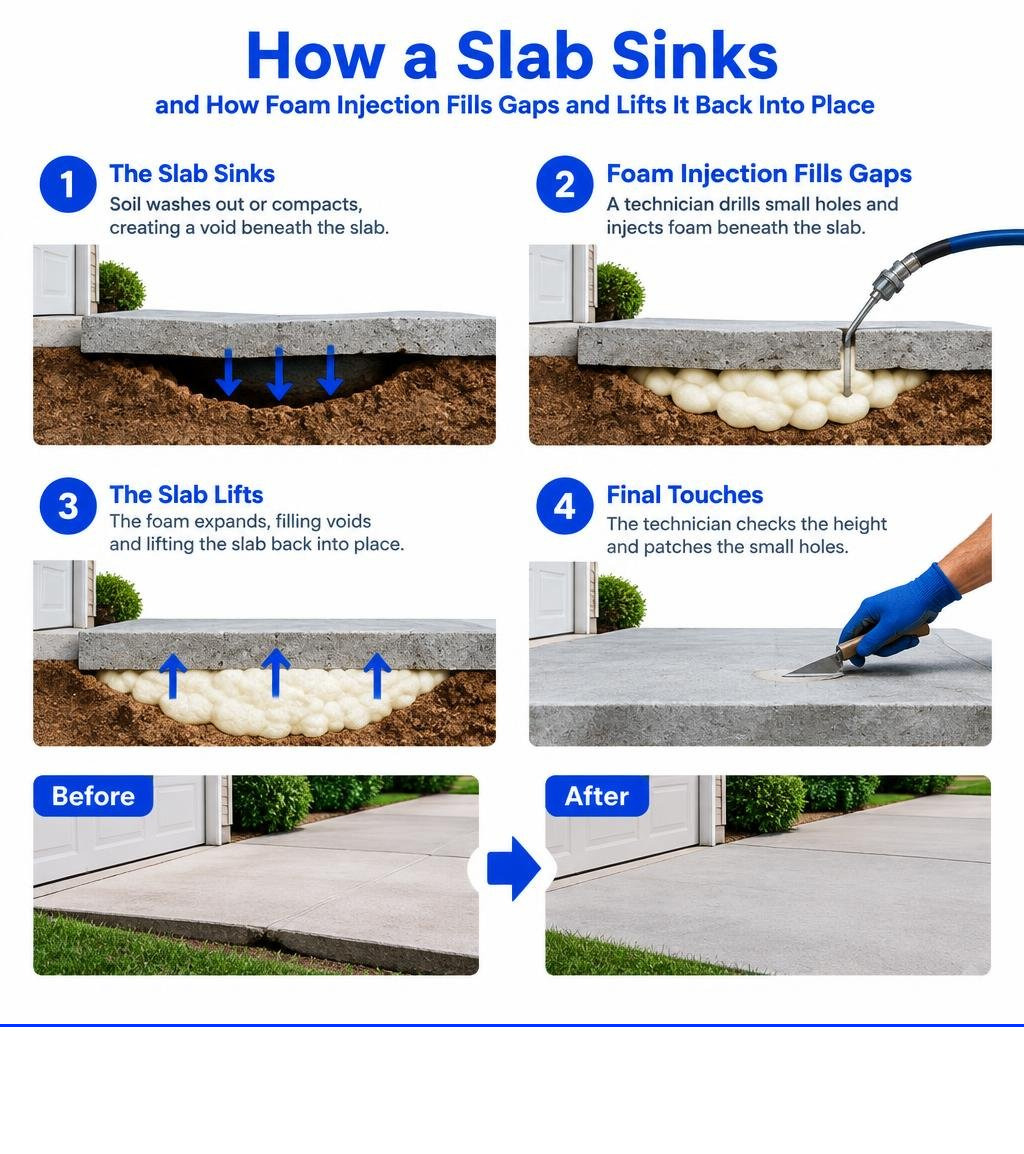
If you’re asking, “how does concrete leveling work?” start by checking whether the slab is sound and looking for drainage problems that could make it sink again. A technician then drills small holes, injects material beneath the concrete to fill gaps and lift the slab, checks its height, and patches the holes. The slab stays in place, so there is no need to tear it out.
For a sunken driveway or patio, the goal is to remove the uneven edge and restore a useful slope. FoamWorks Concrete Leveling uses foam injection for this work; most repairs take just a few hours, and the surface can be used almost immediately.
I’m Trey McNamee, owner of FoamWorks Concrete Leveling, and I help homeowners answer questions like “how does concrete leveling work?” My background includes more than 20 years in building-materials marketing, strategy, and product development at Owens Corning.
Related content about how does concrete leveling work:
- Affordable concrete leveling in Northwest Ohio with 30 years experience
- How concrete lifting and leveling can save your sunken driveways
Why Concrete Slabs Sink: The Science Beneath the Surface
Concrete slabs are remarkably heavy and rigid, but they are only as stable as the soil underneath them. When an uneven surface appears, it is rarely the concrete itself failing; instead, the sub-base beneath the slab has compromised its support. Spotting the early signs your concrete slab is settling helps prevent progressive damage before minor trip hazards turn into costly structural issues.
Several natural sub-surface conditions cause settling:
- Soil Erosion and Water Runoff: Misdirected downspouts, plumbing leaks, or intense rainstorms wash away fine aggregate and loose dirt, creating empty cavities beneath the concrete.
- Moisture Fluctuations: Soil expands when soaked and shrinks during dry spells. In clay-heavy soils, this continuous swelling and contraction leaves empty gaps under the heavy slab.
- Poorly Compacted Backfill: When homes or additions are built, soil excavated around foundations is replaced without thorough mechanical compaction. Over several years, this loose dirt naturally settles under the weight of walkways and porches.
- Tree Roots: Invasive root systems draw significant moisture out of the earth or decay after tree removal, leaving pockets where dirt shifts downward.
- Seasonal Freeze-Thaw Cycles: Water trapped beneath the slab freezes, expands, and heaves the concrete. When the ice thaws, the soil slumps, creating uneven sub-base voids.
As a general rule, concrete leveling is recommended when a slab settles a quarter-inch or more below its adjacent section. A drop of this size is enough to create a serious trip hazard, disrupt natural drainage slopes, and direct rainwater straight toward your home’s foundation. Homeowners wondering why concrete driveways sink usually find that unaddressed soil movement and water pooling are the primary culprits.
How Does Concrete Leveling Work Step-by-Step?
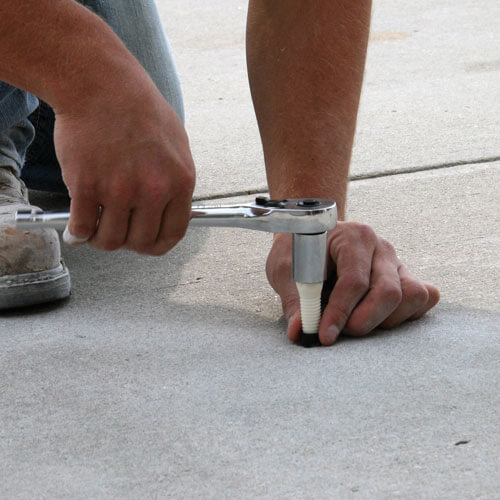
The process of concrete lifting and leveling restores settled slabs through precision material injection rather than destructive tear-out. Standard concrete leveling follows a systematic four-step procedure designed to stabilize the soil and restore the surface grade.
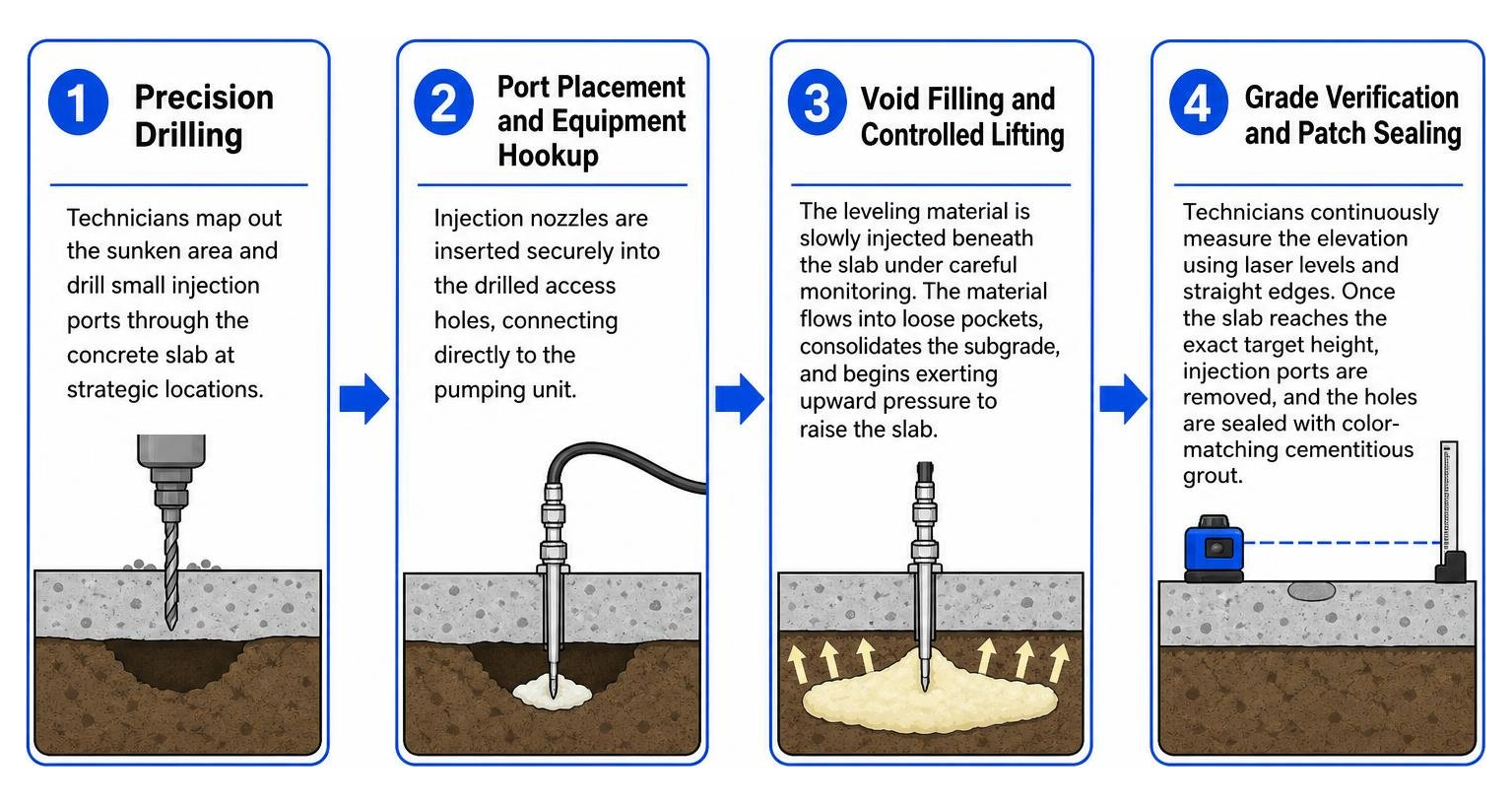
- Precision Drilling: Technicians map out the sunken area and drill small injection ports through the concrete slab at strategic locations.
- Port Placement and Equipment Hookup: Injection nozzles are inserted securely into the drilled access holes, connecting directly to the pumping unit.
- Void Filling and Controlled Lifting: The leveling material is slowly injected beneath the slab under careful monitoring. The material flows into loose pockets, consolidates the subgrade, and begins exerting upward pressure to raise the slab.
- Grade Verification and Patch Sealing: Technicians continuously measure the elevation using laser levels and straight edges. Once the slab reaches the exact target height, injection ports are removed, and the holes are sealed with color-matching cementitious grout.
Polyurethane Foam Injection: How Concrete Leveling Works with High-Density Polymers
Polyurethane foam leveling utilizes high-density, two-part expanding polymers to raise settled concrete. Understanding how polyurethane foam lifting works comes down to basic chemistry: two liquid components mix at the injection nozzle tip, initiating an immediate chemical reaction that expands into rigid, closed-cell foam.
Because the liquid reacts quickly, it requires minimal access space. Technicians drill tiny 5/8-inch holes (roughly the size of a dime), minimizing surface disruption. The expanding foam easily travels through underground channels, filling sub-base voids before gently lifting the slab into position.
Despite being extremely lightweight—adding virtually no extra burden to unstable soils—the foam achieves a high compressive strength of 50 to 100 psi, which translates to 7,200 to 14,000 pounds per square foot of structural load support. The foam cures within 15 minutes, creates an impermeable hydrophobic barrier that repels water and prevents future washouts, and represents one of the most effective modern solutions for concrete sinking repair.
What to Expect: Timeline and Durability
Because polyurethane foam cures so quickly, most residential leveling jobs move from start to finish in just a few hours. The material’s light weight means it will not add stress to already weakened soil, and its hydrophobic nature means it holds up well through seasonal moisture changes. For homeowners comparing their options, the biggest advantages of foam injection are its small access holes, fast cure time, and long-term resistance to water damage, which together help the repair last for many years with minimal maintenance.
Concrete Leveling vs. Slab Replacement: Which Makes Sense?
When faced with an uneven walkway, patio, or driveway, homeowners frequently weigh the cost differences between leveling and slab replacement. Replacing concrete involves heavy excavation equipment, demolition noise, landscape disruption, and several days of pouring and curing.
Concrete leveling costs between $3 and $8 per square foot on average, while complete replacement costs $6 to $12 per square foot. FoamWorks Concrete Leveling uses polyurethane foam injection to repair sunken or uneven concrete for 30% to 50% less than full tear-out and replacement, helping homeowners save significantly on repair costs. Most repairs are completed in just a few hours, and the surface can be used almost immediately. Because there’s no need for heavy excavation, the process also reduces landscape damage, labor costs, debris removal, and disposal fees that come with replacing concrete.
However, leveling is not appropriate for every scenario. It is important to recognize when concrete replacement is necessary:
- Leveling Is Best When: Slabs are structurally sound, intact, and have settled evenly or cracked cleanly into two or three large pieces without crumbling.
- Replacement Is Necessary When: Concrete exhibits severe alligator cracking, extensive surface spalling, severe crumbling aggregate, or has suffered structural failure due to deep ground faults that cannot support injection pressure.
Longevity, DIY Feasibility, and Insurance Considerations
How long concrete leveling lasts depends heavily on the chosen material and site moisture control. Exploring the real longevity behind polyurethane slab lifting shows that high-density polymers can easily last 20 years or more. Polyurethane foam does not degrade underground, will not wash out during heavy rain, and creates a stable foundation that prevents future moisture infiltration.
To ensure long-term stability after lifting, follow these routine maintenance practices:
- Seal Joints and Cracks: Apply flexible polyurethane or silicone caulk along expansion joints and surface cracks to stop surface runoff from entering the sub-base.
- Redirect Downspouts: Route roof runoff and gutter extensions at least five feet away from concrete surfaces.
- Maintain Proper Yard Grading: Ensure adjacent soil slopes away from walkways and driveways to prevent standing water.
Some homeowners look into DIY foam leveling kits for quick concrete repairs. While retail kits exist for minor surface filling, structural slab leveling requires specialized high-pressure equipment, precise temperature regulation, and commercial-grade material formulations. Injecting expanding polymers without professional monitoring can over-lift slabs, crack concrete beyond repair, or blow out surrounding foundation elements.
Regarding insurance, standard homeowners insurance policies generally do not cover concrete settlement or leveling. Insurers classify sinking slabs as normal wear-and-tear or gradual soil settling. Coverage applies only in rare cases where concrete movement results directly from a covered peril, such as specific storm disasters or catastrophic utility line ruptures.
Frequently Asked Questions About Concrete Leveling
How long does concrete leveling take, and when can you walk or drive on it?
Most residential concrete leveling projects take between 2 and 4 hours to complete from initial setup to final cleanup. Because high-density polyurethane foam expands and cures within 15 to 30 minutes, foot traffic can resume immediately after the technicians finish, and vehicles can drive onto the leveled surface the very same day.
Can you use self-leveling concrete instead of lifting a sunken slab?
Self-leveling concrete overlays are designed solely for indoor cosmetic adjustments and smoothing rough floors before installing tile or vinyl. Pouring self-leveling compound over an outdoor sunken slab adds extra surface weight without addressing the underlying soil voids, accelerating future sinking and causing the new top layer to crack and flake over time.
How much does professional concrete leveling cost on average?
Across the industry, professional concrete leveling costs between $3 and $8 per square foot, with typical residential projects averaging around $1,174 depending on project scope. Mudjacking generally ranges from $3 to $6 per square foot, while high-density polyurethane foam injection ranges from $5 to $25 per square foot depending on void depth and material volume required.
Conclusion
Understanding how concrete leveling works allows property owners to fix tripping hazards, correct poor drainage, and extend the life of their concrete without the cost and mess of replacement. By injecting high-density polyurethane foam through dime-sized access holes, sunken slabs can be brought back to their original grade in just a few hours.
FoamWorks Concrete Leveling is a family-owned concrete repair and leveling contractor serving Northwest Ohio, Southeast Michigan, and Northeast Indiana. We offer fast foam-injection leveling, crack repair, and sealing backed by a lifetime warranty, 30+ years of building-materials experience, and a commitment to 100% customer satisfaction. We provide free estimates so you can see how much you will save—reach out today to schedule your concrete leveling services and restore your property’s safety and curb appeal.