
Raise Settled Concrete Before It Becomes a Bigger Problem
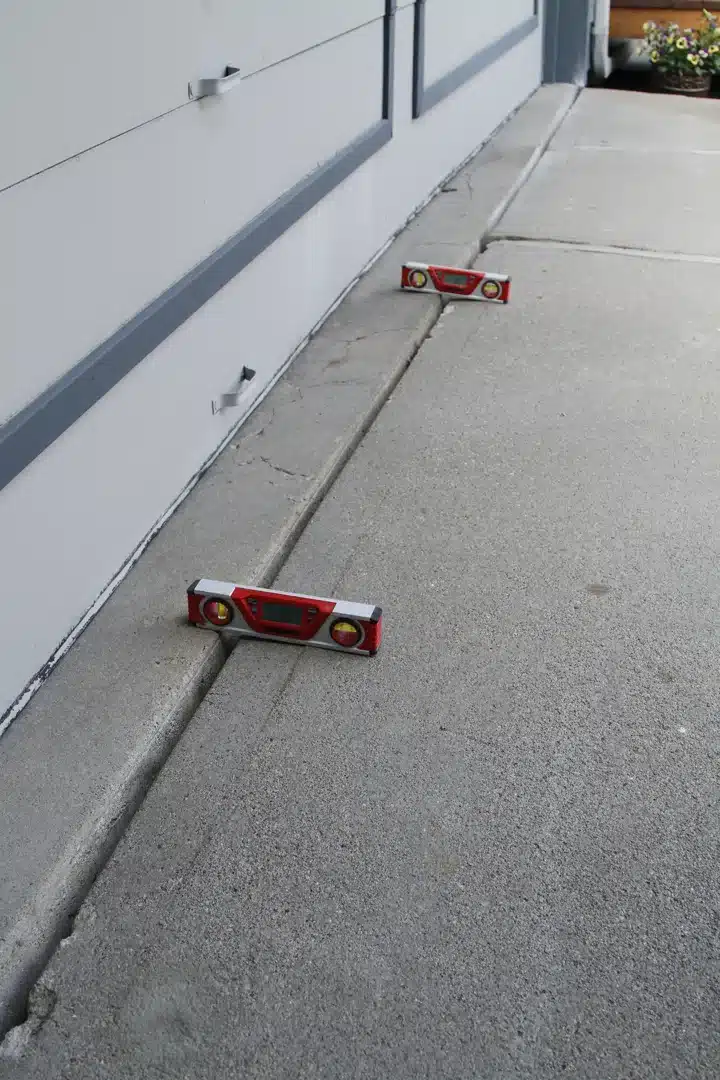
Raising settled concrete restores a sunken driveway, sidewalk, patio, or garage slab by filling voids below it and lifting it back toward its proper level. It is often a faster, less disruptive alternative to demolition when the slab is still in good condition.
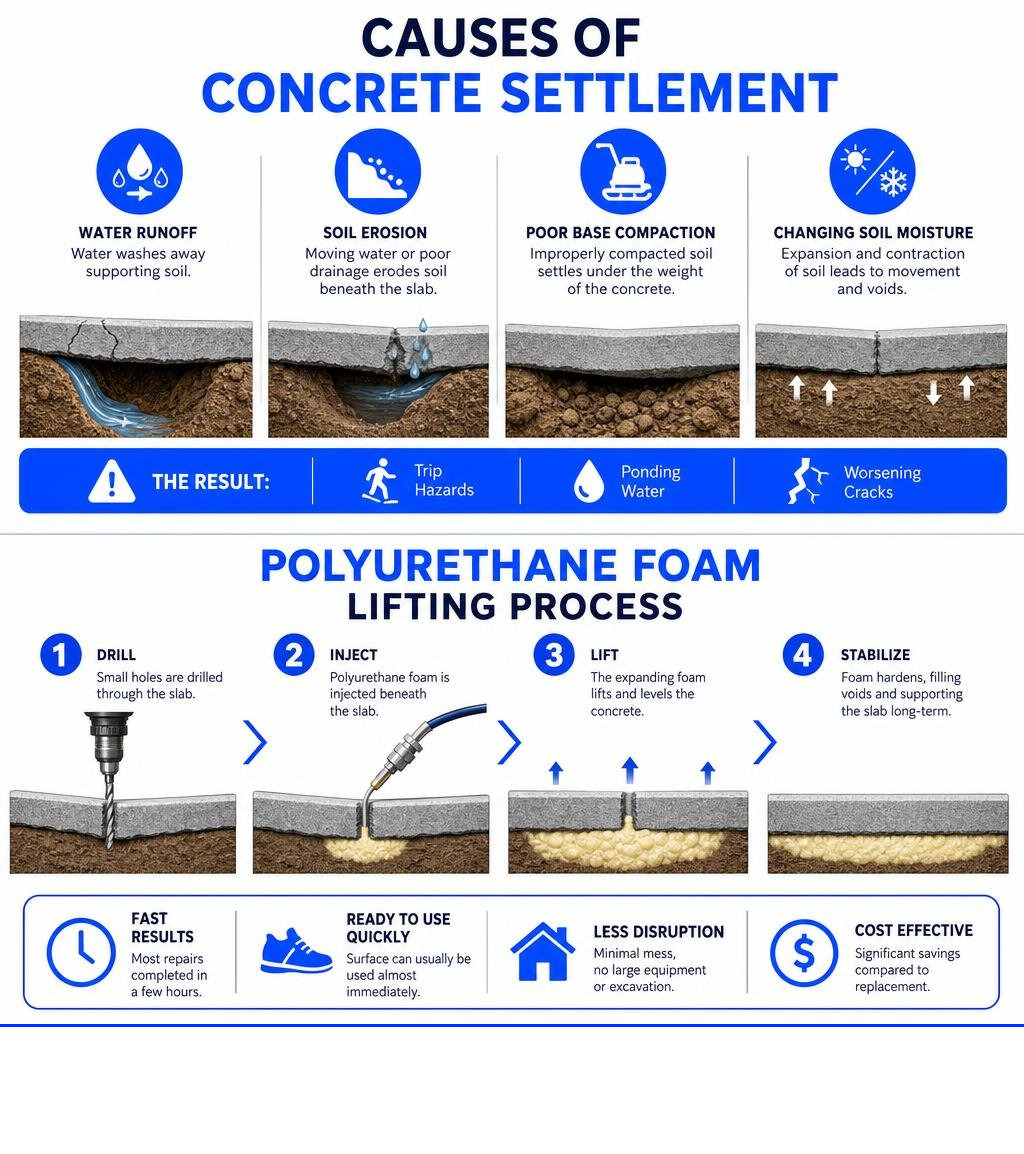
- Why slabs sink: Water runoff, soil erosion, poor base compaction, and changing soil moisture can leave empty space beneath concrete.
- Why it matters: Uneven slabs create trip hazards, collect water, and can worsen cracks or separation over time.
- The modern repair: Polyurethane foam injection lifts and supports the slab through small drilled holes. Most repairs take only a few hours, and the surface can usually be used almost immediately.
- The potential savings: FoamWorks Concrete Leveling can repair sunken concrete for 30% to 50% less than full tear-out and replacement, without the mess of major excavation or hauling away old concrete.
The key is to repair the reason the slab moved, not simply cover the low spot with more concrete. A thin overlay adds weight to already unstable soil and can crack again if water and erosion are still active.
I am Trey McNamee, owner of FoamWorks Concrete Leveling, and our team brings more than 30 years of combined experience to raising settled concrete across Northwest Ohio, Southeast Michigan, and Northeast Indiana. My background in building-material strategy and product development helps guide a practical, homeowner-focused approach to restoring slabs instead of replacing them.
Understanding Concrete Settlement: Causes and Warning Signs
When you notice your walkway, pool deck, or driveway starting to tilt, it is easy to assume the concrete itself has failed. However, concrete is remarkably durable; in almost every case, the underlying issue is the ground supporting it. Understanding the root Causes of Concrete Problems helps homeowners catch issues early before structural damage spreads.
Concrete slabs rely entirely on a stable subgrade—a foundation composed of compacted soil, gravel, or sand. If this subgrade shifts, washes away, or shrinks, empty space forms beneath the slab. Without support beneath, heavy concrete naturally settles into these subterranean voids due to gravity.
The primary warning signs of concrete settlement include:
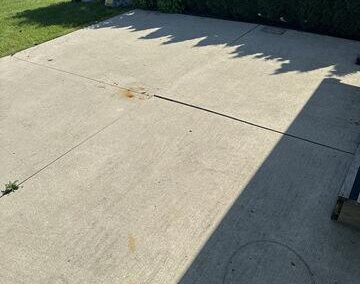
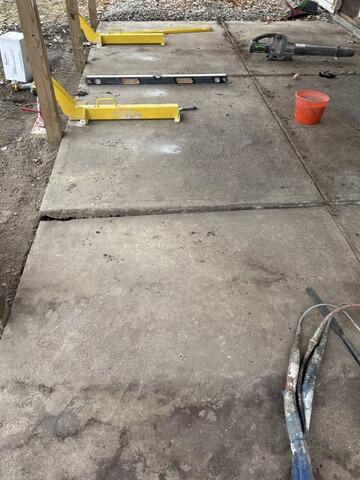
- Uneven Joints: Steps or vertical offsets forming between adjacent concrete slabs. Any vertical displacement exceeding 1/4 inch is officially classified as a trip hazard safety liability under ADA Accessibility Guidelines.
- Puddling Water: Rainwater pooling in low spots on patio floors or driveways rather than draining away naturally.
- Cracking and Crumbly Edges: Stress cracks forming where a slab overhangs an unsupported void.
- Gaps at Walls or Foundations: Walkways or garage floors pulling away from exterior walls, porches, or thresholds.
- Slanted Doors and Entrances: Interior or garage slabs dropping, causing exterior doors to stick or drag against the floor.
If you observe these warning signs around your property, taking quick action to raise settled concrete preserves the original slab before tension causes it to snap completely.
Primary Causes of Soil Erosion and Settlement
Why does the subgrade fail in the first place? Soil instability across our regional service area—from Toledo and Ann Arbor down to Fort Wayne—is typically driven by four major physical forces.

- Water Infiltration and Soil Erosion: Uncontrolled water is the leading enemy of solid ground. Heavy precipitation, melting snow, and poorly directed downspouts create subterranean channels beneath slabs. As water flows through the subgrade, it washes away fine sand and soil particles, creating a hidden void.
- Poor Initial Subgrade Compaction: During original home or driveway construction, soil is moved and backfilled. If contractors fail to compact this dirt in uniform layers before pouring the concrete, the loose soil slowly settles under the heavy weight of the slab over several years.
- Seasonal Clay Shrink-Swell Cycles: Soil composition across Northwest Ohio and Southern Michigan contains high levels of expansive clay. Clay expands significantly when saturated with moisture during wet spring months, then shrinks and bakes tight during hot summer droughts. This constant expansion and contraction creates movement and structural settling under slabs.
- Tree Root Decay and Burrowing Pests: Tree roots growing beneath concrete can lift slabs initially; however, when those roots rot away after tree removal, they leave large subterranean cavities. Similarly, burrowing animals like rodents or groundhogs excavate soil under porches and walkways, accelerating settlement.
If you are asking Why Is My Concrete Driveway Sinking?, checking your roof downspout drainage is almost always the best place to start.
Methods for Raising Settled Concrete: Polyjacking vs. Mudjacking
When homeowners discover sunken slabs, they historically chose between traditional mudjacking or total slab tear-out. Today, high-density polyurethane foam injection (often referred to as polyjacking) has emerged as the modern gold standard for raising settled concrete.
To understand why polyurethane foam has revolutionized the industry, it helps to compare how different lifting techniques interact with the soil below.
Traditional Mudjacking
Mudjacking involves drilling large holes (1.5 to 2 inches in diameter) through the concrete and pumping a heavy slurry of mud, sand, water, and cement beneath the slab under high pressure. While mudjacking can raise concrete, it has serious inherent limitations:
- The “Weight Trap” Paradox: Mudjacking slurry is extremely heavy, weighing between 100 and 120 pounds per cubic foot. Injecting hundreds of pounds of wet mortar onto soil that has already failed under the weight of concrete often leads to secondary settlement down the road.
- Washout Vulnerability: Mudjacking slurry relies on organic soil and cement, which remain susceptible to water erosion over time if drainage issues persist.
- Large Injection Holes: The process leaves behind noticeable, large concrete patches that look like polka dots across your driveway or patio.
Polyurethane Foam Injection (Polyjacking)
Polyjacking uses lightweight, two-component expanding polymer foam. The components combine at the tip of an injection gun beneath the concrete, triggering a chemical reaction that expands the material up to 15 times its liquid volume.
- Lightweight Support: High-density lifting polyurethane weighs only 2 to 4 pounds per cubic foot. It adds virtually no burden to vulnerable base soils while providing exceptional compressive lifting force.
- Waterproof & Hydrophobic: Polymer foam is completely waterproof. It does not wash away, degrade, or break down when exposed to moisture, acting as a underground seal against future erosion.
- Dime-Sized Holes: Foam injection requires tiny holes—roughly 5/8 inch, or the size of a dime—which are easily patched and blended into the concrete’s original finish.
| Feature / Metric | Polyurethane Foam Injection (Polyjacking) | Traditional Mudjacking | Full Concrete Replacement |
|---|---|---|---|
| Material Weight | Extremely lightweight (2–4 lbs/cu. ft.) | Very heavy (100–120 lbs/cu. ft.) | Heavy new slab (140+ lbs/cu. ft.) |
| Drill Hole Size | Penny/Dime-sized (5/8 inch) | Large (1.5 to 2 inches) | N/A (Full Demolition) |
| Cure & Traffic Time | 15–30 minutes | 24–72 hours | 28 days for full cure |
| Erosion Resistance | 100% Hydrophobic / Waterproof | Susceptible to water washout | N/A |
| Aesthetic Impact | Virtually invisible micro-patches | Visible large circular patches | Mismatched color compared to old slabs |
| Relative Cost | 30% to 50% less than replacement | Moderate initial cost | Highest cost (Demo + Hauling + Pour) |
Raising Settled Concrete vs Full Concrete Replacement
Full concrete replacement involves smashing up existing slabs with jackhammers, hauling away tons of heavy debris, re-grading the site, and pouring fresh concrete. Beyond being noisy and disruptive, replacement comes with several drawbacks:
- High Expenses: Demolition labor, dumpster fees, environmental disposal rates, and fresh concrete delivery make replacement exceptionally expensive.
- Extended Downtime: Freshly poured concrete requires days before you can walk on it and weeks before you can park cars or machinery on it. Polyurethane foam leveling lets you drive on your driveway within 30 minutes.
- Mismatched Aesthetics: Pouring a brand-new white slab directly adjacent to ten-year-old weathered concrete leaves an eye-searing visual mismatch across your property.
- Landscape Destruction: Heavy demolition machinery and concrete mixer trucks can tear up lawn turf, flower beds, and irrigation lines.
Choosing to raise settled concrete preserves your existing, fully cured concrete while eliminating trip hazards at a fraction of the cost. If your slab is structurally intact without severe crumbling, Concrete Replacement is rarely necessary.
Step-by-Step Process and Equipment for Raising Settled Concrete
At FoamWorks Concrete Leveling, we follow a precise, engineered process to ensure settled slabs are restored accurately to within 1/10th of an inch of flush grade. Here is how our professional technicians execute a lifting repair project:
- Comprehensive Site Assessment & Surface Preparation: We inspect the settled slab, identify underlying drainage patterns, locate underground utilities, and clean joint seams. If a sunken slab is tightly bound against a foundation wall or adjoining concrete, we utilize a concrete saw to cut it free, preventing stress cracks during the lift.
- Micro-Hole Drilling: Technicians strategically drill dime-sized (5/8 inch) injection holes across the concrete surface spaced approximately 2 to 3 feet apart. These small ports ensure even material distribution under the slab.
- Precision High-Density Polyurethane Foam Injection: Using custom hydraulic proportioning units and high-pressure injection guns, liquid polyurethane is injected through the ports. As the chemical reaction occurs, the foam rapidly expands beneath the slab, filling every underground void and compacting loose subsoil.
- Real-Time Elevation Monitoring: While injecting material, technicians continually monitor movement using optical laser levels and mechanical dial indicators. This guarantees controlled, incremental lifting and eliminates the risk of over-raising slabs.
- Port Removal and Aesthetic Hole Patching: Once the slab is perfectly level, injection ports are removed. We fill the small drill holes with high-strength non-shrink cementitious grout, carefully color-matching the surface patch to your original concrete.
- Site Cleanup and Immediate Area Use: Because polyurethane expands and reaches over 90% of its structural compressive strength within 15 to 30 minutes, there is zero messy cleanup or multi-day waiting period.
DIY vs Professional Options for Raising Settled Concrete
It is common for handy homeowners to search for DIY shortcuts when faced with a sunken slab. You might see video tutorials suggesting you leverage up a slab with pry bars or pour quick-setting self-leveling topping over low spots.
However, attempting to raise settled concrete as a DIY project carries severe risks and hidden drawbacks:
- The “Topper” Failure: Pouring self-leveling mortar or feather-edge concrete over a sunken area to smooth it out is one of the most common mistakes in home maintenance. Thin overlays lack structural bonding strength; they quickly crack, freeze-thaw, and spall off. Worse yet, adding heavy concrete on top increases the weight pushing down on the underground void, accelerating future sinking!
- Store-Bought Spray Foam Myths: Off-the-shelf expanding gap sprays from home improvement stores are designed for draft insulation, not structural support. They lack the compressive strength required to support heavy concrete and will collapse under load.
- Slab Rupture and Safety Hazards: Heavy concrete slabs weigh approximately 120 pounds per cubic foot. Attempting to manually pry, jack, or lift a 1,000-pound slab without hydraulic pressure distribution frequently snaps the slab into unsalvageable pieces or causes crush injuries.
- Specialized Rig Requirements: Professional polyjacking requires multi-component heated hoses, specialized volumetric injection pumps, and precise temperature regulation equipment costing tens of thousands of dollars.
For structural integrity, long-term stability, and personal safety, concrete slab leveling is a task best left to experienced specialists equipped with precise diagnostic tools.
How to Prevent Future Concrete Settlement and Maintain Slabs
Once your concrete has been restored to level grade, taking simple proactive maintenance steps prevents future soil erosion and protects your investment for decades to come.
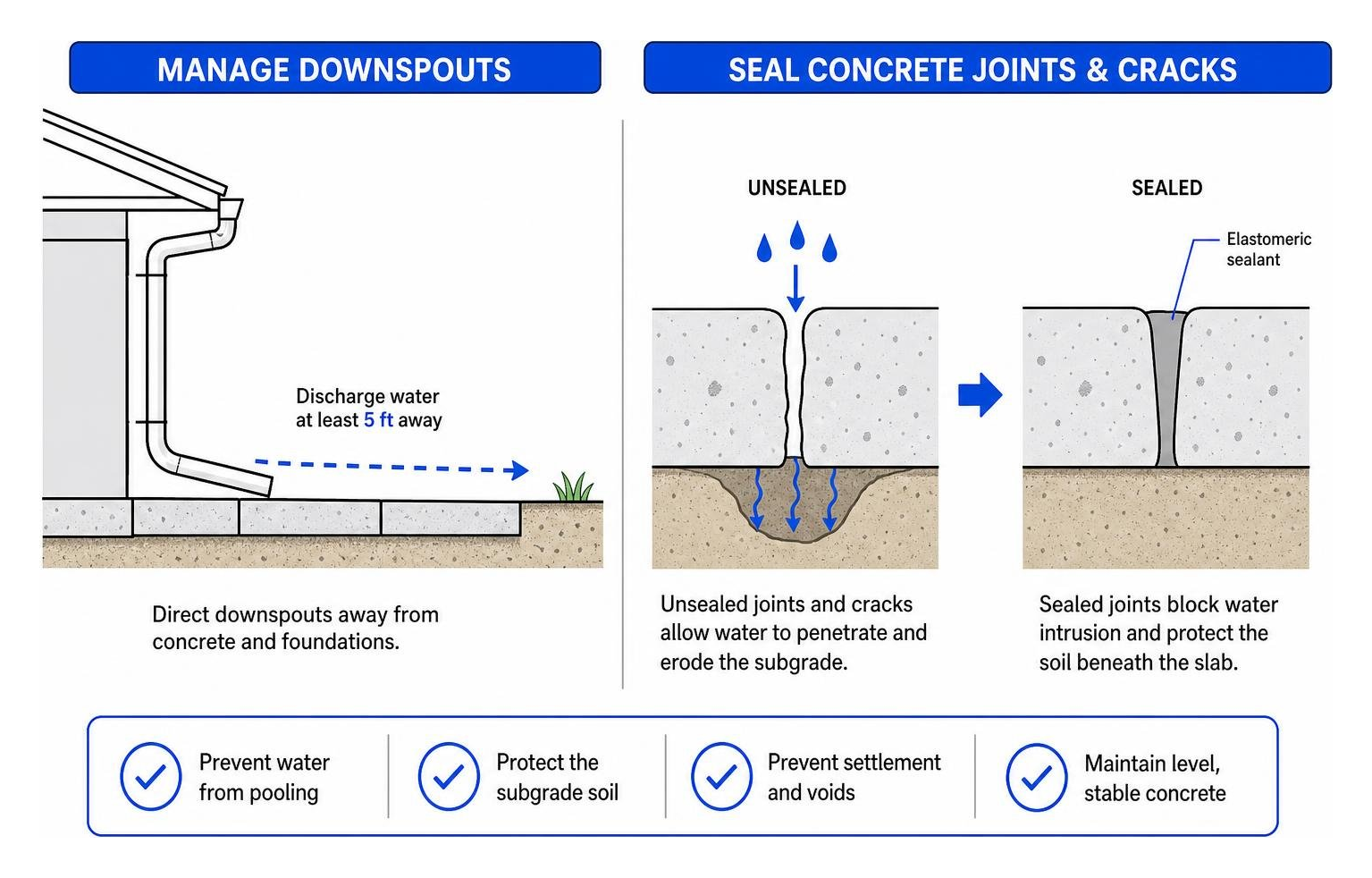
- Manage Surface Water and Gutter Runoff: Ensure your home’s roof downspouts discharge water at least 5 feet away from driveways, walkways, and foundation walls. Install downspout extensions or underground conductor pipes if necessary.
- Maintain Proper Soil Grading: Check that flowerbeds, turf, and topsoil slope gently away from concrete edges (ideally dropping at least 1 inch per foot). This prevents standing rainwater from soaking into the subgrade along slab borders.
- Seal Joint Seams and Cracked Concrete: Open expansion joints and unsealed surface cracks act as direct funnels for surface water, allowing rain to flow under the slab and wash away subgrade particles. Clean out old debris, install flexible backer rod where needed, and seal all cracks using high-grade elastomeric polyurethane sealant.
- Address Burrowing Pests Promptly: Fill animal burrows around porches and slab edges with compactable gravel or dirt to stop subterranean soil excavation.
Frequently Asked Questions About Concrete Leveling
Homeowners frequently ask us detailed questions about what to expect during and after concrete raising. Here are answers to the most common queries:
How long does concrete leveling last?
When performed with high-density hydrophobic polyurethane foam, concrete leveling is designed to last for the remaining life of the concrete slab itself.
Unlike organic soils or cementitious mudjacking slurries, structural polyurethane foam is inert, non-biodegradable, and completely waterproof. It does not wash away, compress under heavy traffic, or break down when exposed to moisture in the soil. As long as surrounding site drainage is maintained to prevent broad soil erosion around the perimeter, your leveled slab will remain stable indefinitely.
How soon can I drive on concrete after leveling?
You can walk on leveled concrete immediately after the technician finishes patching the injection holes, and you can drive personal vehicles on driveways or garage slabs within 15 to 30 minutes of injection!
Polyurethane foam achieves over 90% of its full compressive strength in under half an hour. This rapid cure time stands in stark contrast to traditional mudjacking (which requires 24 to 72 hours of complete isolation) and fresh concrete replacement (which requires up to 28 days for full design cure).
Is it cheaper to repair or replace sunken concrete?
Yes, repairing settled concrete using polyurethane foam injection is dramatically cheaper than replacement.
At FoamWorks Concrete Leveling, our foam injection services save homeowners 30% to 50% compared to full tear-out and replacement costs. Because there is no heavy machinery required, no concrete disposal fees, no site re-landscaping needed, and lower overall labor time, raising existing concrete delivers unmatched value while restoring safety and curb appeal to your property.
Conclusion
A sunken driveway, patio, or sidewalk does not mean you are forced to endure expensive, messy demolition projects. Raising settled concrete with high-density polyurethane foam offers a fast, permanent, and environmentally friendly repair that eliminates dangerous trip hazards and prevents further structural cracking.
By fixing the subterranean voids beneath your slab rather than just adding heavy temporary patches on top, you protect your property’s value for the long haul.
At FoamWorks Concrete Leveling, we take pride in serving homeowners across Northwest Ohio, Southern Michigan, and Northeast Indiana with modern foam injection techniques backed by a lifetime warranty.
Ready to eliminate trip hazards and save up to 50% compared to concrete replacement? Visit our page on Polyurethane Foam Injection to learn more about our concrete leveling solutions, or contact our experienced team today to request your Free Estimate!