
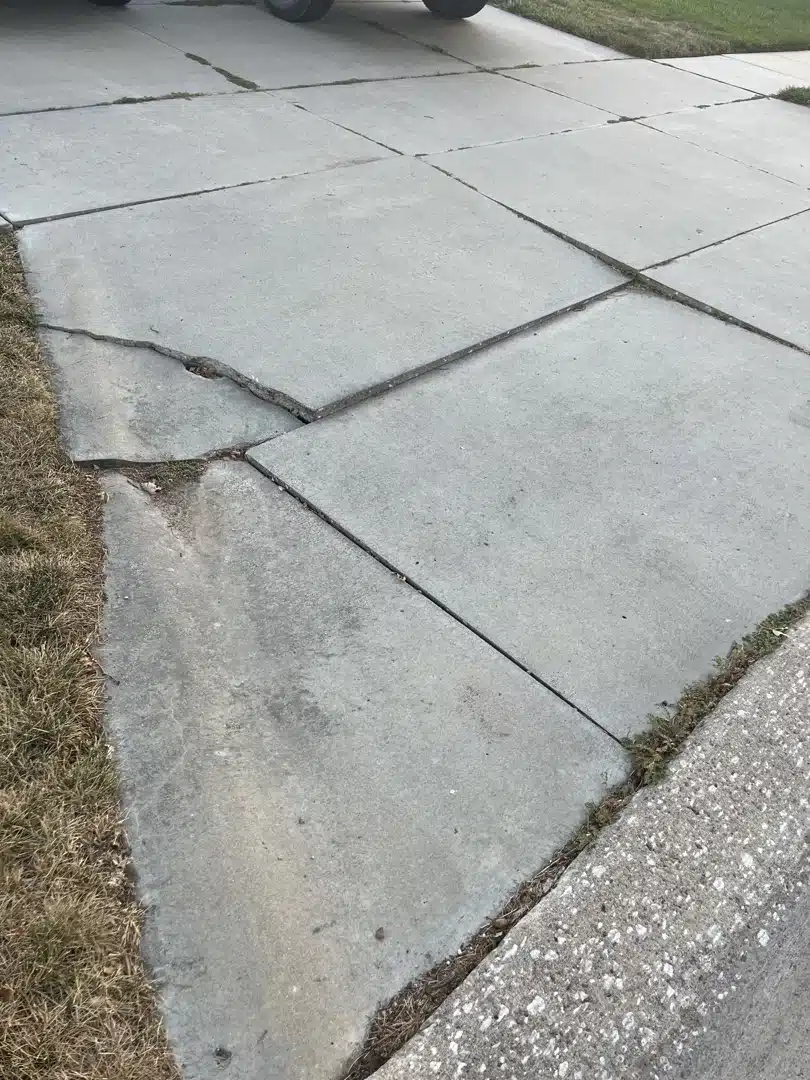
How Concrete Leveling Saves a Sunken Driveway
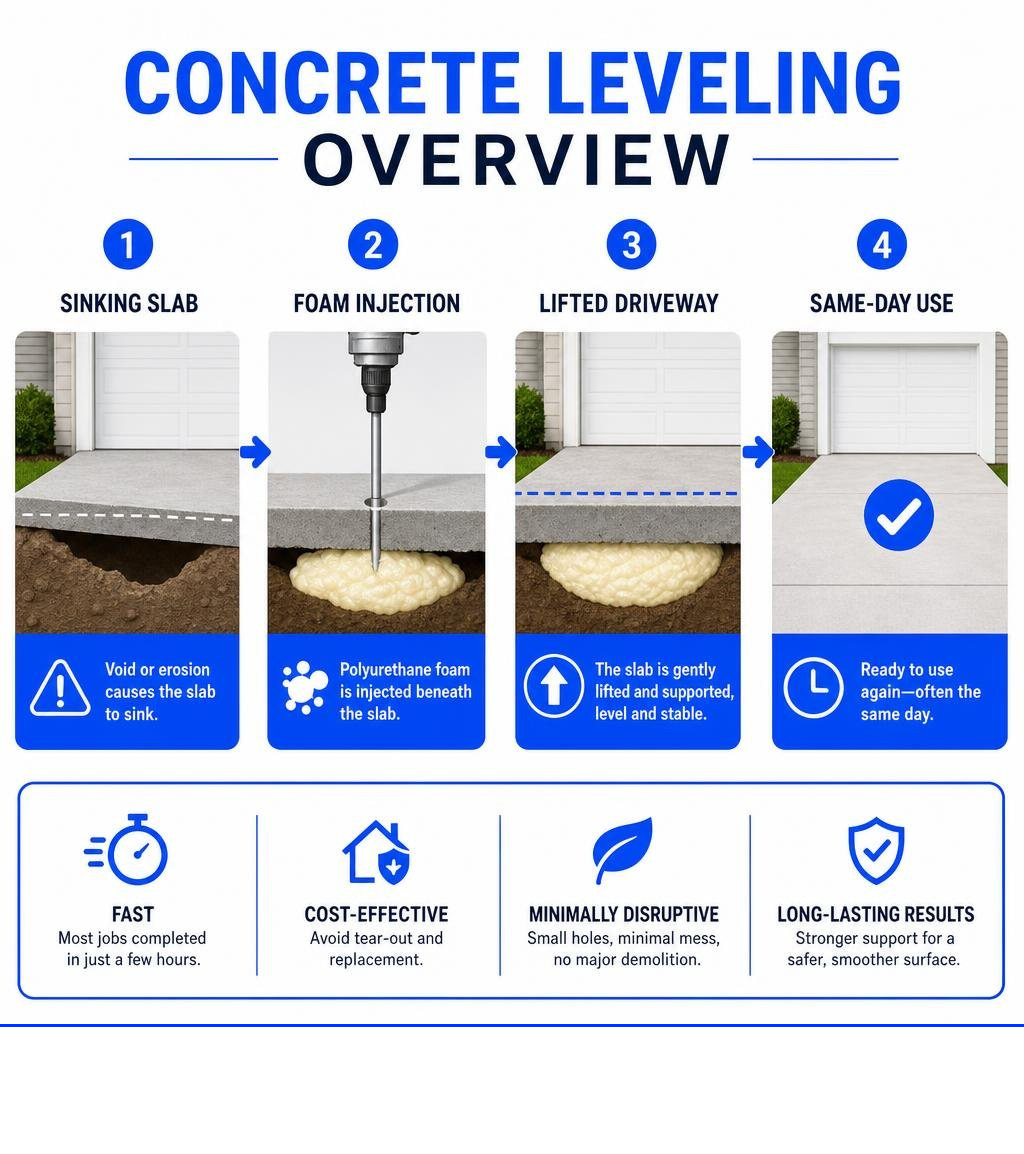
Concrete leveling raises a settled but structurally sound slab by filling the empty space beneath it and carefully returning it to a safer, more even position. It is often a faster, less disruptive alternative to tearing out and repouring a driveway, patio, sidewalk, or garage floor.
For homeowners, the quick answer is:
- Best for: Concrete that has sunk, tilted, or created a trip hazard but is still in good condition.
- Common causes: Soil erosion, poor drainage, loose backfill, moisture changes, and tree roots.
- How it works: Small holes are drilled, material is injected below the slab, and the slab is lifted and supported.
- Timeframe: Many residential repairs take only a few hours, with polyurethane foam allowing near-immediate use.
- Cost: FoamWorks uses polyurethane foam injection that can cost 30% to 50% less than full tear-out and replacement.
A sunken driveway is more than a curb-appeal issue. It can direct water toward your home, create a tripping point, damage vehicle tires, and worsen as water continues to wash soil away below the concrete. When the slab itself is sound, lifting it preserves the concrete you already own while avoiding the excavation, debris, and landscape disruption of replacement.
I am Trey McNamee, owner of FoamWorks Concrete Leveling, with more than two decades of experience in marketing, strategy, and product development in the building-materials industry. Today, our family-owned team applies that experience to practical, long-lasting concrete leveling repairs throughout Northwest Ohio, Southeast Michigan, and Northeast Indiana.
Understanding Why Concrete Driveways Sink
Civil engineers define concrete leveling as a specialized sub-surface restoration technique designed to alter the underlying subbase beneath a slab. Instead of breaking up structural concrete, technicians introduce hydraulic or expanding material under pressure into hidden subterranean voids. This pressure gently elevates settled panels back into alignment.
The history of slabjacking dates back to the early 20th century. In those early days, highway maintenance workers and municipal crews noticed that heavy pavement slabs were sinking into soft roadside dirt. Contractors began pumping crude mixtures of local soil, water, sand, and cement underneath roads through large drilled access points. This process became known as “mudjacking.” While the tools and materials have evolved dramatically since then, the basic mechanical principle remains the same: lift the concrete by supporting it from below.
If you are asking, Why Is My Concrete Driveway Sinking?, the underlying answer rarely lies within the concrete itself. High-quality concrete slabs are exceptionally durable and actually continue gaining compressive strength over time as they age. The true culprit almost always lies in the shifting, dynamic ground beneath the surface. You can learn more about these subterranean triggers on our Causes page.
Primary Causes of Concrete Settlement
Concrete is incredibly heavy, typically weighing around 145 to 150 pounds per cubic foot. A single standard driveway panel can easily weigh several thousand pounds. If the soil support beneath that massive weight gives way, the concrete slab naturally sinks with gravity.
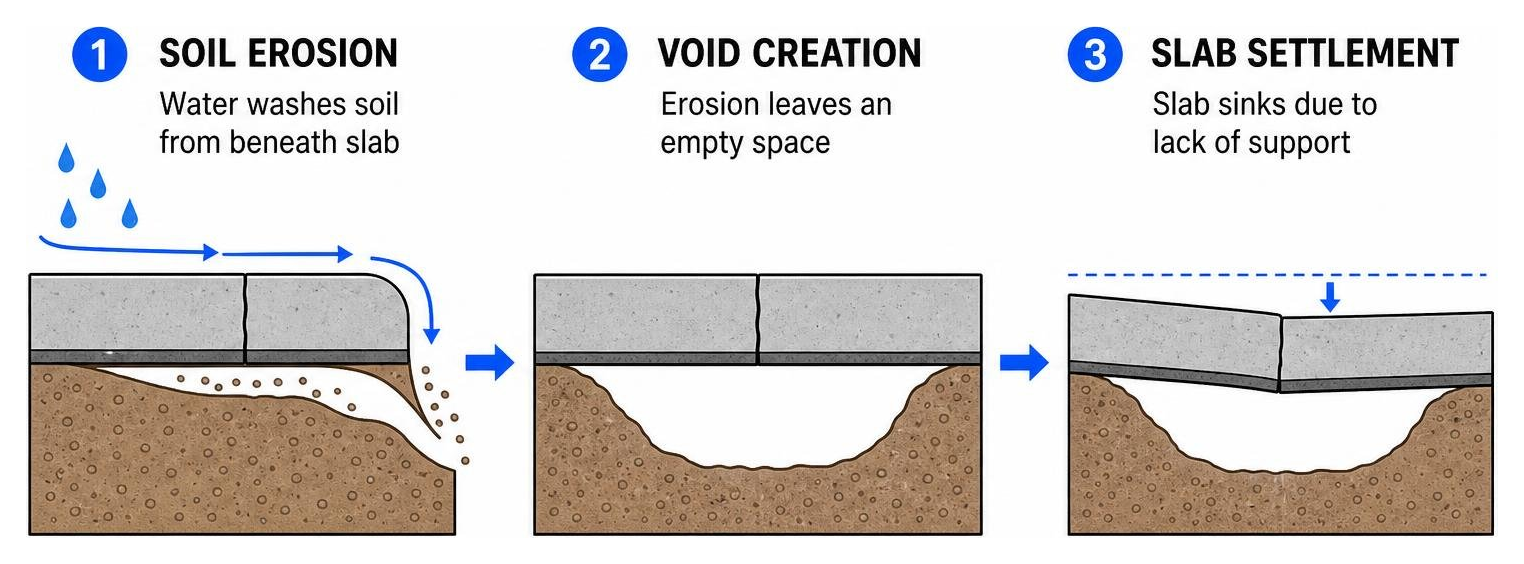
Here are the five primary drivers behind sub-surface failure:
- Soil Erosion and Poor Drainage: Uncontrolled water runoff from roof downspouts, gutter outlets, or poor landscape grading is the number one enemy of concrete stability. Water flows along the path of least resistance, carrying fine dirt particles away from under the slab. Over time, this erosion leaves hollow underground pockets called voids.
- Uncompacted Backfill Soil: During the initial construction of a home or driveway, builders excavate dirt around foundations and utility trenches. If this backfilled soil is not properly mechanically compacted in layers before the concrete is poured, it slowly consolidates and settles under the weight of vehicles over the following months or years.
- Soil Moisture Fluctuations: Clay-heavy soils (common throughout the Midwest) act like massive sponges. During rainy seasons, clay absorbs water and expands. During summer dry spells or droughts, the soil shrinks significantly and pulls away from the bottom of the slab. This constant expansion-contraction cycle leaves the slab unsupported.
- Tree Roots: Fast-growing tree roots growing under driveways can push slabs upward initially. However, when those roots rot away, die, or are cut, they leave behind sizeable subterranean channels. The dirt above collapses into these open tunnels, causing the driveway above to drop suddenly.
- Freeze-Thaw Cycles: Water trapped beneath a slab freezes and expands during cold winter conditions, lifting the concrete unevenly. When the ice melts in spring, it leaves behind oversaturated, weakened soil that collapses under heavy vehicle traffic.
Concrete Repair vs. Full Replacement
When faced with a settled driveway, many homeowners naturally assume that total demolition is the only fix. However, understanding the difference between choosing targeted Concrete Leveling and opting for full tear-out and replacement can save you thousands of dollars and endless headaches.
Full concrete replacement involves bringing in heavy demolition equipment, jackhammering old slabs into rubble, loading debris onto dump trucks, hauling it to landfills, and rebuilding the base gravel. Afterward, fresh concrete must be poured, finished, and left to cure for days before you can even walk on it. Furthermore, fresh concrete poured over the exact same unstable, uncompacted subsoil will often sink again in the future!
If your slab has maintained its structural integrity—meaning it isn’t crumbling into miniature pieces like a jigsaw puzzle—lifting and leveling is almost always the superior choice. Mature concrete that has cured for years is extremely strong. Preserving that strength while filling the empty voids beneath is both financially smart and structurally sound.
Comparing the Main Concrete Leveling Methods
Not all slabjacking techniques are created equal. Over the decades, three main methods have been utilized to lift sunken concrete slabs: traditional mudjacking, limestone grout slurry leveling, and expanding high-density structural polyurethane foam leveling.
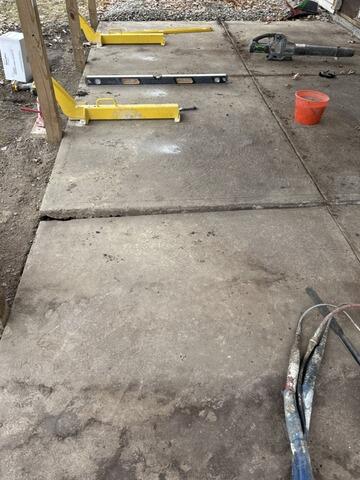
| Feature / Metric | Traditional Mudjacking | Limestone Grout Slurry | Expanding Polyurethane Foam |
|---|---|---|---|
| Material Composition | Sand, soil, cement, water | Pulverized limestone & cement | Two-part expansion polymer |
| Drill Hole Diameter | 1.0 to 2.0 inches | 1.0 to 2.0 inches | 5/8 inch (dime-sized) |
| Material Density/Weight | Extremely heavy (100+ lbs/cu ft) | Heavy (100+ lbs/cu ft) | Lightweight (2 to 6 lbs/cu ft) |
| Compressive Strength | 50–100+ psi | 240 to 6,000+ psi | 50 to 100 psi (7,200–14,000 lbs/sq ft) |
| Cure Time | 24 to 48 hours | 24 hours | ~30 minutes |
| Washout Resistance | Vulnerable to water erosion | Moderate resistance | 100% Waterproof / Hydrophobic |
Traditional Concrete Leveling Methods
Traditional mudjacking relies on pumping a heavy mix of topsoil, sand, water, and a small percentage of Portland cement under sunken concrete. While mudjacking represented a major leap forward half a century ago, it carries significant inherent engineering flaws.
First, mudjacking requires drilling large access holes (1 to 2 inches in diameter) directly through your decorative driveway surface. These noticeable circular patches are difficult to blend into aged concrete. Second, the mudjacking slurry itself is exceptionally heavy, weighing over 100 pounds per cubic foot. Injecting hundreds of pounds of wet mud onto soil that has already proven it cannot support weight often leads to further soil consolidation down the road. Finally, because mudjacking materials are organic and soil-based, groundwater and winter rains can wash the slurry away over time, leaving the concrete right back where it started.
Limestone grout leveling uses a finer stone slurry. While it offers high initial compressive strengths (240 psi base, rising above 6,000 psi when blended with cement), it suffers from the exact same fundamental weakness: extreme material weight and large drill hole sizes.
Expanding Polyurethane Concrete Leveling
Modern high-density polyurethane foam represents the technological evolution of slabjacking. The process, known as PolyLevel Injection, utilizes a closed-cell liquid polymer injected beneath the slab.
Here is how the expansion mechanics work:
- Technicians drill clean, tiny 5/8-inch holes (roughly the size of a dime) in strategic locations across the sunken slab.
- A specialized injection gun delivers two liquid polyurethane components beneath the concrete.
- The chemical reaction generates precise heat and expanding micro-bubbles, causing the liquid to expand rapidly into a dense, structural foam.
- As the foam expands, it flows into every nook, cranny, and subterranean void following the path of least resistance.
- Once voids are filled, the expanding foam exerts tremendous upward hydraulic pressure, easily lifting concrete slabs upwards of 5 inches to achieve perfect pitch and level alignment.
Polyurethane foam reaches an incredible compressive strength of 50 to 100 psi in a free-rise state, which translates to a massive lifting capacity of 7,200 to 14,000 pounds of support per square foot! That is more than enough strength to support heavy pickup trucks, utility vans, and commercial vehicles without yielding.
Crucially, structural polyurethane foam weighs only 2 to 6 pounds per cubic foot. It adds almost zero physical weight to sensitive, compromised subsoil. Furthermore, closed-cell polyurethane cures in a completely hydrophobic state—meaning it is 100% waterproof. It will never absorb moisture, break down, decay, or wash away during severe storms.
Environmental Impact and Material Longevity
When choosing home improvement solutions, material sustainability matters. Polyurethane foam injection materials are chemically inert once fully cured, meaning they will not react with soil chemistry or leach harmful chemicals or microplastics into surrounding groundwater or lawn soil.
From a long-term landfill perspective, concrete leveling is one of the greenest property repairs available. Concrete production is an energy-intensive industrial process responsible for significant carbon emissions. By salvaging existing driveways through leveling rather than sending thousands of pounds of broken concrete rubble to municipal landfills, homeowners significantly shrink their environmental footprint. Additionally, because polyurethane foam forms a permanent, non-biodegradable structure beneath the slab, the lift holds firm year after year.
Benefits, Costs, and Usability Timelines

When evaluating driveway restoration, speed and practicality are paramount. Nobody wants their driveway turned into an active construction zone for weeks on end.
Driveway and Sidewalk Concrete Leveling Applications
Polyurethane foam leveling is versatile and effectively lifts virtually any flatwork concrete structure around your residence:
- Concrete Driveway Repair: Eliminates harsh lip edges where driveway panels meet garage floors, saving vehicle tires and suspension systems.
- Sidewalk Repair: Removes serious trip hazards, ensuring family and delivery personnel can walk safely while preventing municipal code violations.
- Pool Deck Repair: Re-levels sunken pool decking slabs to protect delicate pool coping, tile lines, and subterranean PVC plumbing lines from cracking under shear stress.
- Patio and Garage Floor Leveling: Corrects improper drainage pitch that channels rainwater back toward basement walls or foundation footings.
Cost Comparison: Repair vs. Demolition
Understanding the financial savings makes choosing foam concrete leveling simple. FoamWorks Concrete Leveling uses polyurethane foam injection to repair sunken or uneven concrete for 30% to 50% less than full tear-out and replacement, helping homeowners save significantly on repair costs. Most repairs are completed in just a few hours, and the surface can be used almost immediately. Because there’s no need for heavy excavation, the process also reduces landscape damage, labor costs, debris removal, and disposal fees that come with replacing concrete. We provide free estimates to see how much you can save.
To put this into perspective, tearing out and replacing a standard residential driveway can run anywhere from $6,000 to $12,000 or more depending on square footage, concrete thickness, and haul-away logistics. In contrast, precision foam leveling solves the root cause of settlement at a fraction of that investment while leaving your surrounding lawn, garden beds, and sprinkler lines completely untouched.
DIY Repairs vs. Professional Slabjacking
Many handy homeowners ask whether concrete leveling is something they can tackling as a weekend DIY project. The short answer depends entirely on whether you are fixing surface cosmetic defects or structural void settlement.
When DIY Surface Methods Work
If your concrete driveway has small surface hairline cracks, minor spalling, or open expansion joints, high-quality DIY products work wonderfully. Applying a professional-grade elastomeric sealant like Loctite PL Self-Leveling Concrete or our specialized Concrete Sealant helps block surface water from penetrating through joints and reaching the soil below.
For extremely small, unattached patio pavers or tiny walkway blocks (like a single 3-foot by 2-foot border slab), homeowners sometimes dig side access trenches, use heavy steel pry bars with wooden fulcrum blocks to lift the piece manually, and hand-tamp fresh gravel underneath.
However, pouring liquid self-leveling cement overlays or thin mortar toppings over sunken driveways in an attempt to feather out uneven transitions is a mistake. Thin concrete overlays tapering from 2 inches down to zero fail to bond permanently to weathered concrete. Within a single winter freeze-thaw cycle, those paper-thin patches chip, flake, and break apart into loose gravel.
Why Professional Lifting Is Superior
Attempting deep structural lifting on heavy driveway slabs using off-the-shelf equipment or retail spray cans is impossible. Standard retail gap-filling spray foam lacks the high density and compressive strength required to lift heavy loads; it will crush flat under the weight of concrete.
Professional slabjacking requires precise hydraulic flow controllers, high-pressure heating reactors, specialized two-part delivery hoses, and trained technicians who understand structural slab dynamics. Experienced crews calculate injection points, monitor slab elevation with optical lasers, and control foam expansion speed to lift slabs evenly without snapping or cracking the mature concrete.
To read detailed answers regarding professional safety, site preparation, and injection techniques, explore our comprehensive Lift & Level FAQ.
Frequently Asked Questions About Driveway Repair
How long does a repair job take and how soon can I drive on it?
Most residential concrete leveling projects take between 1 and 4 hours from arrival to final cleanup. Because high-density polyurethane foam expands rapidly and reaches full cure in roughly 30 minutes, downtime is minimal. You can walk across the leveled concrete immediately after technicians complete work, and you can park full-sized passenger vehicles or heavy pickup trucks on your restored driveway the exact same day!
When is slab lifting better than full replacement?
Concrete leveling is the clear choice whenever existing slabs remain structurally intact despite sinking or tilting. If your driveway panels are free from spiderweb crumbling, severe pitting, or crushed fragments, lifting retains the high mature strength of your existing concrete while saving you substantial time and money. Full replacement is only necessary when concrete has crumbled into small broken pieces, suffered deep structural decay, or when subgrade soil requires major excavation.
How durable is polyurethane foam over time?
Polyurethane foam is engineered for long-term subterranean durability. Because cured closed-cell polyurethane is hydrophobic, it will not absorb water, rot, or degrade in damp environments. It is completely immune to underground soil erosion and washout from rainwater. With strong compressive strengths backing the concrete, high-density foam provides permanent support that outlasts traditional mudjacking materials by decades.
Conclusion
A sunken, uneven concrete driveway hurts your home’s curb appeal, damages vehicle tires, creates dangerous trip hazards for your family, and risks sending destructive rainwater runoff straight toward your house foundation. Tearing out and replacing sound concrete is an expensive, messy, and time-consuming process that often fails to address the unstable soil beneath.
With fast, lightweight polyurethane foam leveling from FoamWorks Concrete Leveling, you can lift, stabilize, and restore your driveway in just a few hours—at a price 30% to 50% lower than complete replacement! Backed by over 30 years of industry experience, our family-owned team delivers clean, long-lasting repairs with a lifetime warranty and 100% customer satisfaction across Northwest Ohio, Southeast Michigan, and Northeast Indiana.
Don’t wait for sunken slabs to cause expensive property damage or dangerous trips and falls. Contact our friendly experts today to request your Free Estimate and discover how easy professional Concrete Leveling can be!