

Choosing a Concrete Foam Lifting Kit for a Sunken Slab
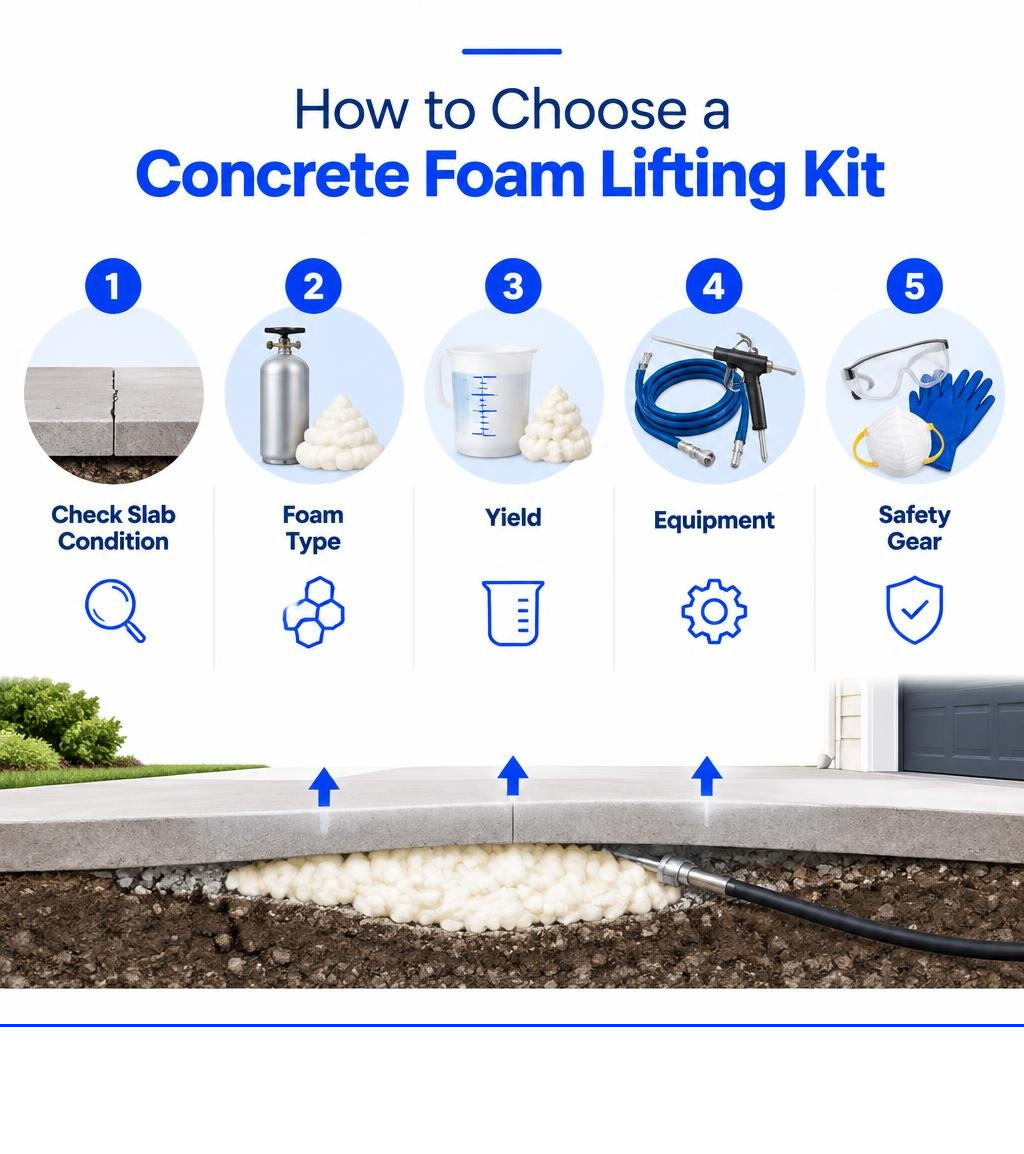
For a small, settled slab, look for a concrete foam lifting kit made for slab lifting, not a can of gap-filling spray foam. Check that it uses closed-cell foam, lists its yield, and tells you what injection equipment is included. The foam is injected beneath the slab, where it fills empty space and expands to raise the concrete. If the slab is badly cracked, sits near a foundation, or carries heavy vehicles, get a professional assessment before trying a DIY lift.
The right kit depends on the slab and the space beneath it. In this roundup, we’ll focus on what helps you compare kits and spot jobs that need more precise control.
I’m Trey McNamee, owner of FoamWorks Concrete Leveling. My building-products background and our team’s foam-injection work help me explain what to look for in a concrete foam lifting kit and when to call a pro.
Helpful guides on foam lifting:
- Learn how polyurethane foam lifting works
- Understand polyurethane concrete leveling
- Discover why polyurethane foam outperforms traditional lifting methods
Understanding the Concrete Foam Lifting Kit
When a concrete walkway, patio, or garage apron begins to sink, the culprit is almost always the soil beneath it. Soil erodes, consolidates, or washes out during heavy Midwest rains, creating hidden voids. A concrete foam lifting kit provides the chemical materials and basic hardware needed to stabilize the subbase, fill those hidden voids, and raise the concrete back to an even grade.
Unlike basic crack sealants or cosmetic patch mixes, a lifting kit addresses the root structural issue under the surface. It delivers specialized expanding polyurethane directly underneath the concrete. As it expands, it stabilizes loose subgrade soils, performs thorough void filling to eliminate empty pockets, and completes undersealing to prevent future water runoff from carving out new pathways.
Using high-density, closed-cell materials ensures that the cured polymer will not wash away, degrade, or hold water. The low viscosity of the liquid components before expansion allows the mixture to travel into microscopic soil fissures and narrow gaps before expanding into an ultra-strong, lightweight base.
How a Concrete Foam Lifting Kit Works
The chemistry behind structural foam lifting relies on a precise two-part polymer formulation: an “A-side” isocyanate and a “B-side” polyol blend. When these two liquids are mixed inside an injection nozzle at the correct ratio and temperature, an exothermic chemical reaction begins almost instantly.
This chemical expansion generates tremendous upward force. As the liquid transforms into rigid foam within seconds, it creates hydro-insensitive hydraulic lifting force capable of raising thousands of pounds of reinforced concrete. Because the foam is hydro-insensitive, it can expand and cure even in standing groundwater without diluting or washing out. For a deeper breakdown of this process, see our guide on how polyurethane foam lifting works to fix sinking concrete.
Closed-Cell vs. Open-Cell Foam Formulations
Not all polyurethane foams are built for heavy structural repairs. If you have ever used canned insulation foam around window frames, you have seen low-density, open-cell material. Open-cell foam has broken cell walls that allow moisture absorption and compress easily under light pressure—making it completely unsuitable for lifting concrete.
In contrast, a 2.8 lb closed-cell formulation creates tightly packed, sealed microscopic bubbles. This closed-cell structure provides exceptional moisture resistance, impenetrable waterproofing, and the rigid compressive strength needed to support continuous vehicle traffic.
| Feature | Open-Cell Foam | 2.8 lb Closed-Cell Lifting Foam |
|---|---|---|
| Primary Use | Interior thermal/sound insulation | Slab lifting, void filling, undersealing |
| Cell Structure | Permeable, broken cell walls | Sealed, impermeable cell walls |
| Water Absorption | High (acts like a sponge) | Hydrophobic (zero water absorption) |
| Density | 0.5 lbs / cu. ft. | 2.8 lbs / cu. ft. |
| Compressive Strength | Low (< 5 psi) | High (60–100+ psi) |
| Subbase Stability | Degrades under heavy loads | Permanent support, will not compress |
The technical specifications of 2.8 lb closed-cell lifting foam make it the industry baseline for structural applications:
- Core Density: ~2.8 lbs/cu. ft.
- Compressive Strength: 60 to 100+ psi (sufficient for sidewalks, patios, and residential driveways)
- Dimensional Stability: Minimal shrinkage or expansion after full cure
- Reaction Time: Cream time of 5–15 seconds, rising within 30–45 seconds, fully cured within 15–30 minutes
Key Features to Evaluate in a Concrete Foam Lifting Kit
Before purchasing a concrete foam lifting kit, evaluate these critical factors:
- Expansion Yield: Always verify the theoretical cubic footage of expanded foam the kit will produce. A kit might seem inexpensive until you calculate the void volume beneath your slab and realize you need three kits to finish the job.
- Compressive Rating (PSI): Ensure the cured material achieves at least 50 to 80 psi for pedestrian walkways and 80+ psi for areas supporting vehicles.
- Cure Speed and Expansion Profile: Fast-reacting formulations prevent the foam from running off into adjacent soil beds, keeping the lift concentrated right where you need it.
- Temperature Tolerance: Polyurethane chemicals are sensitive to ambient and substrate temperatures. Look for kits that provide clear guidelines on container pre-warming and minimum soil temperatures (typically 40°F to 50°F).
- Storage and Shelf-Life: Most two-part chemical kits have an unopened shelf life of 6 to 12 months when stored between 60°F and 80°F. Exposure to extreme cold or high humidity can degrade the polyol components.
Step-by-Step Guide to Applying Foam Lifting Kits
Lifting a concrete slab with a portable kit requires careful preparation, strict safety adherence, and precise execution.
- Inspect and Clean the Area: Identify the low spots on your concrete using a 4-foot level or string line. Clear all dirt, debris, and standing water from joints and cracks.
- Drill the Injection Holes: Using a heavy-duty rotary hammer drill with a masonry bit, drill holes through the slab into the underlying void. Most small-scale kits utilize 5/8-inch ports, whereas larger commercial equipment can use holes as small as 3/8-inch. Space holes roughly 2 to 3 feet apart in a triangular pattern across the settled area.
- Install Injection Ports/Tubes: Insert the injection ports firmly into the drilled holes to create a tight mechanical seal, preventing back-pressure blowouts.
- Don Full PPE: Put on chemical-resistant nitrile gloves, safety goggles or a face shield, and an organic vapor respirator aligned with OSHA respiratory protection guidelines. Polyurethane chemicals stick aggressively to skin and surfaces.
- Attach the Injection Gun and Purge: Connect your two-part chemical supply hoses to the mechanical injection gun. Follow kit instructions to balance pressure and purge any air pockets.
- Inject in Short, Controlled Bursts: Inject the mixed liquid in 3- to 5-second pulses. Wait 30 to 45 seconds between bursts to let the foam expand fully and observe the slab movement. Continuous injection often leads to over-lifting, which cannot be reversed.
- Monitor the Lift: Keep a level on the slab to watch for movement. Stop injecting as soon as the slab aligns with adjacent sections.
- Remove Ports and Patch: Snap off or unscrew the injection ports below the surface line. Clean the hole edges and seal them flush with a high-strength concrete patching compound.
Understanding how to raise sunken slabs with modern solutions can save substantial time and prevent the massive mess of traditional replacement.
DIY Kits vs. Professional Polyurethane Leveling
While a retail concrete foam lifting kit might work for a single, small sidewalk flag, larger residential and commercial projects present major hurdles for DIYers.
A self-contained DIY kit typically delivers low-to-medium pressure through static mixing nozzles. When attempting to lift a 4-inch thick garage floor or a multi-panel driveway, the dynamic slab weight creates tremendous downward resistance. Without high-pressure hydraulic delivery systems, DIY foam can take the path of least resistance—shooting out through expansion joints or nearby lawn edges rather than lifting the concrete.
| Factor | DIY Concrete Lifting Kit | FoamWorks Professional Injection |
|---|---|---|
| Injection Pressure | Low to moderate pneumatic/static pressure | High-pressure, heated hydraulic proportioner rigs |
| Drill Hole Size | Typically 5/8-inch to 1-inch holes | Penny-sized 5/8-inch (or smaller) holes |
| Lifting Precision | High risk of under-lifting or over-lifting | Controlled to within 1/10th of an inch |
| Equipment Cost | Upwards of $2,000+ for single-use setups | Zero equipment investment; bundled service |
| Material Guarantee | DIY kit manufacturers offer no labor/lift warranty | Lifetime warranty backed by 30+ years of experience |
| Cleanup & Disposal | You handle hazardous chemical disposal | Turnkey service; minimal landscape disruption |
At FoamWorks Concrete Leveling, our mobile rigs maintain heated, high-pressure lines that guarantee ideal chemical ratios regardless of outside weather conditions. For a closer look at how this process compares with traditional methods, see our guide on polyurethane foam performance.
Frequently Asked Questions About Concrete Foam Leveling
How much does a DIY concrete lifting foam kit cost?
A structural 2.8 lb closed-cell concrete lifting foam kit is a significant investment, since a full two-part canister or cylinder setup provides enough foam to lift only a few small patio sections or a standard sidewalk run. That price does not include extra masonry drill bits, heavy-duty hammer drills, or replacement mixing nozzles if your lines clog during application.
By contrast, professional polyurethane foam injection through FoamWorks Concrete Leveling generally costs 30% to 50% less than full tear-out and replacement. Because we bring high-capacity equipment right to your driveway in Northwest Ohio, Southeast Michigan, or Northeast Indiana, you avoid the hefty upfront purchase price of disposable equipment while benefiting from guaranteed results.
How fast does polyurethane lifting foam cure?
Polyurethane lifting foam cures exceptionally fast. The chemical reaction reaches 90% of its ultimate compressive strength within just 15 minutes of injection. Homeowners can walk and drive on the concrete almost immediately after the injection ports are sealed. Learn more about durability in our detailed overview on the real longevity behind polyurethane slab lifting.
Can foam lifting kits fix heavy driveway slabs?
A small DIY foam kit often struggles with thick, heavily reinforced driveway slabs. Driveways require substantial volumetric expansion and hydraulic injection pressure to overcome the combined weight of the concrete and the friction along the joint lines.
Professional injection rigs generate hundreds of pounds of continuous lifting force per square foot, making it easy to raise even heavy vehicle-bearing pads. You can see how this works across real-world residential driveways in our gallery of proven concrete lifting examples.
Conclusion
A specialized concrete foam lifting kit can offer a viable solution for very small, simple slab repairs. However, when dealing with substantial settling, expensive decorative concrete, or heavy driveways, the risk of over-lifting, chemical blowouts, or incomplete void filling makes DIY kits a costly gamble.
FoamWorks Concrete Leveling is a family-owned concrete repair contractor serving communities across Northwest Ohio, Southeast Michigan, and Northeast Indiana—from Toledo, Bowling Green, and Findlay to Ann Arbor, Monroe, and Fort Wayne. Backed by 30+ years of experience, we provide fast, reliable, lifetime-warranted repairs that restore your surfaces in just a few hours.
Skip the guesswork and chemical cleanup of disposable kits. Contact us today for a free estimate and discover the advantages of our precision professional foam injection services.