

Fix Pool Deck Cracks Before They Become Trip Hazards
For concrete pool deck crack repair, remove loose material, clean the crack, and let it dry before adding a filler made for outdoor concrete. Use a flexible filler for a small, stable crack and a concrete patch for a wider, nonmoving break. If one side of the crack has sunk or become a trip edge, deal with the slab movement first. Filler alone will not level it.
Freeze-thaw cycles can make cracks worse, so check your deck before summer pool use. A sound repair helps keep water out and makes the surface safer underfoot.
I’m Trey McNamee, owner of FoamWorks Concrete Leveling, where our work includes concrete pool deck crack repair and leveling. My two decades in building-materials marketing, strategy, and product development at Owens Corning help shape the practical checks and repair steps that follow.
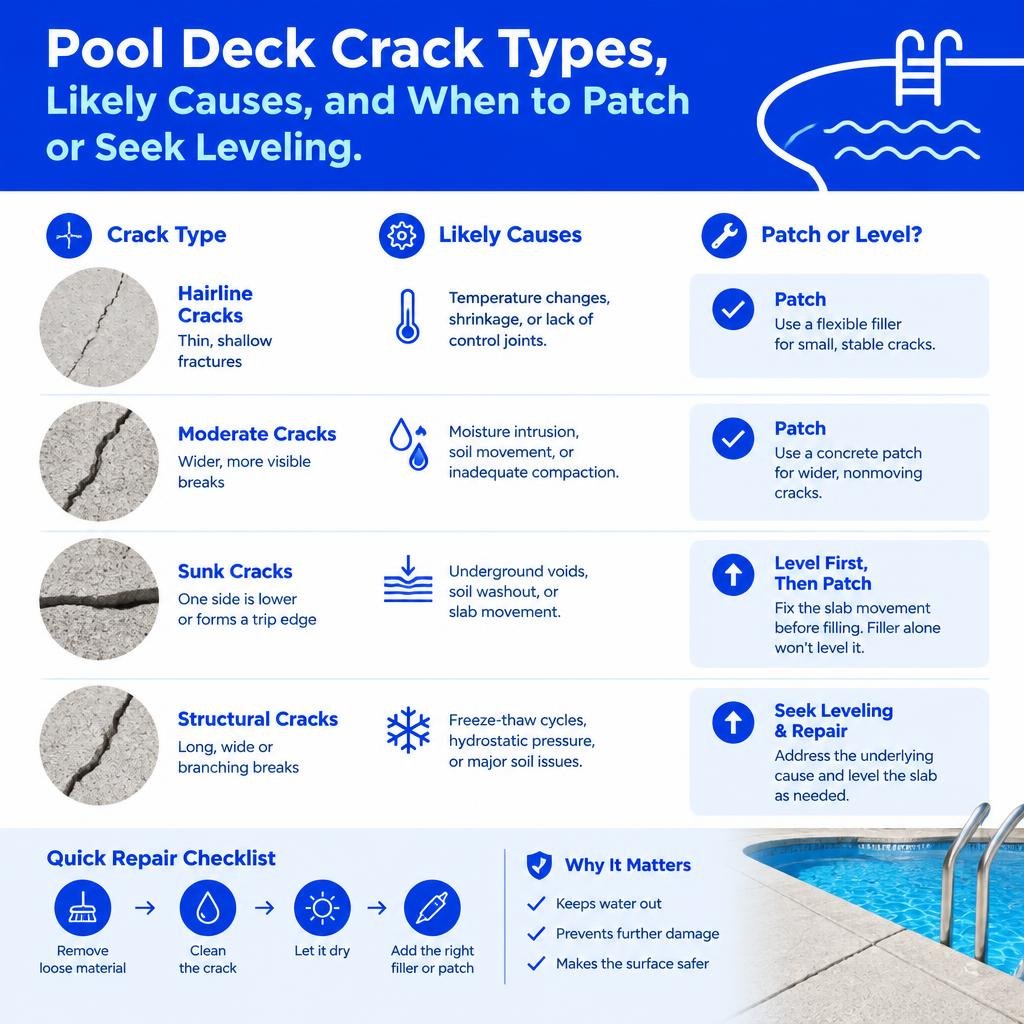
Understanding Pool Deck Cracks: Cosmetic vs. Structural Damage
Not every fracture around your swimming area signals impending structural failure. However, ignoring small breaks can allow moisture intrusion that accelerates slab erosion and frost heaving over the winter months. Understanding what causes these fissures helps you decide whether a basic patch is enough or if a deeper fix is required.
Concrete expands and contracts as temperatures change across the seasons. When installers do not place enough control joints, the slab creates its own relief points through shrinkage cracks. In other cases, soil washout, hydrostatic pressure from surrounding groundwater, or improper compaction around the pool excavation wall creates underground voids. Over time, heavy concrete drops into these empty spaces.
Knowing how to tell if concrete cracks pose major risks will keep your backyard safe for bare feet. Minor hairline surface checks are usually cosmetic. In contrast, cracks accompanied by height differences between adjacent slabs indicate active soil movement beneath the surface. Our guide to diagnosing sunken pool deck slabs outlines the early warning signs of ground settlement.
| Crack Type | Typical Width & Visual Signs | Underlying Cause | Recommended Repair Action |
|---|---|---|---|
| Hairline / Crazing | Under 1/8 inch; shallow, spiderweb surface lines | Plastic shrinkage, rapid surface drying | Clean, seal with penetrant or flexible elastomeric caulk |
| Wide Fractures | Over 1/8 inch; deep separation, level edges | Thermal expansion, poor joint spacing | Chase into V-groove, fill with polymer-modified cement or epoxy |
| Sinking / Offset Slab | Variable width; vertical ledge or trip hazard (>1/4 inch) | Subbase erosion, soil settlement, void formation | Level slab using polyurethane foam injection, then seal joints |
Identifying Sinking Slabs and Joint Movement
When the subgrade beneath a pool deck washes away or consolidates, differential settlement occurs. This manifests as coping separation, widening perimeter gaps, and jagged vertical offsets between slabs. Simply packing cement mix into a dropped slab crack will fail; the patch will crack again as the slab continues to move.
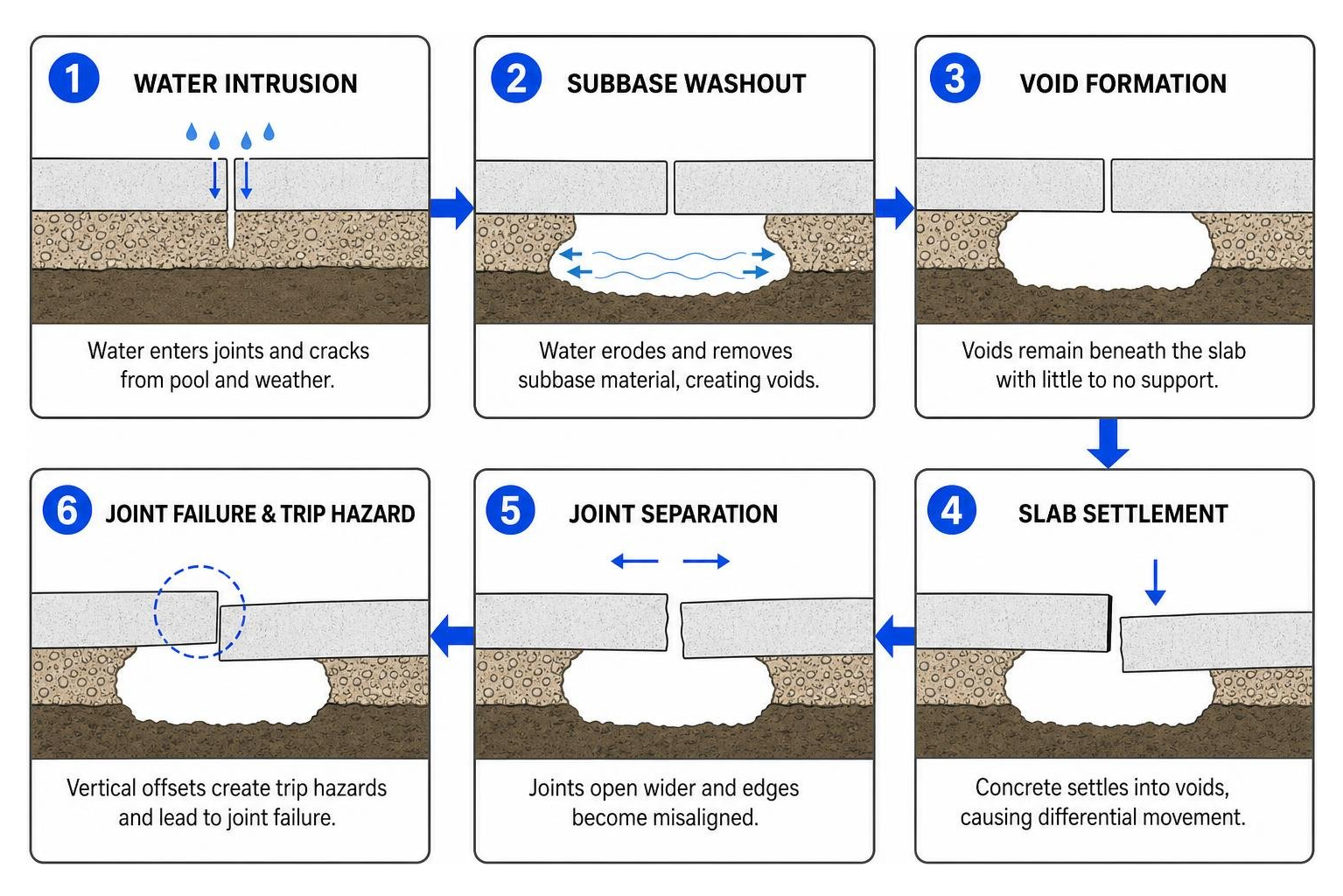
Leaving uneven edges untreated creates serious trip hazard liabilities for guests and family. Before applying any cosmetic sealants, the slab must be lifted back to its original grade to restore proper pitch away from the pool. High-density polyurethane foam slab leveling expands beneath the concrete to fill hidden voids and lift dropped slabs with pinpoint accuracy. In many projects, such as a recent pool deck lifting and joint sealing job, stabilizing the base first guarantees that joint sealants remain watertight for years.
Choosing the Right Filler: Patch vs. Epoxy vs. Silicone Caulk
Selecting the proper repair compound depends on crack width, slab movement, and UV exposure. Using the wrong material often results in brittle bond failure or yellowed, peeling patches.
- Acrylic-Modified Cement Patch: Best for wide, rigid cracks and textured coatings. Rapid-setting mixes can reach compressive strengths of 3,800 psi in dry air after 28 days, making them ideal for rigid concrete repairs.
- Epoxy Resins: High-strength, two-part systems designed for structural anchoring and gluing stationary cracks together. Epoxy bonds tenaciously and resists water infiltration, though rigid formulas can crack if the deck experiences ongoing thermal movement.
- Elastomeric Silicone & Polyurethane Sealants: Flexible compounds engineered for expansion joints and active fractures. They move with the natural expansion cycles of the deck without losing adhesion or degrading under harsh sunlight.
| Material | Flexibility | UV Resistance | Best Application | Expected Cure Time |
|---|---|---|---|---|
| Polymer-Modified Concrete Patch | Low (Rigid) | High | Wide stationary breaks, spalled areas, Kool Deck repairs | 24 hours (Foot traffic), 28 days (Full cure) |
| Semi-Flexible Epoxy Resin | Moderate | Moderate (May amber) | Structural cracks, bonding severed concrete sections | 4 to 12 hours |
| Commercial Polyurethane / Silicone | Very High | Excellent | Active control joints, perimeter coping, hairline fractures | 24 to 48 hours |
Essential Materials for Concrete Pool Deck Crack Repair
Gather your tools and personal protective equipment before opening any repair containers.

- Cutting & Chiseling: Angle grinder with a diamond tuck-pointing blade or a cold masonry chisel and small hand sledge.
- Cleaning: Wire bristle brush, shop vacuum, pressure washer, and a diluted muriatic acid or concrete degreaser solution.
- Application Tools: Margin trowel, stiff putty knife, professional caulk gun, dash brush (for texturing), and clean mixing buckets.
- Chemicals & Binders: Liquid acrylic cement bonder, dry pool deck repair mix, color pigments, and closed-cell foam backer rod.
- Safety Gear: Safety goggles, heavy-duty rubber gloves, dust mask or respirator, and sturdy work boots.
Step-by-Step Guide to Concrete Pool Deck Crack Repair
Achieving a durable bond requires meticulous preparation. Repair materials will peel away quickly if applied over loose grit, dust, or algae.
- Safety First: Put on your safety glasses, gloves, and dust mask. Cementitious repair materials contain alkaline compounds that irritate skin and eyes.
- Route the Crack: For fractures wider than a credit card, use an angle grinder equipped with a diamond wheel to widen the break into a clean V-groove roughly 1/4 inch wide. As outlined in standard Desert Crete crack preparation specifications, routing creates uniform sidewalls that allow repair materials to bite deep into sound concrete.
- Clear Debris: Chisel away any remaining loose concrete chips. Vacuum the entire joint to remove fine silica dust.
- Etch and Rinse: Scrub the routed groove with a 1:3 diluted muriatic acid solution using a stiff brush to remove mineral glaze and open the concrete pores. Rinse thoroughly with clean water and let the area dry until damp but free of standing puddles.
- Apply Bond Coat: Brush a thin layer of liquid acrylic cement bonder directly onto the inside faces of the routed crack to promote adhesion.
Repairing Hairline Cracks and Expansion Joints
For fine surface cracks under 1/8 inch, routing may not be necessary if the concrete is stationary. Penetrating low-viscosity sealers can seal hairline checks permanently to prevent water infiltration.
When dealing with functional expansion joints or long, straight control joints, flexibility is essential. Press a closed-cell backer rod into the joint cavity so it rests roughly 1/4 to 3/8 inch below the deck surface. The backer rod controls sealant depth and prevents three-sided adhesion, allowing the sealant to stretch freely. Gun a premium, UV-stable commercial-grade concrete joint sealant smoothly along the seam, tooling it flush with a damp spatula to form a continuous moisture barrier.
Patching Wide Fractures and Textured Kool Deck Surfaces
Restoring textured, lace, or knockdown pool coatings requires careful matching of both color and surface relief.
- Mix the Mortar: Combine dry pool patch mix with a pre-mixed liquid blend of 1 part acrylic bonder to 3 parts clean water. Mix until you reach a stiff putty consistency—similar to heavy mashed potatoes—that holds its shape on a trowel.
- Pack the Crack: Press the stiff mortar firmly into the routed V-groove with a margin trowel, working out any trapped air pockets. Pack it slightly below the level of the surrounding textured deck.
- Texture Application: For knockdown finishes like Kool Deck, dab a small amount of wet repair mix onto the tips of a dash brush or stiff-bristle paintbrush. Splatter or stipple small peaks over the fresh repair to match the surrounding deck pattern.
- Knock Down and Blend: Allow the applied peaks to set for 5 to 10 minutes until they lose their wet sheen and become thumb-print firm. Lightly drag a clean, damp margin trowel flat across the raised peaks to flatten them flush with the surrounding texture.
- Edge Blending: Use a lightly damp sponge to feather the edges of the repair into the original deck, wiping away any stray cement paste before it hardens.
When to Patch vs. Seek Professional Pool Deck Repair
DIY patching is an effective, economical solution for isolated, non-settling cracks. However, there are clear signs that point to the need for professional intervention:
- Slab Height Differences: When one side of a fracture drops lower than the other, patching will not fix the underlying soil failure. Polyurethane lifting is required to relevel the slab.
- Widespread Spalling and Flaking: If large sections of the top concrete layer are crumbling, spot patching will result in a patchwork appearance. Resurfacing or stabilizing the slab base provides a lasting solution.
- Perimeter Coping Separation: Gaps opening between the deck and pool coping often indicate that the deck is migrating or tilting outward toward soft backfill.
FoamWorks Concrete Leveling uses polyurethane foam injection to repair sunken or uneven concrete for 30% to 50% less than full tear-out and replacement, helping homeowners save significantly on repair costs. Most repairs are completed in just a few hours, and the surface can be used almost immediately. Because there’s no need for heavy excavation, the process also reduces landscape damage, labor costs, debris removal, and disposal fees that come with replacing concrete. We provide free estimates to see how much you can save.
Frequently Asked Questions
How long does concrete pool deck crack repair take to cure?
Fast-setting cementitious patches begin to stiffen within 5 to 15 minutes and can bear light foot traffic after 24 hours. Keep heavy patio furniture, grills, and pool loungers off the repaired section for at least 3 days. While the patch is functional within a few days, full internal chemical hydration and maximum compressive strength develop over a standard 28-day cure period. In hot weather, shade the fresh repair to prevent rapid moisture loss.
How do I color-match the repair material to my existing pool deck?
Concrete pool deck patch kits are available in standard pre-tinted shades, with sand buff being the most common base color. Because sun exposure, weather, and age alter concrete color, mix a small test batch of dry powder with water and apply a small dab to an inconspicuous area. Concrete always dries lighter than it appears when wet. You can fine-tune the mix by adding small pinches of black cement dye to darken it, or titanium dioxide white pigment to lighten the base until you achieve an exact match.
Can sunken pool deck slabs be leveled instead of replaced?
Yes. Sinking pool deck slabs are typically caused by void formation and soil settlement in the non-compacted backfill zone around the pool walls. Instead of breaking up good concrete with jackhammers, high-density expanding polyurethane foam can be injected through dime-sized holes drilled directly through the slab. As the foam expands, it compacts the subbase, fills hidden voids, and raises the concrete back to an even plane. Homeowners interested in understanding how concrete raising works will find that modern polyurethane lifting delivers immediate results without making a mess of landscaping.
Conclusion
A well-maintained pool deck protects your investment, eliminates dangerous tripping hazards, and keeps your outdoor space looking great throughout the summer. By catching cracks early, preparing joints properly, and selecting the right repair compounds, you can complete lasting repairs that withstand heavy use and changing seasons.
If your pool deck has settled, tilted, or developed uneven tripping edges around the coping, simple surface fillers cannot solve the underlying subbase movement. Our team brings over 30 years of hands-on experience restoring settled concrete across Northwest Ohio, Southeast Michigan, and Northeast Indiana. Explore our professional pool deck repair and concrete leveling services to schedule your free estimate and get your pool area safe, level, and ready for summer fun.