

Fix a Sinking Pool Deck Before It Becomes a Bigger Hazard
How to fix a sinking pool deck starts with finding and stopping the cause of settlement, such as loose fill soil, water erosion, drainage problems, or animal burrows. Then, a concrete-leveling professional can fill voids and lift stable slabs with polyurethane foam injection; replacement is usually reserved for concrete that is badly broken or crumbling.
Uneven pool concrete is more than an eyesore. It can create a trip hazard for bare feet, pull away from pool coping, and let more water reach the soil beneath the slab. The sooner you address a low spot, crack, or hollow-sounding section, the better chance you have of avoiding wider damage and a full tear-out.
At FoamWorks Concrete Leveling, polyurethane foam injection can repair sunken concrete for 30% to 50% less than replacement. Most repairs take only a few hours, with little disruption to your pool area or landscaping.
I am Trey McNamee, owner of FoamWorks Concrete Leveling, and our team brings more than 30 years of combined concrete-repair experience to homeowners across Northwest Ohio, Southeast Michigan, and Northeast Indiana. I will walk you through how to fix a sinking pool deck, what causes the problem, and when professional slab lifting is the safer long-term choice.
What Causes a Pool Deck to Sink?
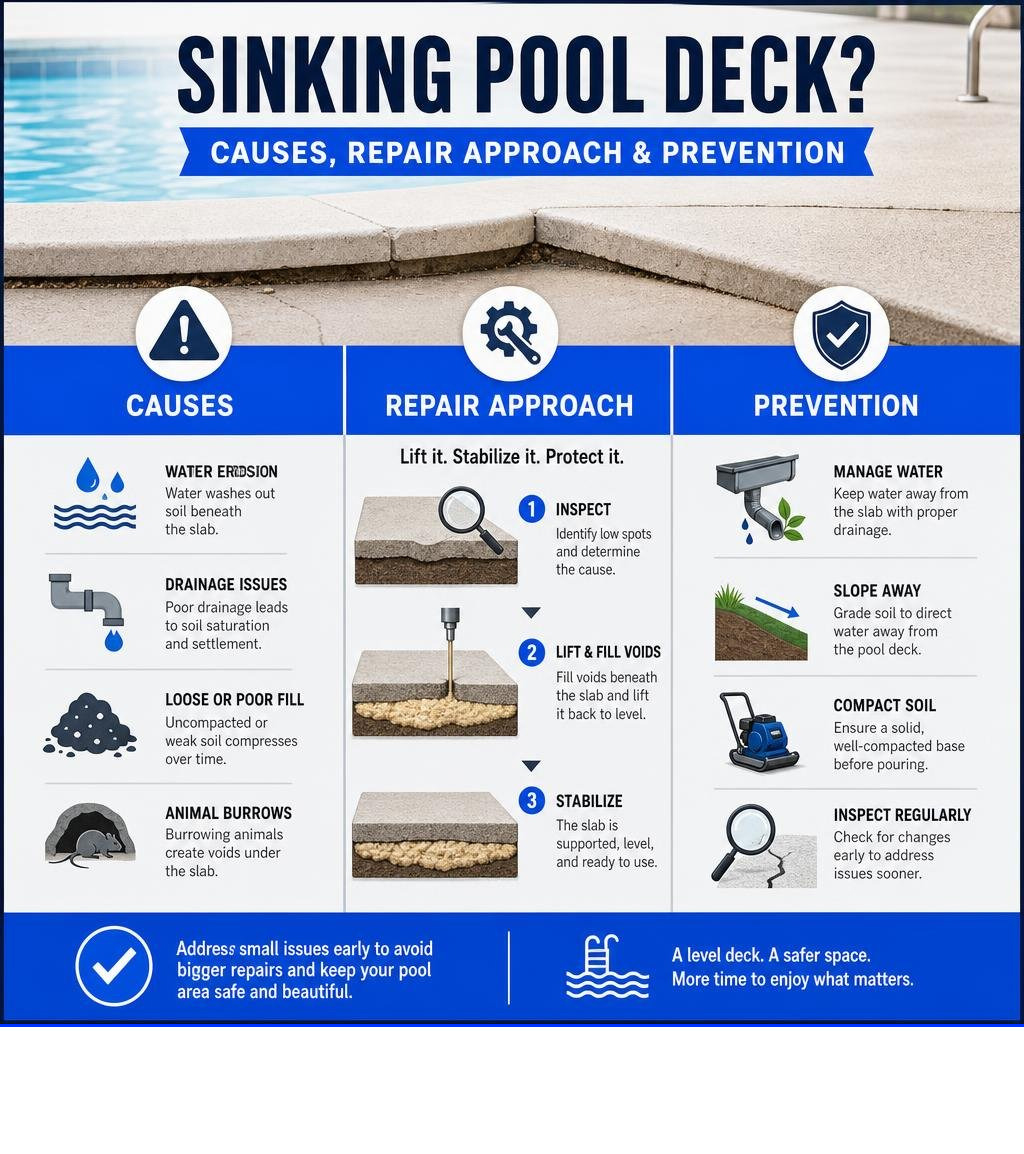
Before jumping into repair options, it is essential to understand why swimming pool decks drop in the first place. Concrete slabs are extraordinarily durable, typically poured at a thickness of 3.5 to 4 inches (and up to 7 inches near heavy equipment like diving boards). However, concrete is only as stable as the soil underneath it. When the sub-base shifts, washes away, or compresses, the heavy slab above naturally follows.
Here are the primary Causes of Sinking Concrete around residential and commercial swimming pools:
- Improper Soil Compaction During Pool Construction: This is by far the single most common cause of pool deck settlement. When an inground pool is excavated, contractors dig out a massive footprint. After placing the pool shell or walls, backfill dirt is dumped into the surrounding trench. If this fill dirt is not compacted meticulously in thin layers (lifts), it retains loose air pockets. Over the following months or years, gravity, rain, and foot traffic cause this loose soil to settle, leaving massive underground voids beneath the slab.
- Water Erosion and Poor Drainage: Water is concrete’s silent adversary. Overflowing pool water, leaking skimmer lines, poor rainwater drainage, or misplaced downspouts can wash away fine soil particles under your deck. As the soil washes away, empty pockets form beneath the concrete.
- Subterranean Pest Burrowing: Underground pests like voles and moles can ruin pool deck foundations. These small animals dig intricate tunnel networks through soft sub-base dirt. Over time, rainwater channeled into these tunnels accelerates internal erosion, leaving wide voids that lead to localized deck sagging or sudden drops.
- Plumbing Leaks and Coping Separation: Unsealed expansion joints between the pool coping and the deck allow splash-out water to seep straight down into the sub-base. Furthermore, minor leaks in return lines or skimmers saturate the sub-soil, turning firm earth into weak, unstable mud.
- Freeze-Thaw Cycles: In areas across Northwest Ohio, Southeast Michigan, and Northeast Indiana, severe winter freeze-thaw cycles play a major role in concrete displacement. Water trapped in sub-base voids freezes and expands (frost heave), lifting the slab. When the ice thaws in spring, the soil collapses further than its original level, causing uneven sinking.
Recognizing these symptoms early—such as hollow sounds when walking on slabs, cracks forming near pool corners, or gaps pulling away from the coping—allows you to act before structural stress destroys the slab completely. For a deeper breakdown of structural movement and soil behavior, review standard structural stabilization guides.
How to Fix a Sinking Pool Deck: Comparing Your Main Repair Options
When facing a sunken concrete apron around your pool, you generally have four choices: full concrete replacement, mudjacking, surface grinding, or high-density polyurethane foam injection.
Surface grinding is merely a surface band-aid. Grinding shaves down high edges to eliminate trip hazards, but it scars the decorative finish of your concrete and does absolutely nothing to fill the empty voids beneath the slab. In fact, grinding leaves the concrete thinner and weaker while the underlying soil continues to sink.
To permanently solve settlement, you must choose a method that restores support from beneath. Here is how the primary structural options compare:
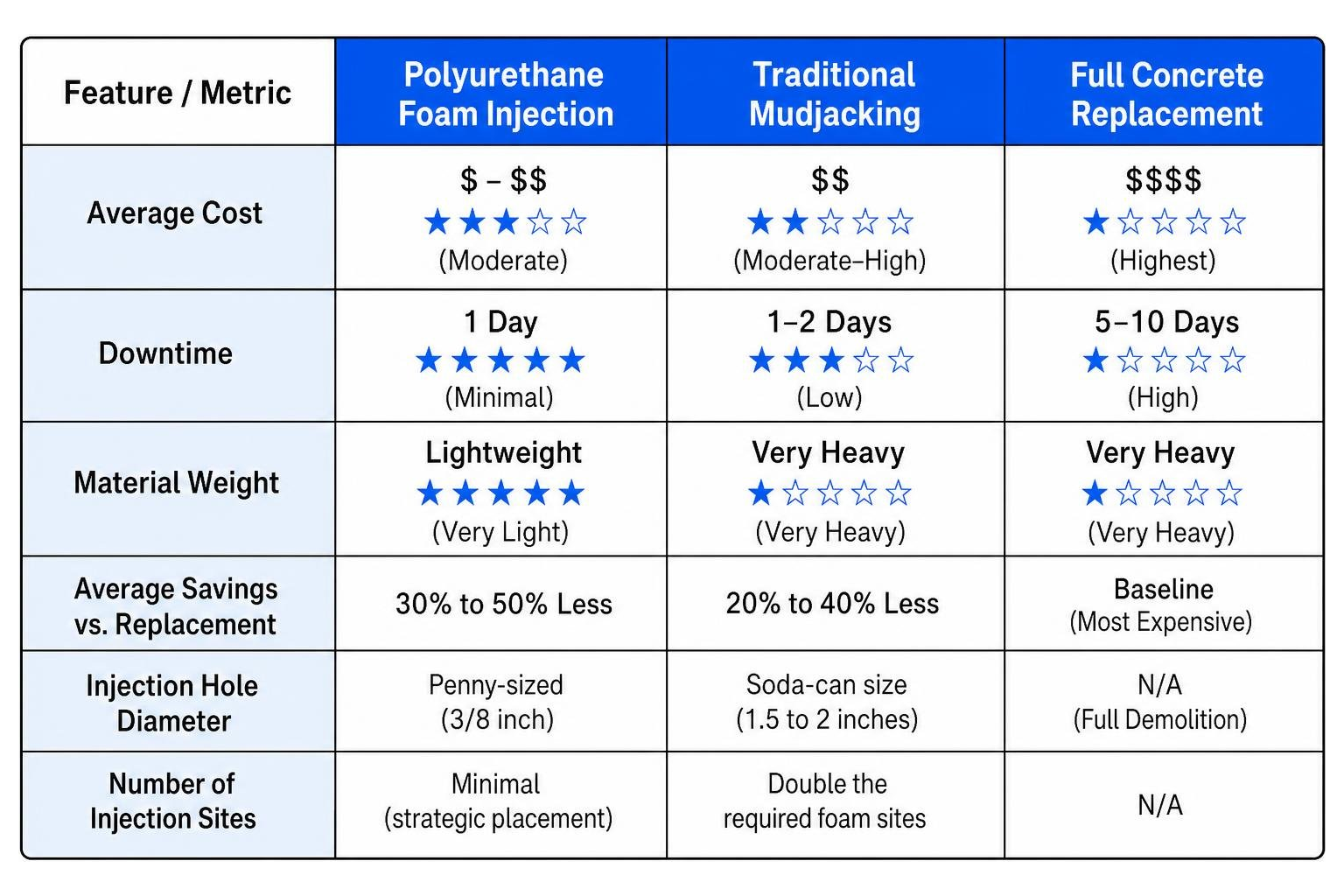
| Feature / Metric | Polyurethane Foam Injection | Traditional Mudjacking | Full Concrete Replacement |
|---|---|---|---|
| Average Savings vs. Replacement | 30% to 50% Less | 20% to 40% Less | Baseline (Most Expensive) |
| Injection Hole Diameter | Penny-sized (3/8 inch) | Soda-can size (1.5 to 2 inches) | N/A (Full Demolition) |
| Number of Injection Sites | Minimal (strategic placement) | Double the required foam sites | N/A |
| Material Weight | Ultra-lightweight (2–4 lbs/cu.ft.) | Heavy slurry (100+ lbs/cu.ft.) | Extremely Heavy |
| Cure Time & Pool Downtime | Ready in 15–30 minutes | 24–48 hours | 28 days for full cure |
| Landscape / Yard Impact | Zero (no heavy equipment) | Moderate (heavy pumps/trucks) | High (excavation, haul-off) |
| Lifespan & Soil Impact | Hydrophobic, won’t wash out | Susceptible to water washout | Depends on new soil base |
To learn more about how contractors address these options across different properties, review these key insights on sinking pool deck repair options.
How to Fix a Sinking Pool Deck Using Polyurethane Foam Injection
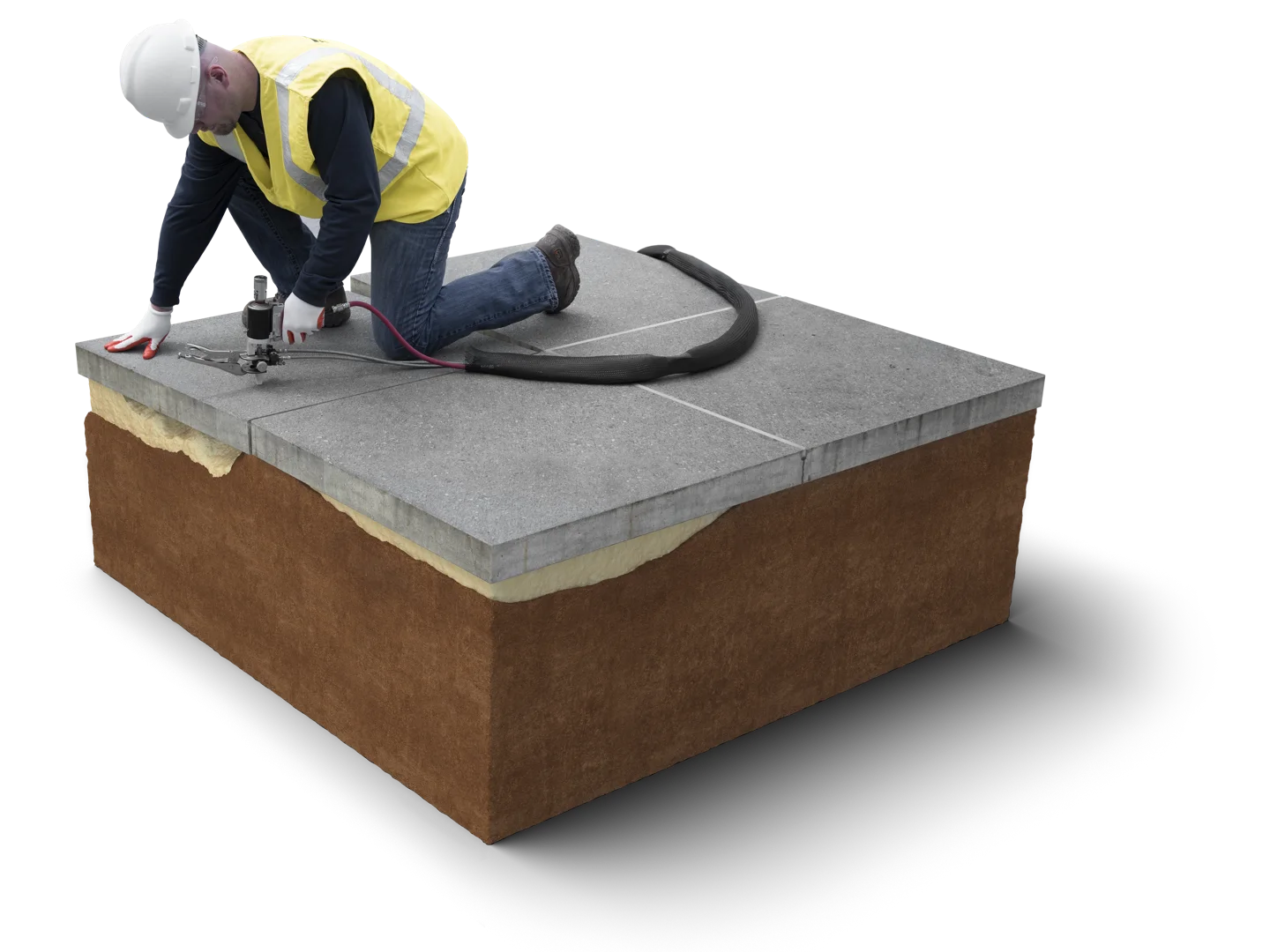
High-density polyurethane foam injection—often called foam jacking or polyjacking—is the gold standard for raising sunken pool decks. Through our specialized Foam Injection Leveling process, high-strength structural polymer is injected underneath the dropped slab.
The process follows a clean, highly controlled sequence:
- Inspection and Drilling: Technicians drill small, 3/8-inch holes—about the size of a penny—through the affected concrete slab at key injection points.
- Foam Injection: High-density closed-cell polyurethane liquid is pumped through specialized ports into the voids below.
- Expansion and Lifting: Within 5 to 15 seconds, the liquid components react, expanding up to 15 times their original volume. As the expansion occurs, the powerful foam compresses loose sub-soil and gently hydraulic-lifts the heavy concrete slab back to its precise original height.
- Patching and Cleanup: The injection ports are removed, and the penny-sized holes are patched with color-matched grout that blends seamlessly into your existing pool deck finish.
Because our closed-cell polyurethane material is completely hydrophobic (waterproof), it acts as an underground moisture barrier. It will never erode, wash away, or decompose, making it an ideal choice for wet pool environments. Explore our comprehensive Pool Deck Repair services to see how this process protects your outdoor living space.
Mudjacking vs. Foam Jacking vs. Full Concrete Replacement
When evaluating how to fix a sinking pool deck, many homeowners ask why modern polyurethane foam lifting has largely replaced traditional mudjacking and concrete replacement.
Mudjacking Disadvantages Around Swimming Pools
Mudjacking involves pumping a wet slurry of sand, cement, water, and topsoil under the slab. While it was once the industry standard, it suffers from severe drawbacks near swimming pools:
- Excessive Weight: Mudjacking slurry weighs roughly 100 to 120 pounds per cubic foot. Injecting hundreds of pounds of heavy mud onto sub-soil that has already proven weak often leads to secondary settlement.
- Large, Unslightly Holes: Mudjacking requires drilling large holes (1.5 to 2 inches wide)—roughly the size of a soda can. Drilled around delicate pool coping, these large patches look unsightly and mar decorative pool concrete.
- Vulnerability to Erosion: Because the mudjacking slurry is sand- and soil-based, splash-out pool water or groundwater leaks can re-erode the material over time, recreating the very voids you paid to fix.
Full Concrete Replacement Disadvantages
Demolishing and re-pouring a pool deck should always be a last resort, saved only for concrete that is completely crumbling, structurally shattered, or physically disintegrating.
- High Cost: Demolition, jackhammering, hauling, concrete delivery, and labor make full replacement twice as expensive as foam injection.
- Extensive Property Damage: Heavy machinery driving across your lawn can ruin landscaping, crack nearby pavers, and destroy irrigation lines.
- Long Downtime: New concrete takes up to 28 days to cure fully, leaving your swimming pool unusable during peak summer months.
- Risk of Repeat Settlement: Replacing the surface slab does not solve underlying soil compaction issues. Unless the excavated soil is perfectly compacted, new concrete decks often sink all over again within a few years.
By choosing lightweight foam injection via our Concrete Leveling services, you stabilize the sub-soil while avoiding the extreme expense and hassle of full slab replacement.
DIY Remedies vs. Professional Methods: How to Fix a Sinking Pool Deck Safely
With home improvement tutorials widely accessible online, some homeowners wonder if they can fix a sinking deck themselves using off-the-shelf aerosol spray foam, expanding cans, or dry sand packing.
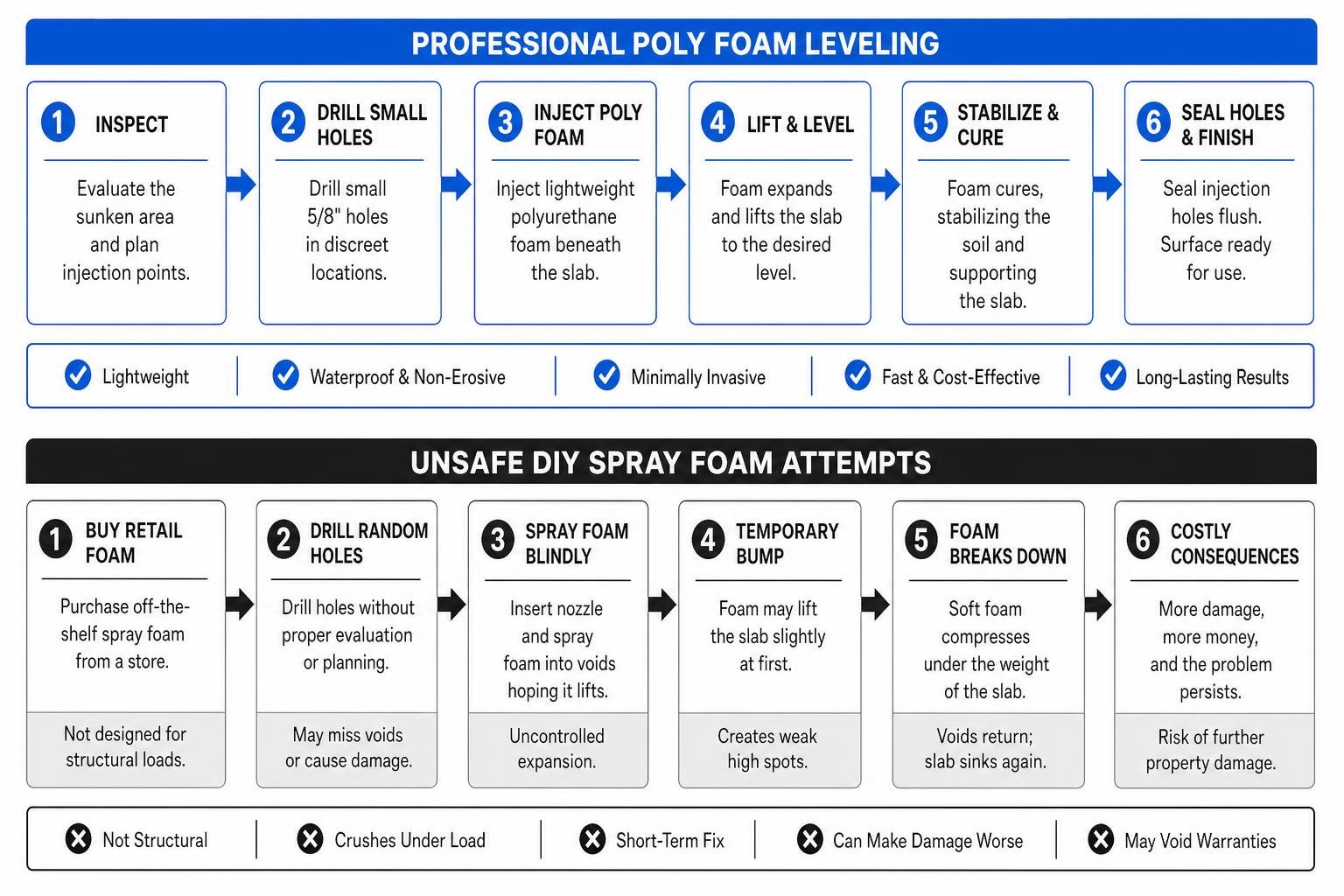
While low-cost DIY options sound tempting, using retail expanding foam under a multi-ton concrete pool slab is extremely hazardous. For a visual comparison of these risks, watch this video on How To Fix A Sunken Pool Deck With Spray Foam.
Here is why DIY spray foam methods fail:
- Lacks Structural Compressive Strength: Canned expanding spray foams purchased at local hardware stores are soft, open-cell or light closed-cell formulations designed for insulating windows and filling minor air gaps. They lack structural density. Under the tremendous weight of a 4-inch concrete slab (roughly 50 lbs per square foot), retail foam immediately crushes, collapses, and flattens out.
- Non-Controlled Expansion Risks: Professional polyurethane lifting equipment relies on dual-component chemical reactions controlled by precise temperature, pressure, and volume gauges. Hand-dispensed aerosol cans provide zero volume control, which can result in uneven lifting or trapped air pockets.
- Inability to Compress Sub-Base Earth: Structural poly foam used by professionals generates up to 100 PSI of lifting force, compressing loose dirt and filling micro-voids simultaneously. Off-the-shelf spray foam lacks the pressure required to move dirt or raise heavy concrete.
- Temporary Dry Sand Packing: Some DIY enthusiasts try shoveling dry sand or gravel into visible voids at the slab edge. While this may temporarily block pest entry, it cannot lift settled slabs, and rain or pool splash-out will quickly wash uncompacted sand away.
Attempting to lift heavy concrete slabs yourself without professional hydraulic equipment poses a serious risk of structural cracking, injury, or catastrophic slab collapse.
Cost, Timeline, and Preventing Future Pool Deck Settlement
Understanding project costs, timeline expectations, and long-term preventative care will help you plan your repair project effectively.
Average Repair Costs and Project Timelines
When evaluating how to fix a sinking pool deck, cost savings is one of the biggest benefits of choosing polyurethane foam injection over traditional tear-out.
At FoamWorks Concrete Leveling, our polyurethane foam injection repairs cost 30% to 50% less than full tear-out and replacement. Because there is no need for heavy excavation, heavy machinery, or haul-off disposal fees, labor costs are dramatically reduced.
- Typical Leveling Investment: Professional foam jacking for a typical residential pool deck area often ranges between $1,200 and $3,500 depending on the size of the void, total square footage, and soil conditions.
- Expansion Joint Caulking: Properly sealing expansion joints and pool coping gap perimeters typically costs between $500 and $1,200, protecting your investment for years to come.
- Rapid Completion: While tearing out and pouring fresh concrete shuts down your pool area for weeks, most polyurethane foam injection projects are completed in as little as 45 minutes to a few hours.
- Zero Pool Downtime: Because closed-cell foam cures to 90% of its full compressive strength in just 15 minutes, your pool deck is ready for foot traffic, outdoor furniture, and summer fun almost immediately.
Read our real-world project spotlight on Patio and Pool Deck Repair in Sylvania OH to see how quickly local pool decks can be transformed.
Long-Term Settlement Prevention: Water Infiltration Control and Joint Sealing
Lifting your pool deck back to perfect level is only half the battle. To keep it level permanently, you must prevent water from entering the sub-base soil.
When pool water splashes over the edge, or when rain falls, water naturally flows toward low points and open cracks. If your expansion joints (the gaps engineered between individual concrete slabs and around the pool coping) are unsealed or filled with cracked, degraded caulk, water streams down beneath the deck, re-igniting soil erosion and freeze-thaw settlement.
To prevent future movement, we recommend a two-step protection plan:
- Professional Joint Caulking: Injecting high-grade, commercial polyurethane joint sealant into all expansion joints and coping gaps blocks water from reaching the sub-soil foundation.
- Surface Hydrophobic Sealing: Applying a penetrating Concrete Sealant protects the concrete surface from moisture absorption, salt damage, and freeze-thaw flaking.
For project examples on sealing coping joints and patio boundaries, check out our guide on Sealing Joints on Patio and Around Pool Coping in Sylvania OH, as well as our case study on a Pool Deck Leveled and Sealed in Toledo OH.
In addition, consider checking out this helpful resource on Pool Deck Sinking On One Side to diagnose single-sided deck drops caused by localized surface runoff.
Frequently Asked Questions About Sinking Pool Decks
Is a sinking pool deck an immediate safety hazard?
Yes, a sinking pool deck is an immediate safety concern that requires prompt attention.
First, concrete edges sticking up even 1/2 inch create severe trip hazards for barefoot swimmers, leading to stubbed toes, falls, or head injuries near the water’s edge. Second, as a deck drops, it puts intense stress on pool coping, skimmer boxes, and underground return plumbing lines. Left unaddressed, a sinking slab can snap subterranean PVC pipes, leading to costly pool structural leaks.
Will polyurethane foam injection prevent future sinking permanently?
Polyurethane foam injection provides a extremely durable, long-lasting solution because the structural polymer material itself will never degrade, erode, or absorb water underground. It fills every hidden void and compresses weak loose soil beneath the slab.
However, foam injection fixes the sub-base void—it cannot stop new water from entering if roof downspouts, broken plumbing lines, or unsealed expansion joints continue dumping water into your yard. As long as pool expansion joints are properly caulked with high-grade sealant and perimeter drainage is maintained, foam-injected pool decks remain stable for decades. That is why FoamWorks Concrete Leveling backs our slab lifting with a lifetime warranty.
Can I use retail expanding spray foam to raise my sunken pool deck?
No, you should never use retail expanding spray foam from a hardware store to lift structural concrete. Canned spray foam is designed solely for filling low-pressure air gaps around window frames and home insulation projects. It completely lacks the density and compressive force necessary to support thousands of pounds of heavy concrete slab. Under slab loads, consumer spray foam immediately crushes into a thin flat layer, wasting your time and money. Professional concrete leveling requires industrial-grade, dual-component high-density polyurethane structural foam applied with specialized high-pressure equipment.
Conclusion
A sunken pool deck is frustrating, but fixing it does not have to ruin your summer budget or destroy your backyard landscaping. Knowing how to fix a sinking pool deck with modern high-density polyurethane foam injection gives you a fast, long-lasting solution at a fraction of the cost of full concrete replacement.
At FoamWorks Concrete Leveling, we are a family-owned concrete repair and leveling contractor serving communities across Northwest Ohio, Southeast Michigan, and Northeast Indiana—including Toledo, Perrysburg, Sylvania, Fremont, Bowling Green, and Convoy in Ohio; Adrian, Monroe, Ann Arbor, and Saline in Michigan; and Fort Wayne and Angola in Indiana.
With over 30 years of combined concrete repair experience, we take pride in delivering 100% customer satisfaction, fast single-day turnarounds, and a lifetime warranty on our concrete leveling work. Our high-density polyurethane foam injection repairs your sunken pool deck for 30% to 50% less than full replacement, keeping your pool deck level, safe, and beautiful for decades to come.
Ready to restore safety and beauty to your pool area? Visit our page on Pool Deck Repair Services or contact our friendly team today to claim your Free Estimate.