

A Fast, Practical Way to Level a Sunken Concrete Stoop
Stoop leveling raises an intact but sunken concrete entryway by filling the void beneath it and bringing the steps back to a safe, stable position. Start by checking for gaps at the threshold, tilted steps, pooling water, or a trip edge. Then correct the drainage or soil problem that caused the settlement before lifting the concrete.
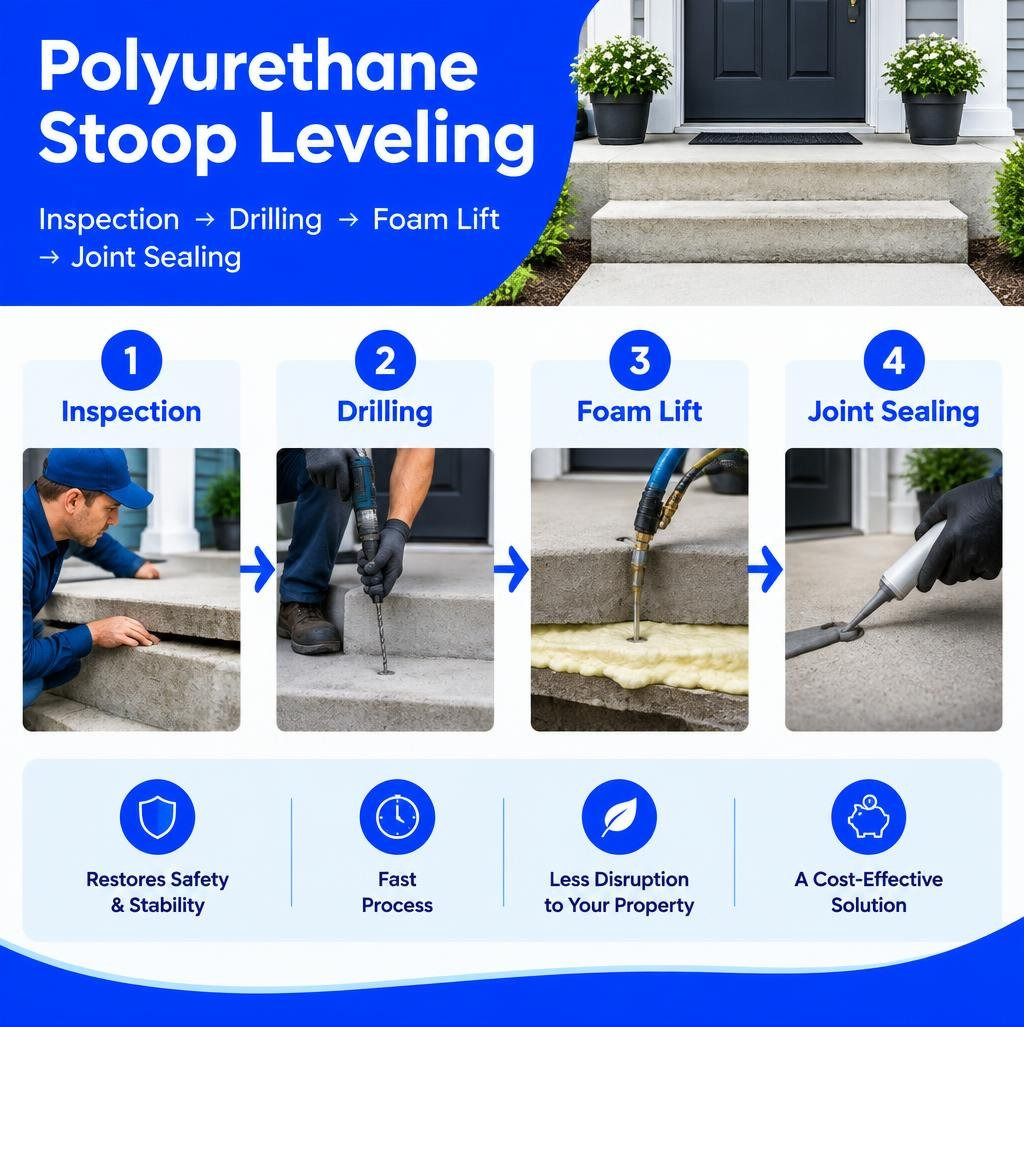
For many sound stoops, polyurethane foam injection is the modern repair option. A technician drills small access holes, injects expanding high-density foam beneath the concrete, monitors the lift, and patches the holes. The process usually takes a few hours, and the steps can often be used almost immediately.
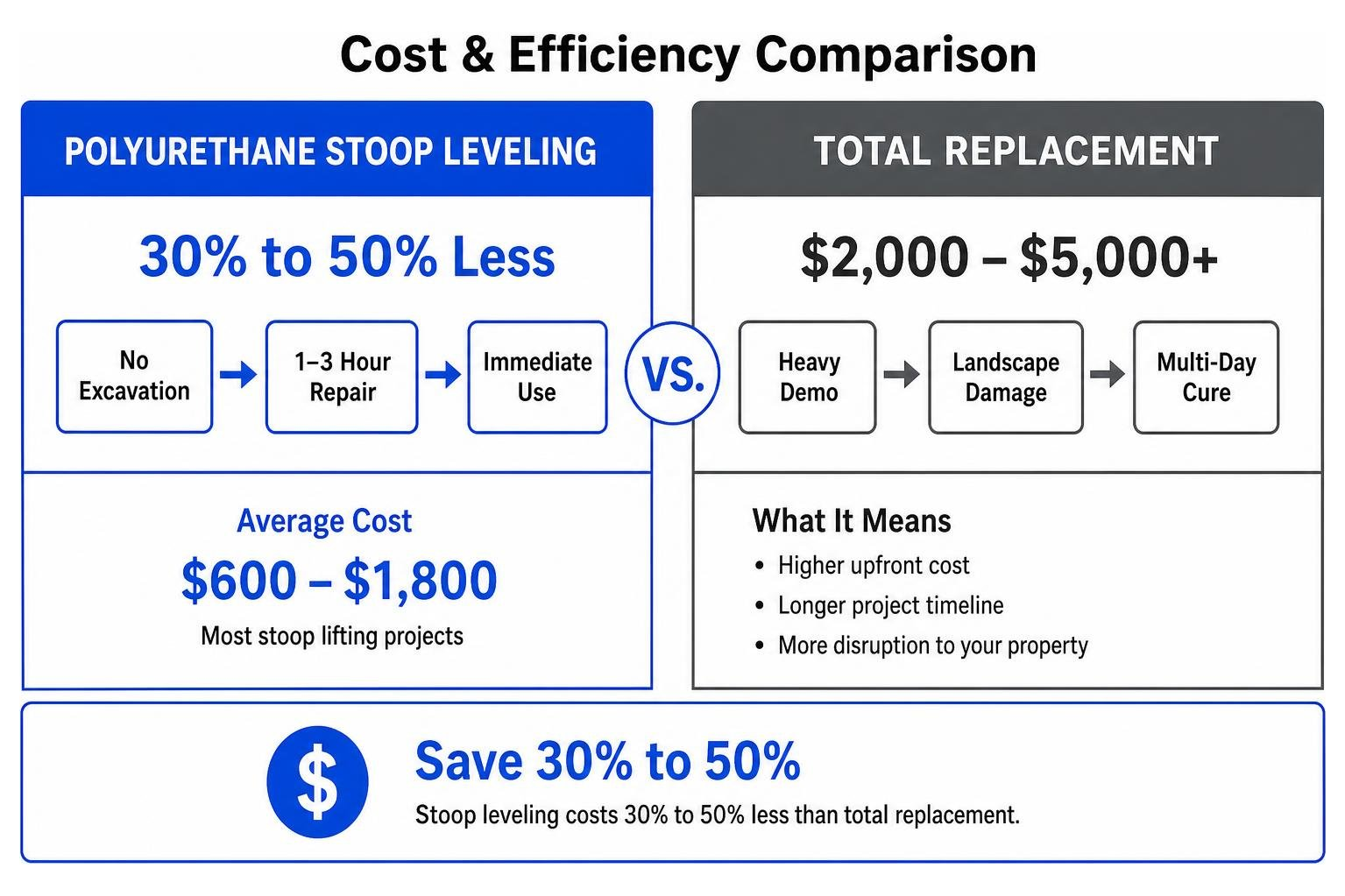
Compared with tear-out and replacement, FoamWorks Concrete Leveling uses polyurethane foam injection to repair sunken or uneven concrete for 30% to 50% less, while avoiding major excavation, landscape damage, and disposal costs.
I am Trey McNamee, owner of FoamWorks Concrete Leveling. With more than two decades of experience in building-material marketing, strategy, and product development, plus FoamWorks’ hands-on concrete repair experience, I help homeowners understand when stoop leveling is the right long-term fix.
Similar topics to stoop leveling:
Signs and Root Causes of a Sinking Front Stoop
When a front stoop begins to sink, it rarely happens overnight. Settlement usually occurs gradually as the supporting base shifts beneath the structure. Recognizing the warning signs early makes it easier to protect your home’s entryway and foundation before severe misalignment takes place.
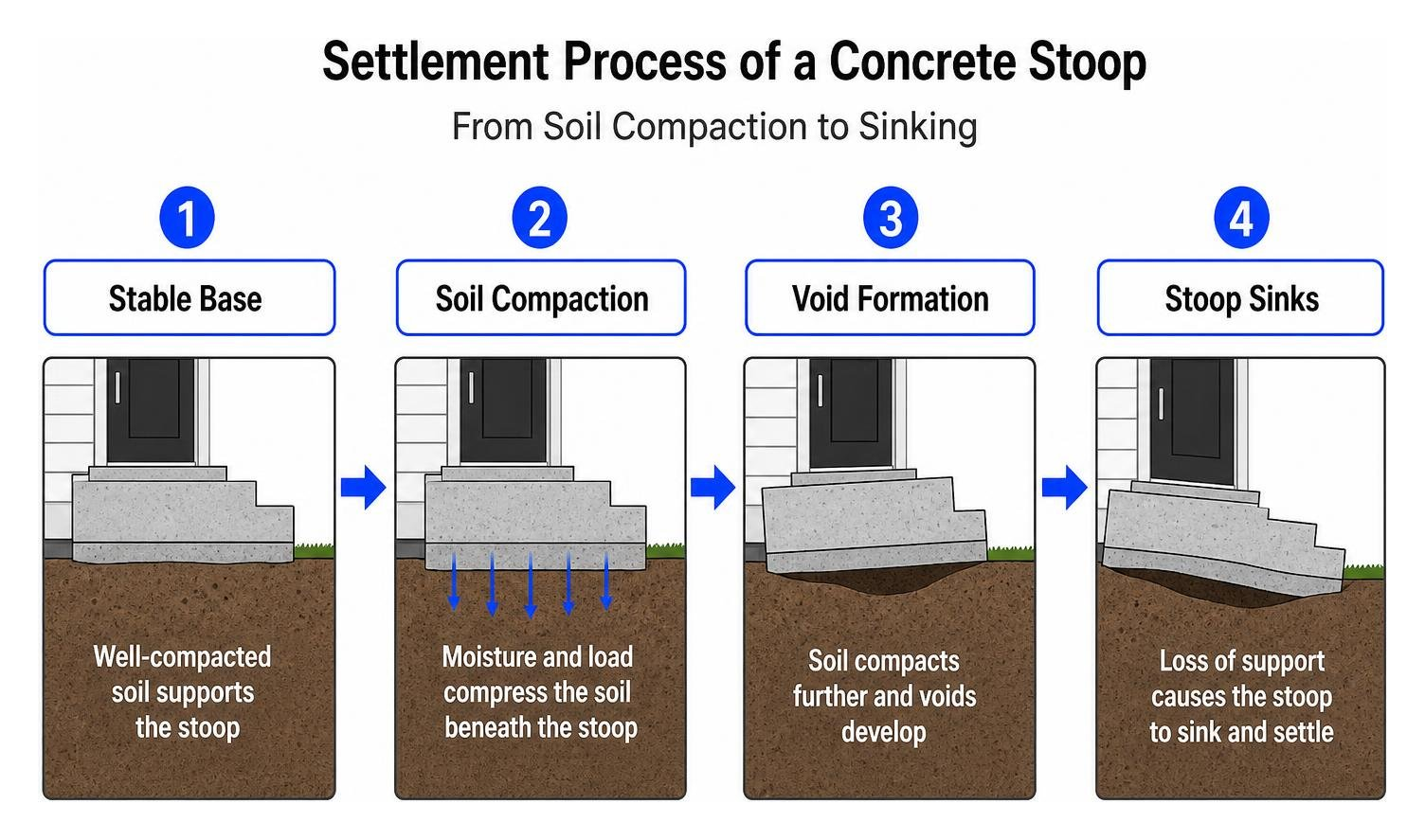
Understanding why your front steps move starts with looking at both the surface symptoms and what is happening below grade. Taking action early by raising sinking concrete steps prevents moisture from entering your home and keeps small trips from turning into major injuries.
Warning Signs of Stoop Settlement and Safety Hazards
Stoop movement produces distinct physical cues around your front door. The most common indicators include:
- Visible Gaps Under the Threshold: A growing gap between the bottom of the front door frame and the concrete landing pad.
- Tilted or Sloping Treads: Steps that angle downward toward the lawn or tilt back toward the foundation walls.
- Caulking and Siding Separation: Ripped expansion joint caulking or siding pulling away from the concrete structure.
- Sticking Entry Doors: Door frames warping out of square because the sinking mass pulls on adjacent framing or exterior walls.
- Water Pooling: Rainwater collecting against the house instead of running off naturally toward the lawn.
- Cracking Mortar and Masonry: Fractures running through adjacent brick veneer, siding joints, or nearby basement walls.
Left unaddressed, these issues create dangerous trip hazards for guests and delivery drivers, leaving homeowners vulnerable to liability concerns.
Soil Erosion, Backfill Consolidation, and Drainage Failures
Concrete stoops are exceptionally heavy, often weighing thousands of pounds. They rely entirely on the soil beneath them for structural support. In our service areas across Northwest Ohio, Southeast Michigan, and Northeast Indiana, several soil dynamics cause stoops to settle:
- Uncompacted Backfill Consolidation: When a home is built, excavators dig out the foundation and backfill loose soil around the exterior basement walls. If this backfill is not mechanically compacted in dense lifts, it naturally consolidates over decades. As the soil settles, it leaves hollow voids directly beneath the stoop.
- Improper Downspout Drainage: Gutter downspouts that discharge within a few feet of the front steps saturate the foundation soil. The rush of water washes away fine sand and silt particles, eroding the supporting base.
- Severe Freeze-Thaw Cycling: Northern winters bring dozens of deep freeze-thaw cycles every season. Saturated soils expand when frozen, heaving concrete upward, and then collapse unevenly during spring thaws, leaving unsupported gaps under the slab.
- Drying and Soil Shrinkage: Hot summer spells dry out native clay soils, causing them to shrink and pull away from the underside of the concrete landing.
Comparing Modern Stoop Leveling Methods: Foam vs. Mudjacking vs. Resurfacing
When faced with an uneven stoop, homeowners generally evaluate three primary repair options: polyurethane foam injection, traditional mudjacking, and surface resurfacing overlays.
| Feature / Metric | Polyurethane Foam Injection | Traditional Mudjacking | Surface Resurfacing / Overlays | Full Concrete Replacement |
|---|---|---|---|---|
| Primary Mechanism | High-density expanding structural polymer | Heavy sand, water, and cement slurry | Thin topical mortar skim coat | Demolition and newly poured concrete |
| Drill Hole Size | 5/8-inch (dime-sized) | 1.5 to 2 inches (soda can base) | No holes (surface prep only) | Complete tear-out |
| Added Sub-base Weight | 3 to 5 lbs per cubic foot | 100 to 120 lbs per cubic foot | Minimal (adds weight to top) | Massive structural mass |
| Cure & Usability Time | Walkable immediately (15–30 min) | 24 to 48 hours | 24 to 72 hours for full cure | 3 to 7 days before full use |
| Moisture Resistance | 100% waterproof; will not wash away | Can erode from subsurface water | Vulnerable to freeze-thaw flaking | Standard concrete durability |
| Relative Cost Savings | 30% to 50% less than replacement | 30% to 50% less than replacement | Low material cost; short-term fix | Full retail expense ($2,000–$5,000+) |
Polyurethane High-Density Foam Injection
High-density polyurethane foam represents the standard in modern concrete lifting. We drill precise 5/8-inch holes through the stoop slab and inject a specialized two-part liquid polymer.
Beneath the slab, the liquid expands 20 to 30 times its initial volume within seconds. As it expands, it fills hidden voids, compacts weak sub-base soil, and generates lifting force to raise the stoop back to its original position.
Homeowners interested in the science behind the process can explore how polyurethane foam lifting works beneath settling slabs. Because the cured foam is closed-cell and hydrophobic, it resists moisture, will not wash away during heavy rain, and adds minimal weight to sensitive sub-soils.
Traditional Mudjacking Slurry
Mudjacking is an older leveling technique that uses a heavy slurry composed of water, topsoil, sand, and Portland cement. Technicians pump this mixture under the slab using hydraulic pressure.
While mudjacking can lift heavy structures, it carries notable drawbacks:
- It requires large injection holes (up to 2 inches in diameter) that leave noticeable circular patches across your entryway.
- The slurry mixture weighs 100 to 120 pounds per cubic foot, adding considerable dead weight onto the uncompacted soil that failed in the first place.
- Because it is cement- and soil-based, water from downspouts or winter run-off can break down the slurry over time, leading to re-settlement.
Surface Resurfacing and Polymer Overlays
When an entryway looks uneven or develops shallow low spots, some homeowners attempt to level the surface using self-leveling compounds or skim-coat mortars. While following the specifications for polymer-modified repair mortars can successfully restore surface texture, resurfacing does not solve structural settlement.
Applying a topical compound adds weight to an already sinking slab without addressing the void beneath it. If the soil continues to consolidate, the underlying concrete will drop further, cracking the thin mortar overlay right along with it.
Step-by-Step How-To: The Concrete Stoop Leveling Process
Leveling a sunken concrete stoop requires careful alignment to protect your home’s exterior cladding and ensure proper water drainage away from the foundation.
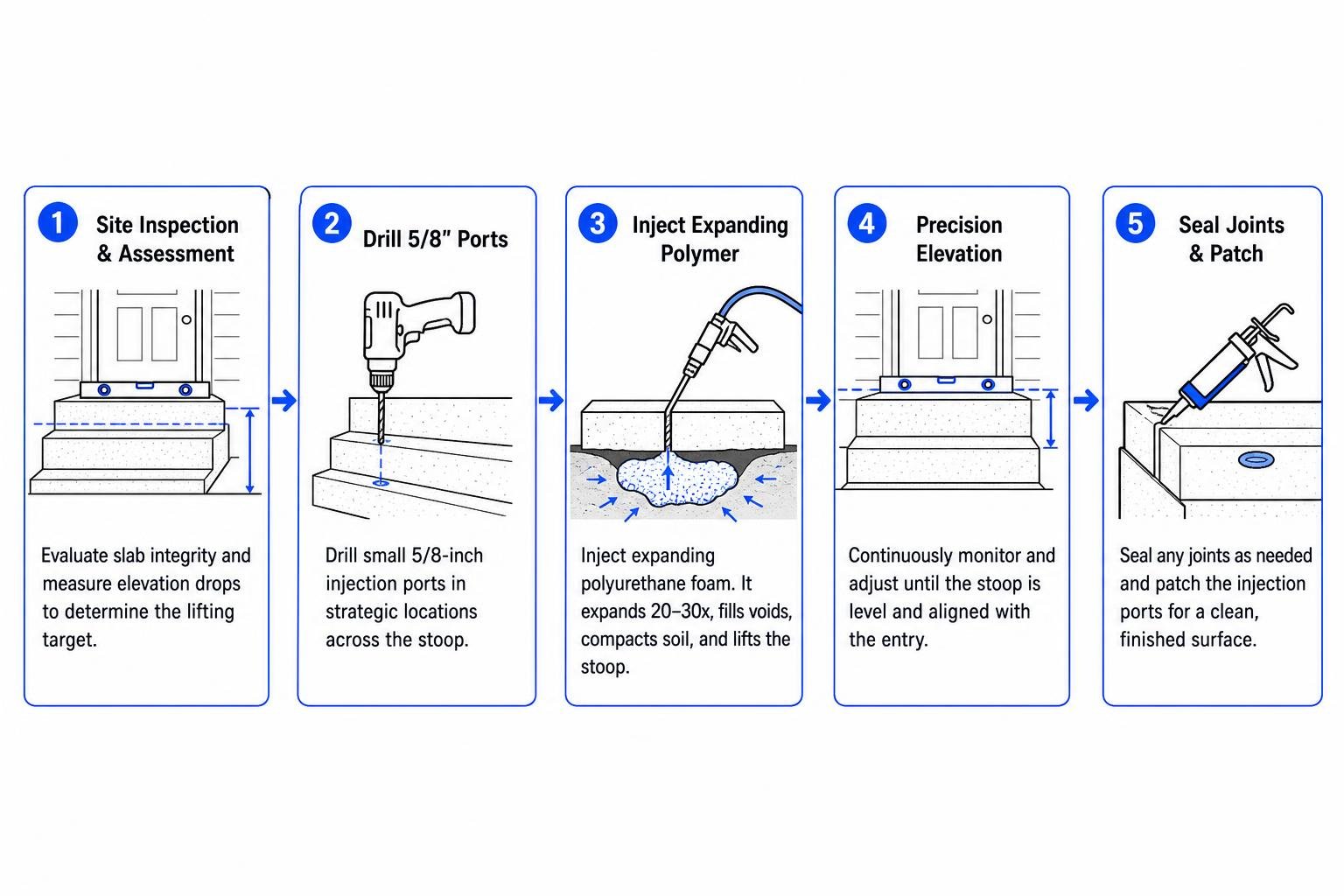
Step 1: Site Inspection and Structural Assessment
Every leveling project begins with a detailed evaluation of the entryway:
- Assessing Slab Integrity: We examine the concrete steps for structural fractures, deep spalling, or separation at the foundation wall.
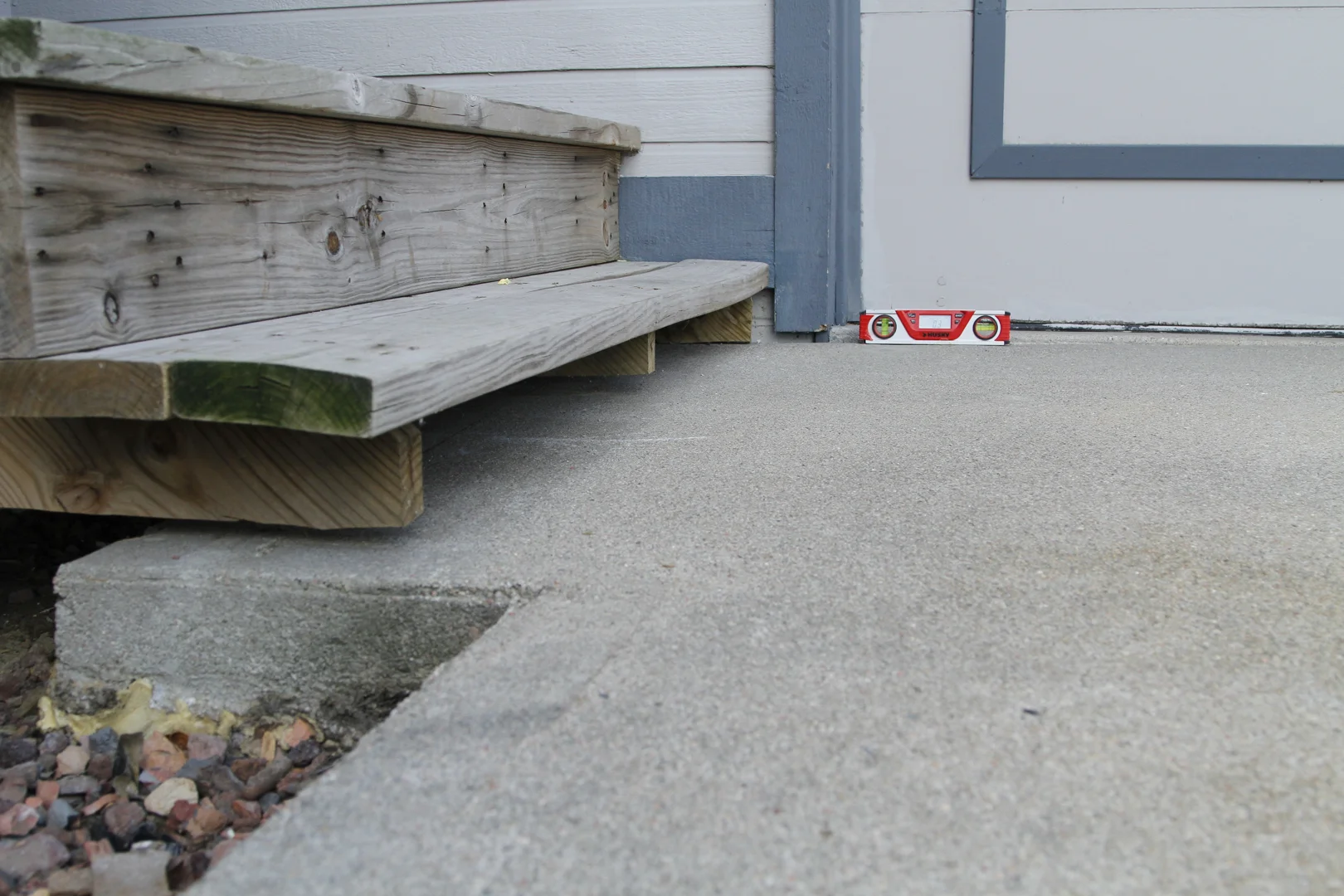
- Measuring Elevation Drops: Using precision levels, we measure the drop at the door threshold and check cross-slopes to determine the exact lifting target.
- Locating Subsurface Voids: We check the perimeter for soil washouts, animal burrowing, or disconnected downspout lines contributing to the settlement.
Step 2: Sub-Slab Injection Port Drilling and Foam Application
Once the scope of the lift is established, installation begins:
- Drilling Access Ports: We drill 5/8-inch ports in strategic locations across the stoop landing and lower treads. These holes are roughly the diameter of a penny and minimize any visual impact.
- Connecting Injection Equipment: Specialized mechanical injection ports are seated into the holes.
- Controlled Polymer Injection: We inject the two-part polyurethane material beneath the concrete in controlled bursts. The liquid flows into open voids under the structure before rapidly expanding.
- Monitoring the Lift: A technician monitors digital levels and the threshold reveal in real time, lifting the stoop millimeter by millimeter until it sits flush and pitches slightly away from the home for positive drainage.
Step 3: Void Filling, Joint Sealing, and Port Grouting
The final phase locks out future moisture:
- Sub-slab Void Consolidation: The foam fills subterranean gaps, creating a high-density, waterproof barrier that supports the entire weight of the concrete steps.
- Port Grouting: Injection ports are removed, and each 5/8-inch hole is filled flush with color-matched concrete grout.
- Joint and Crack Weatherproofing: We seal the critical expansion joint where the stoop meets the house, along with any existing surface cracks, using high-performance polyurethane sealant. This step prevents surface runoff from draining beneath the steps in future seasons.
Cost Comparison: Stoop Lifting vs. Total Replacement
When a concrete entryway sinks, homeowners often wonder whether they should repair the existing structure or completely demolish and repour the steps. Reviewing the considerations of lifting versus rebuilding concrete steps helps clarify the financial and logistical differences.
Average Price Ranges for Stoop Repair
FoamWorks Concrete Leveling uses polyurethane foam injection to repair sunken or uneven concrete for 30% to 50% less than full tear-out and replacement, helping homeowners save significantly on repair costs.
- Polyurethane Leveling: Most settled stoop lifting projects range from $600 to $1,800 depending on the size of the stoop, the amount of void space, and the total lift height required.
- Full Tear-Out and Replacement: Demolishing an existing concrete stoop, hauling away heavy debris, digging new footings, and pouring new steps typically costs between $2,000 and $5,000 or more.
Because there is no need for heavy excavation machinery on your lawn, foam leveling avoids secondary expenses like sod repair, damaged flowerbeds, and landfill disposal fees.
Why Professional Stoop Leveling Outperforms DIY Patches
It is tempting to grab a bag of quick-setting mortar or patch compound from the home improvement store to smooth over a sloping step. However, DIY topical patches cannot address sub-slab soil instability.
- Weight Accumulation: Adding layers of cement patch adds dead weight to a failing subgrade, accelerating the sinking cycle.
- Adhesion Breakdown: Thin feathered edges on concrete patches regularly pop loose during freezing winter weather.
- Structural Integrity: Professional polyurethane injection raises the actual concrete mass from below, supporting the structural load rather than masking the drop.
Building Code Compliance and Ongoing Maintenance
A front door stoop is one of the most strictly regulated structural elements of a home’s exterior due to safety requirements.
International Residential Code (IRC) Requirements for Landings and Risers
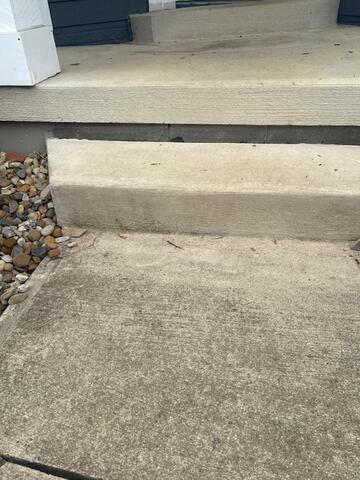
Local municipal building codes generally follow the International Residential Code (IRC Section R311) regarding exterior stairs and landings:
- Landing Dimensions: Exterior door landings must provide a minimum walking surface dimension of 36 inches in the direction of travel and be at least as wide as the exterior door.
- Maximum Riser Height: Step risers cannot exceed 7.75 inches in total vertical height.
- Uniform Step Consistency: The difference between the tallest riser and the shortest riser across a single run of stairs must not exceed 3/8-inch.
- Tread Depth: Step treads must have a minimum depth of 10 inches from front to back.
- Threshold Drops: The landing surface should generally sit no more than 1.5 inches below the top of the door threshold for standard outswinging or inswinging entry configurations.
Following the established guidelines for front stoop building codes and drainage ensures your entryway remains safe and compliant for prospective home buyers and municipal inspectors. Lifting a sunken stoop restores proper riser heights and eliminates step irregularities that violate local safety standards.
Long-Term Longevity and Stoop Leveling Maintenance
A polyurethane foam lift is engineered to provide lasting support for the lifespan of your home when proper surface water management is maintained.
To protect your newly leveled stoop:
- Extend Downspouts: Route downspout extensions at least 4 to 6 feet away from the front steps to prevent soil washout.
- Maintain Joint Seals: Inspect the caulk joint between the stoop and the home foundation annually. Reseal any small separations to keep water from getting beneath the slab.
- Maintain Yard Grading: Ensure adjacent garden beds slope away from the entryway at a minimum pitch of 1/4 inch per foot.
Homeowners with questions regarding seasonal maintenance can consult our comprehensive concrete lifting and leveling FAQ for additional ownership tips.
Frequently Asked Questions About Stoop Leveling
How long does stoop leveling take before I can walk on the steps?
Most stoop leveling projects are completed in just 1 to 3 hours. Because structural polyurethane foam expands and reaches over 90% of its full compressive strength within 15 to 30 minutes of injection, your front steps can be used for normal foot traffic immediately after our crew finishes patching the drill ports.
Will my concrete stoop sink again after being leveled?
High-density polyurethane foam does not degrade underground, wash away from moisture, or lose volume over time. As long as surrounding water issues (like disconnected downspouts or missing gutters) are corrected to stop ongoing subsoil erosion, the lifted stoop will remain stable for the lifetime of the structure.
Can severely cracked or broken stoops be lifted with foam?
Stoops with sound structural slabs that have settled, separated, or tilted can almost always be lifted back into place. However, if the concrete has broken into multiple loose, disconnected fragments or suffers from severe, deep spalling through the entire thickness of the tread, full replacement may be required. A quick on-site inspection determines if the concrete has enough structural integrity for lifting.
Conclusion
A settled or tilting front stoop compromises your home’s curb appeal, creates serious trip hazards, and allows rainwater to collect against your foundation walls. Replacing your entryway steps with a fresh pour is costly, messy, and disrupts your daily routine for days.
Modern high-density polyurethane leveling offers a clean, reliable alternative that restores your steps to their original position in a matter of hours.
FoamWorks Concrete Leveling provides residential and commercial concrete lifting across Northwest Ohio, Southeast Michigan, and Northeast Indiana. With 30+ years of industry experience, a dedicated lifetime warranty, and a commitment to 100% customer satisfaction, our team ensures your front entry is safe, level, and built to last.
Ready to restore your entryway? Contact us today for our expert modern concrete repair and leveling services and schedule your free, no-obligation estimate.