
Concrete Leveling vs Replacement: Which Makes Sense for Your Slab?
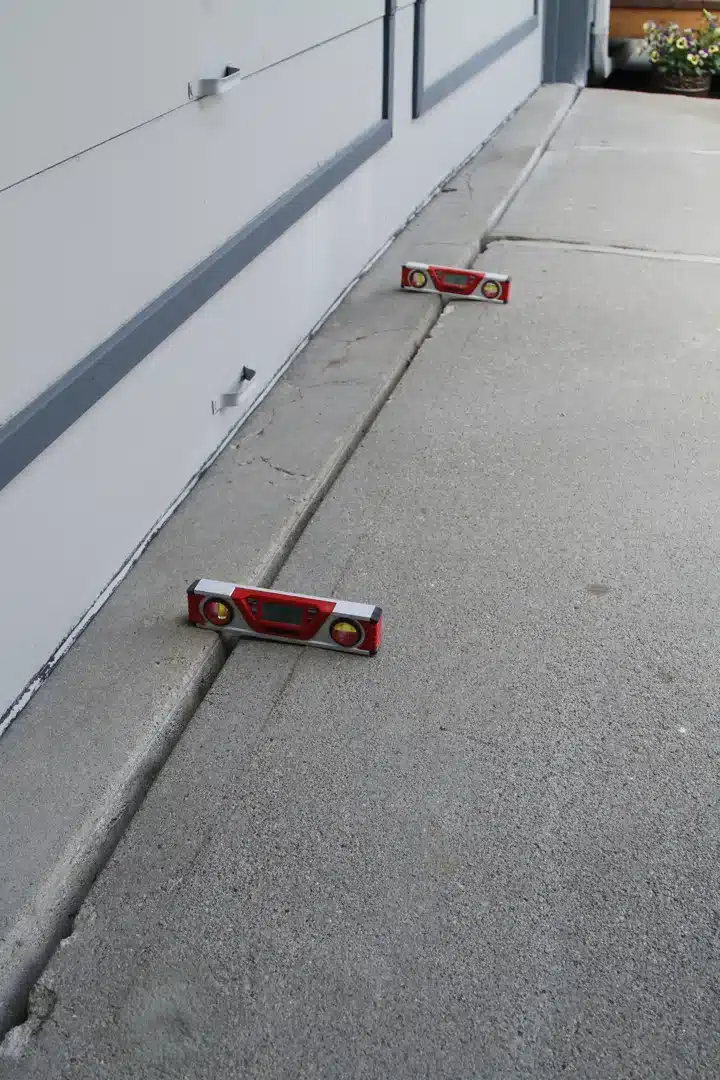
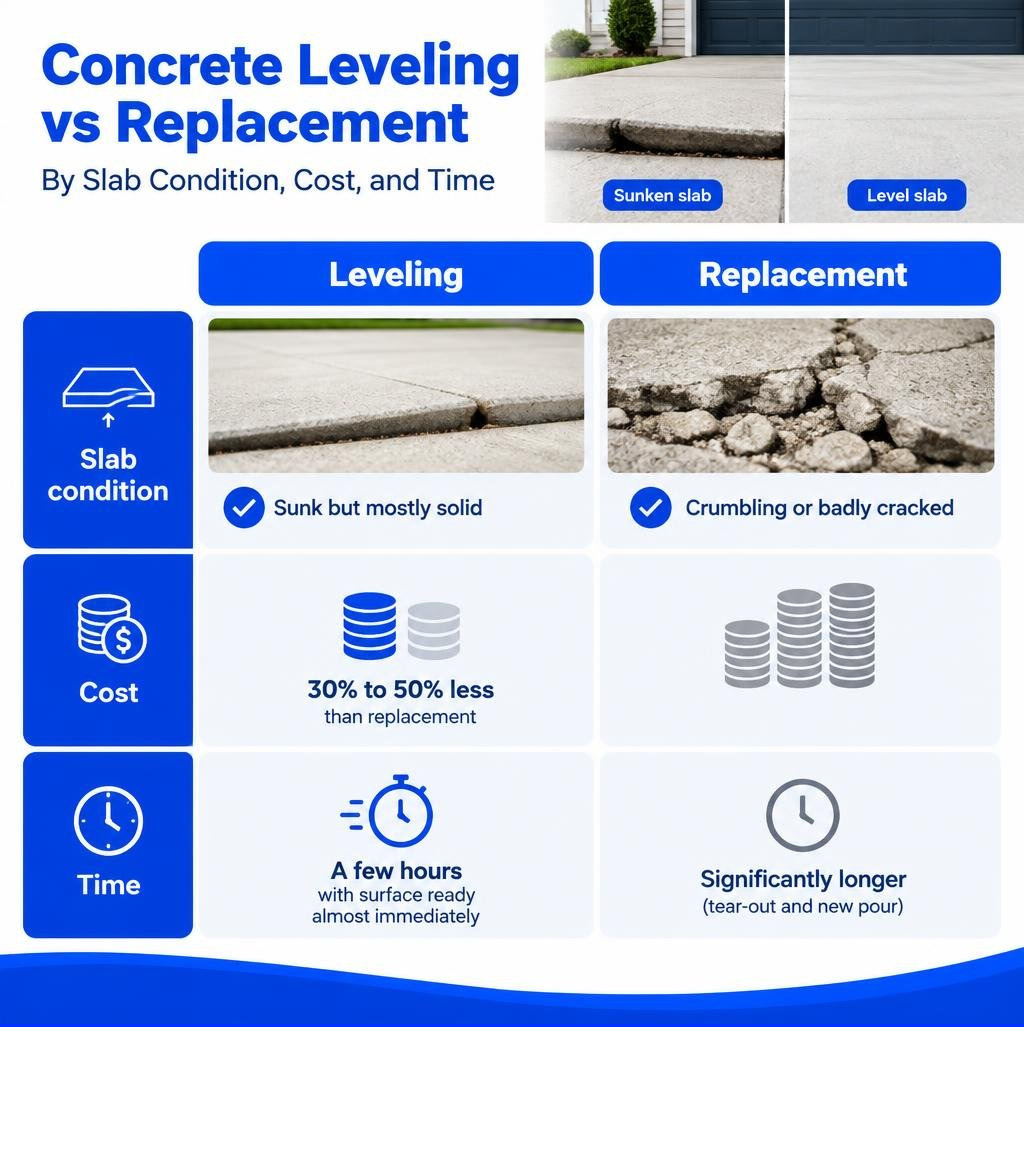
For concrete leveling vs replacement, start with the slab’s condition. If it has sunk but is still mostly solid, leveling can lift it without tearing it out. If the concrete is crumbling or badly cracked, replacement is usually the better choice.
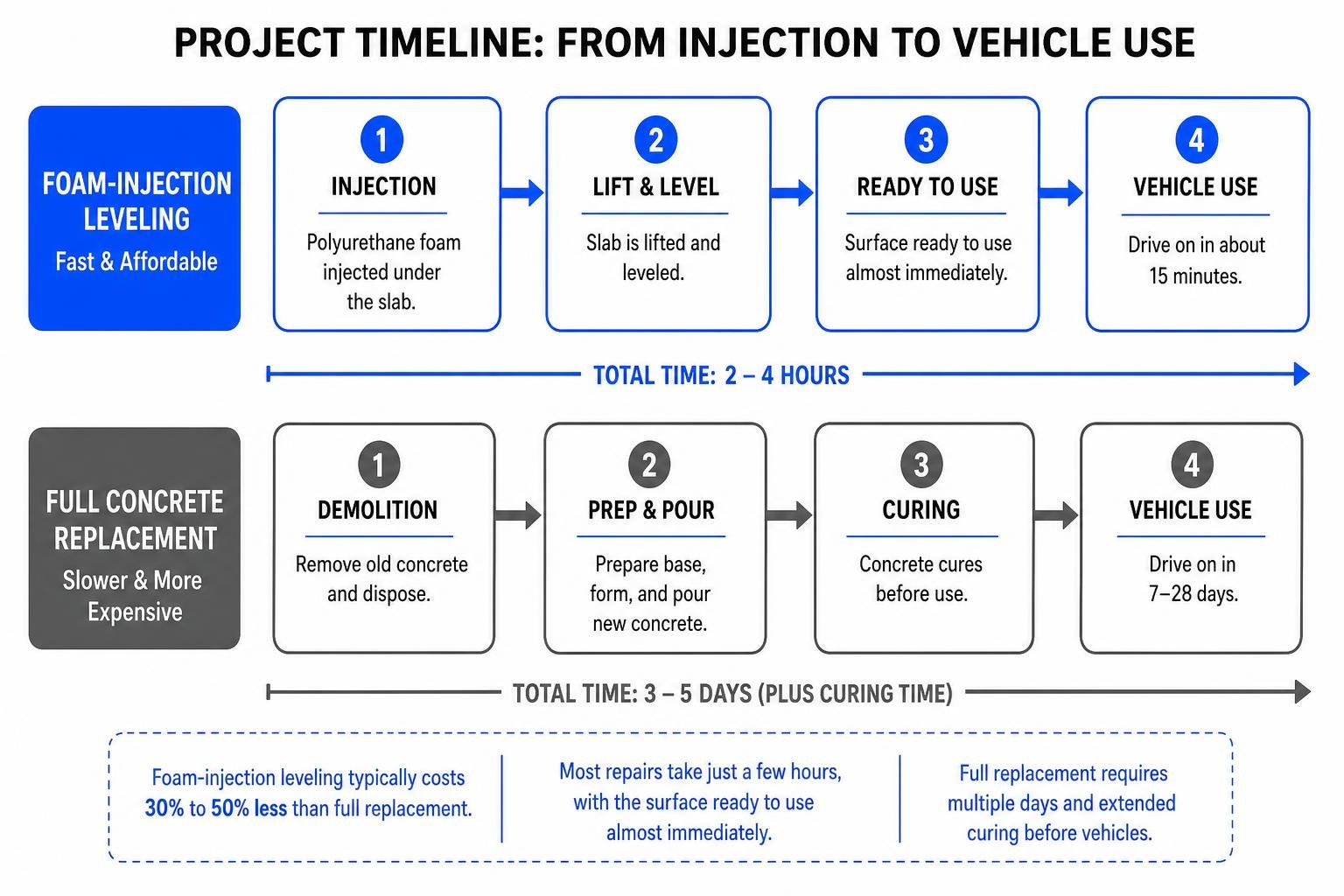
Foam-injection leveling typically costs 30% to 50% less than full tear-out and replacement. Most repairs take just a few hours, with the surface ready to use almost immediately.
I’m Trey McNamee, owner of FoamWorks Concrete Leveling. My background in building materials, strategy, and product development helps me explain concrete leveling vs replacement in practical terms, starting with what your slab needs.
Essential concrete leveling vs replacement terms:
- affordable concrete leveling in NW Ohio
- how concrete lifting and leveling can save your sunken driveways
- the modern homeowner’s guide to how slabs get leveled
Concrete Leveling vs Replacement: Cost Breakdown and ROI
When homeowners discover an uneven walkway, tilting patio, or dipping garage entrance, the immediate worry is often financial. Concrete projects have a reputation for being messy, disruptive, and expensive. However, evaluating the actual numbers reveals that lifting your existing concrete offers substantial return on investment.
Traditional slab replacement involves heavy machinery, jackhammers, demolition crews, dump trucks, framing carpenters, and concrete delivery trucks. The labor alone accounts for a significant portion of the total invoice. Beyond direct labor, you pay for disposal fees at local landfills, permit fees in municipal jurisdictions, and potential landscaping repairs when heavy equipment tears up your yard.
In contrast, modern concrete leveling requires minimal equipment and zero demolition. Professional polyurethane foam injection costs between $3 and $8 per square foot on average, whereas full tear-out and repouring costs $6 to $12 per square foot or more depending on site access and regional material costs. By avoiding the heavy demolition phase, homeowners routinely cut their total expenditure by 30% to 50% or even up to 70% compared to a complete rebuild.
| Factor | Polyurethane Concrete Leveling | Full Concrete Replacement |
|---|---|---|
| Average Cost per Sq. Ft. | $3 – $8 | $6 – $12+ |
| Typical Project Duration | 2 – 4 hours | 3 – 5 days (plus curing time) |
| Usable Time After Work | ~15 minutes | 24–48 hours (foot), 7–28 days (vehicles) |
| Landscape Impact | None to minimal | High (heavy equipment, tire ruts) |
| Noise & Disruption | Minimal (small generator/drill) | High (jackhammers, dump trucks) |
| Lifespan / Durability | 8–10+ years (stabilizes base) | 20–30 years (if base is properly packed) |
For a standard 600-square-foot driveway, full replacement can easily range from $5,400 to $7,200. Professional foam lifting for the same area typically ranges between $3,000 and $4,800, keeping hard-earned money in your pocket while delivering immediate curb appeal.
How Modern Concrete Leveling Methods Work
To understand why concrete sinks in the first place, look beneath the surface. Slabs settle because the underlying soil shifts, erodes, washes out, or consolidates due to poor initial compaction. Water from heavy rain, freeze-thaw cycles, or misdirected downspouts creates voids under the concrete. Once the slab loses continuous support, gravity causes it to drop unevenly.
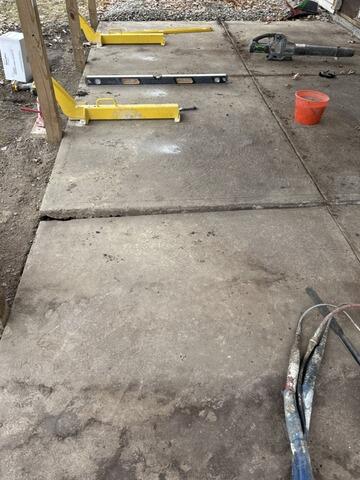
Modern leveling addresses the root cause of the problem by filling those empty voids and restoring uniform support. High-density polyurethane foam represents a modern concrete restoration option. The lightweight polymer expands beneath the slab, filling every hidden pocket before exerting controlled upward hydraulic pressure to gently raise the concrete back into alignment.
The Concrete Leveling vs Replacement Process for Sunken Slabs
The injection process is remarkably clean, accurate, and non-invasive. Understanding what polyurethane concrete leveling involves helps illustrate why it has become the preferred technique:
- Precision Drilling: Small, penny-sized holes (roughly 5/8-inch in diameter) are drilled strategically through the sunken slab.
- Port Installation: Tapered injection ports are set directly into the drilled access holes.
- Controlled Foam Injection: High-density, two-part polyurethane foam is injected beneath the surface. As the liquid components mix, they react and expand rapidly into a rigid, closed-cell structure.
- Targeted Lifting: The expanding foam fills underground voids, compresses loose sub-base materials, and lifts the slab to a precise level alignment with adjacent slabs.
- Patching and Cleanup: The injection ports are removed, and the small holes are patched with color-matched cementitious grout, leaving the surface clean and ready for immediate traffic.
Foam injection uses small entry points that leave virtually invisible patches. Because the foam cures in about 15 minutes, there is zero extended downtime.
Soil Conditions and Long-Term Durability
One major advantage of polyurethane foam is its exceptional resilience across diverse soil types. High-density polyurethane foam weighs only 2 to 4 pounds per cubic foot, lifting thousands of pounds of concrete without overloading fragile sub-grades.
Furthermore, polyurethane is completely hydrophobic. It will not wash away during heavy downpours, nor will it break down when exposed to groundwater. In regions experiencing seasonal freeze-thaw shifts, the cured foam maintains its structural integrity and compressive strength, preventing the expansion and contraction cycles that compromise untreated soil bases. Homeowners seeking modern concrete sinking repair achieve an expected lifespan of 8 to 10+ years—often matching or exceeding the remaining useful life of the concrete itself.
How to Decide Between Leveling and Replacing Your Concrete
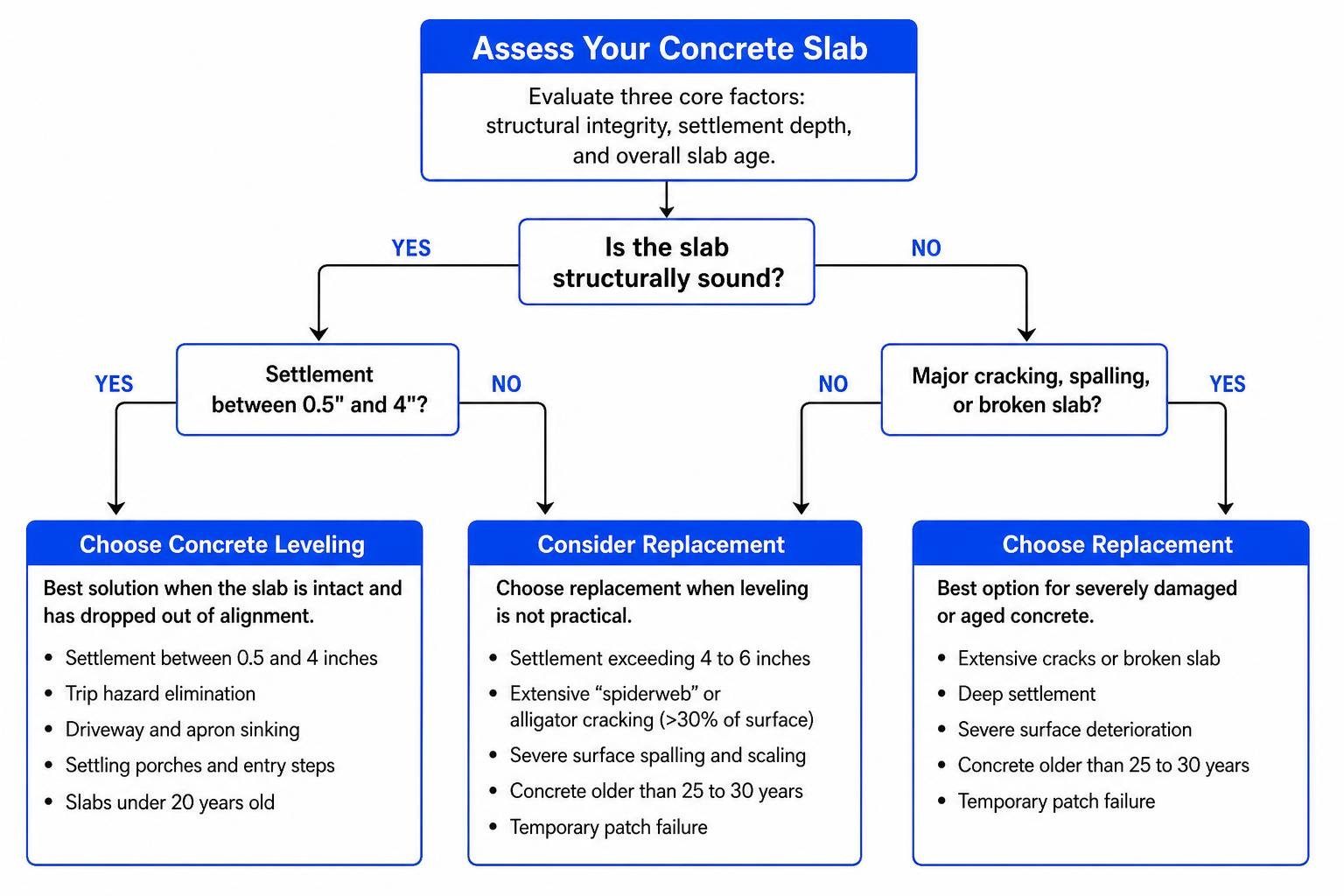
Not every slab is a candidate for lifting, and knowing the difference will protect you from wasting money on the wrong approach. Making an informed choice comes down to evaluating three core factors: structural integrity, settlement depth, and overall slab age.
When Concrete Leveling Is the Best Solution
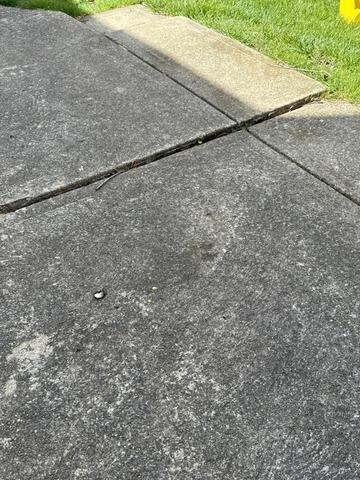
Leveling is the ideal, cost-effective choice when the concrete slab remains fundamentally intact but has dropped out of alignment. Choose leveling for:
- Settlement Between 0.5 and 4 Inches: If a sidewalk panel or patio section has dropped a few inches below the surrounding grade, foam injection can restore it flush with neighboring slabs.
- Trip Hazard Elimination: Sinking walkway joints create liability risks around homes and commercial properties. Leveling restores uniform ADA-compliant transitions without tearing out whole sections.
- Driveway and Apron Sinking: Vehicle vibration and water runoff frequently cause driveway sections to dip near garage thresholds. You can easily protect your vehicle suspension and tires by lifting sunken driveways back to proper pitch.
- Settling Porches and Entry Steps: When front entrance stoops pull away from the house siding, raising settled concrete steps restores safety and prevents water from entering the home foundation.
- Slabs Under 20 Years Old: Concrete that is structurally sound with minimal surface flaking will perform like new once returned to its original grade.
Crucial Factors in Concrete Leveling vs Replacement Decisions
While we always strive to save our customers money by raising their existing slabs, there are distinct situations where leveling is simply not practical. Recognizing these signs helps homeowners invest wisely rather than attempting repairs on compromised material.
Consider full concrete replacement when facing the following conditions:
- Extensive “Spiderweb” or Alligator Cracking: If more than 30% of the slab surface is shattered into small, disconnected fragments, the foam cannot lift the slab as a cohesive unit. Injected foam will simply seep through the cracks without lifting the surface evenly.
- Settlement Exceeding 4 to 6 Inches: Deep settlement often points to severe structural washouts, sinkholes, or major drainage failures that require total sub-base re-excavation.
- Severe Surface Spalling and Scaling: When top layers of concrete flake off due to heavy salt use, improper original curing, or advanced age, leveling will fix the pitch but cannot restore the deteriorated surface finish.
- Concrete Older Than 25 to 30 Years: Concrete has a finite structural lifespan. Slabs exceeding 25 years that show aggregate pop-outs and deep structural fractures should be replaced to ensure long-term safety.
- Temporary Patch Failure: If a slab has been covered in layers of quick-patch cement that are now peeling, homeowners are better served avoiding temporary concrete patches and opting for a permanent solution.
Frequently Asked Questions About Concrete Leveling and Replacement
How much money do you save by leveling concrete instead of replacing it?
Homeowners typically save between 30% and 50%—and often up to 70%—by choosing polyurethane leveling over full replacement. Replacement requires paying for demolition, site disposal fees, formwork, rebar reinforcement, fresh ready-mix delivery, and extended labor. Foam leveling eliminates nearly all of those overhead expenses by utilizing your existing concrete slab.
How quickly can you walk or drive on leveled concrete compared to new concrete?
Polyurethane foam reaches 90% of its full structural rigidity within 15 minutes of injection. You can walk on the leveled surface immediately after our team packs up their gear, and drive vehicles onto it within 30 to 60 minutes. In contrast, freshly poured replacement concrete requires 24 to 48 hours before foot traffic is permitted, and 7 to 28 days of curing before it can withstand the weight of standard passenger vehicles.
Can sinking pool decks and patios be leveled without damaging surrounding structures?
Yes. Pool decks and backyard patios are among the most common leveling applications. Because polyurethane foam is extremely lightweight and non-invasive, it lifts pool aprons smoothly without exerting lateral pressure against delicate pool coping, vinyl liners, or fiberglass shells. Comprehensive concrete repair options that combine foam lifting with elastic joint caulking create a watertight seal that prevents water from eroding pool sub-bases in the future.
Conclusion: Making the Right Investment for Your Slabs
Deciding whether to raise or replace your concrete comes down to assessing the condition of the slab itself. If the concrete is structurally sound but uneven, sinking, or presenting trip hazards, foam injection is the fastest, cleanest, and most budget-friendly solution available. It preserves your existing concrete, saves you thousands of dollars, and eliminates weeks of noisy construction downtime.
At FoamWorks Concrete Leveling, our family-owned team brings over 30 years of industry experience to every project. We specialize in fast, high-density foam injection, precision crack repair, and long-term joint sealing backed by our lifetime warranty and a 100% customer satisfaction guarantee. If you are dealing with a sunken sidewalk, dipping driveway, or uneven patio, contact our team today to schedule your free estimate and discover how easy restoring your concrete can be.