

Find the Right Local Concrete Company for Your Project
Dealing with a sunken driveway, patio, or sidewalk? Ask a local repair contractor whether leveling can save the slab before you pay thousands to tear it out and replace it. Always compare written estimates, check insurance and any required license, and read the warranty terms.
I’m Trey McNamee, owner of FoamWorks Concrete Leveling, and I help homeowners searching for a concrete company near me weigh repair against replacement. I bring more than 20 years of building-materials marketing and product development experience at Owens Corning; the checklist below is a simple place to start.
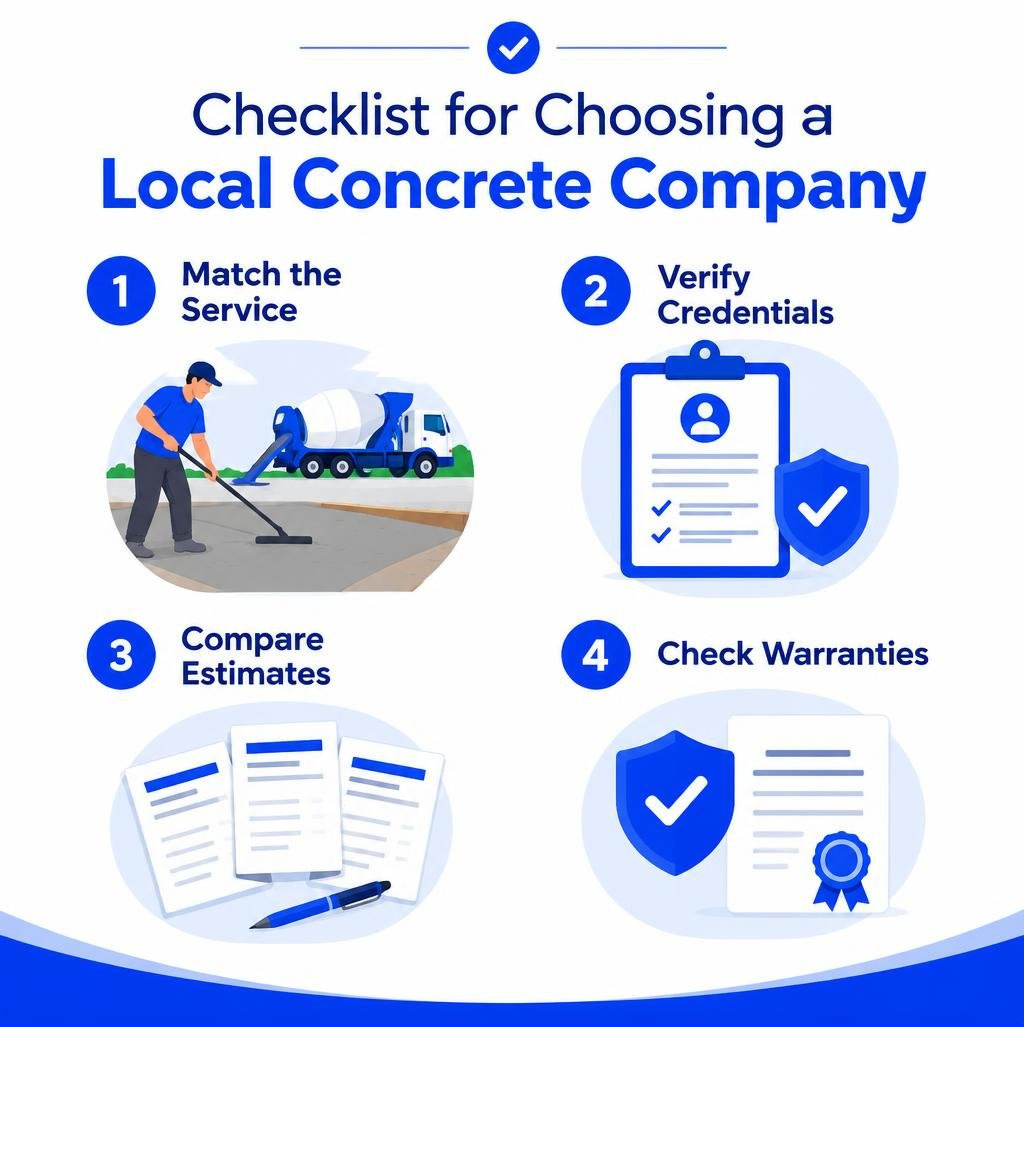
Must-know concrete company near me terms:
Services Offered by a Concrete Company Near Me
When searching for local concrete specialists across Northwest Ohio, Southeast Michigan, and Northeast Indiana, you will find that specialized contractors maintain, level, and protect existing structures without the expense and disruption of full demolition.
Understanding what a full-service repair team provides helps you determine how restorative maintenance can solve your slab problems. A reputable contractor typically offers a diverse suite of solutions, including:
- Polyurethane Slab Leveling: Precision lifting of sunken slabs back to their original grade.
- Crack Repair & Joint Caulking: Sealing vulnerable fissures to stop water infiltration.
- Protective Concrete Sealing: Applying penetrating barriers to protect against freeze-thaw damage and deicing salts.
- Void Filling & Deep Soil Stabilization: Injecting structural materials beneath slabs to reinforce unstable underlying soil.
Rather than assuming a cracked or uneven slab is doomed for the landfill, explore our comprehensive concrete services to see how modern preservation techniques can restore your property without the mess of demolition.
Residential vs Commercial Concrete Specializations
Different properties face distinct structural challenges. Residential concrete work prioritizes aesthetic appeal, foot traffic safety, and water diversion away from home foundations. Commercial concrete, on the other hand, demands heavy load-bearing capacities, compliance with accessibility standards, and strict adherence to industrial safety codes.
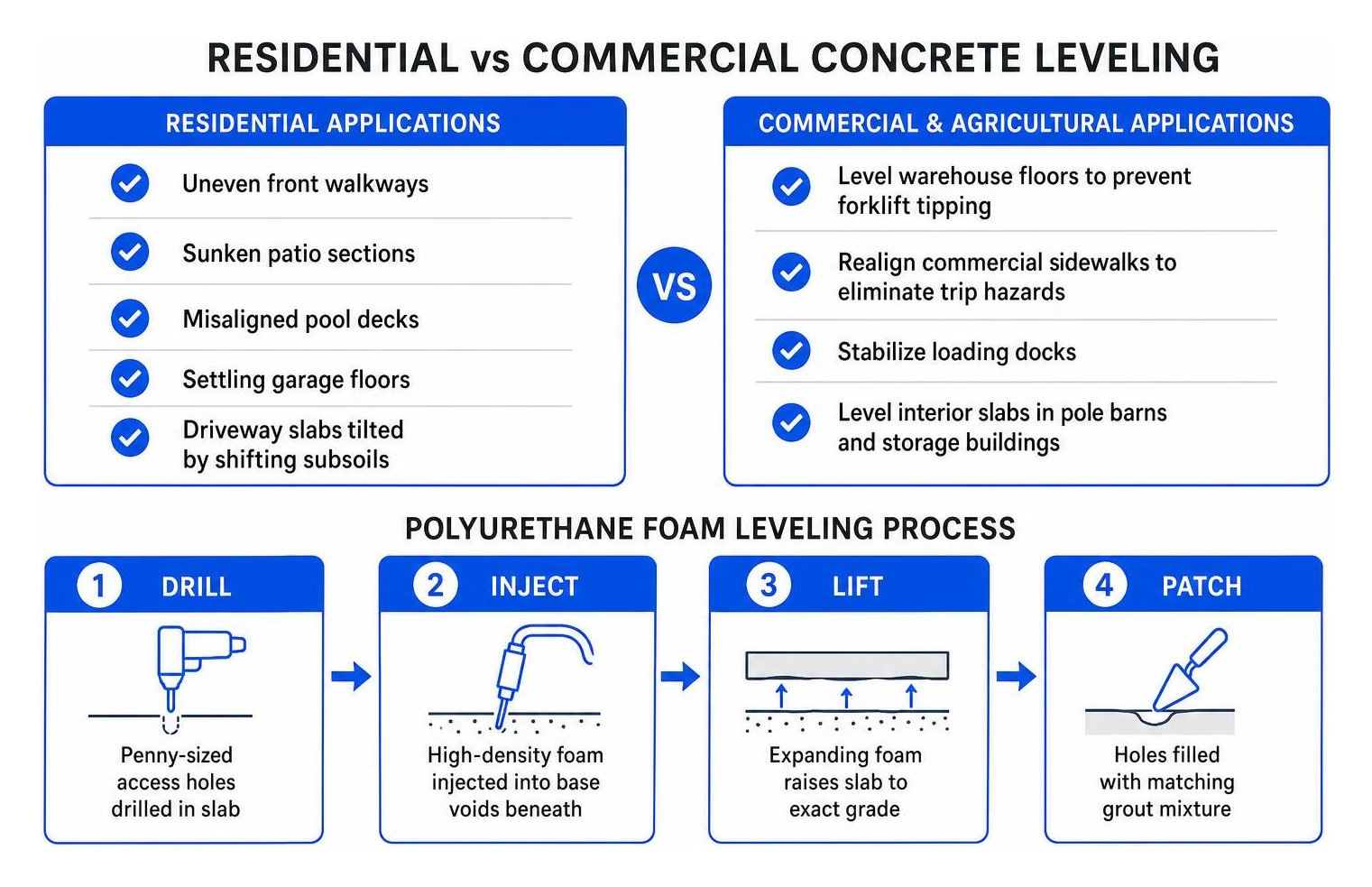
- Residential Applications: We frequently address uneven front walkways, sunken patio sections, misaligned pool decks, settling garage floors, and driveway slabs tilted by shifting subsoils.
- Commercial & Agricultural Applications: Industrial facilities, municipal properties, and farms require heavy-duty stabilization. This includes leveling warehouse floors to prevent forklift tipping, realigning commercial sidewalks to eliminate trip hazards, stabilizing loading docks, and leveling interior slabs in pole barns and storage buildings.
Slab Leveling and Concrete Repair Solutions
Concrete is heavy, but the soil beneath it is dynamic. Over time, poor sub-base compaction, soil erosion from roof runoff, and natural freeze-thaw cycles create subterranean voids. Deprived of solid ground underneath, heavy concrete slabs naturally sink, crack, and become hazardous trip points.
Instead of heavy demolition machinery tearing up your lawn, modern polyurethane foam concrete leveling provides an efficient, non-invasive alternative.
By injecting an expanding, high-density polymer through holes no larger than a dime, we fill sub-surface voids, compact weak soil strata, and gently lift the concrete back to a flush, safe level. You can see how dramatically these techniques restore sunken walkways and patios by checking out these before and after leveling project results.
How to Choose and Vet a Local Concrete Contractor
Hiring a contractor to work on your home or commercial building shouldn’t feel like a roll of the dice. Finding a dependable local professional requires verifying credentials, assessing industry experience, and ensuring the team carries proper protections.
When evaluating prospective companies, always ask for proof of general liability insurance and workers’ compensation coverage. Reputable businesses will readily provide certificates of insurance. You can also research regional contractor track records by checking the Concrete Contractors directory on BBB or browsing authentic client reviews and testimonials from property owners in your immediate area.
Why Choose a Local Concrete Company Near Me Over National Chains
Working with an established, locally-owned company offers distinct advantages over dealing with distant national franchises:
- Familiarity with Regional Soil & Climate: Tri-state soils—from Michigan clay to Ohio silt—behave unpredictably when subjected to wet springs and harsh, freezing winters. A local contractor understands the exact soil movement patterns that affect your slabs.
- Strict Code Compliance: Local teams understand municipal requirements, drainage regulations, and property setbacks specific to your township or county.
- Accountability & Direct Communication: Local business owners have a direct stake in their community’s reputation. You deal directly with experts dedicated to long-term quality rather than a remote call center.
To see if our technicians work in your neighborhood, check out our extensive regional service area coverage across Ohio, Michigan, and Indiana.
Verifying Credentials, Insurance, and Warranties
Before signing any agreement, verify that your contractor holds active municipal registrations where applicable and carries up-to-date insurance coverage. Independent verification platforms such as the Construction business listings on BBB provide transparent records of business standing, unresolved complaints, and reliability ratings.
Equally important are the terms of the company’s warranty. A solid warranty should clearly outline:
- How long the workmanship and materials are guaranteed.
- What degree of slab movement triggers a warranty claim.
- Whether crack caulking and joint sealing are covered alongside slab lifting.
While some contractors offer limited 1- to 3-year warranties, we back our foam-injection leveling and crack repairs with a lifetime warranty, giving you lasting peace of mind.
Understanding Site Assessment, Project Timelines, and Costs

Every concrete project is unique. An accurate estimate requires a thorough on-site evaluation to determine what is happening beneath the surface. During a site visit, technicians evaluate:
- Total Slab Surface Area: The square footage that requires lifting or sealing.
- Settlement Depth: How many inches the slab has dropped relative to adjacent structures.
- Sub-base Voids: The volume of empty space underneath the concrete that must be filled.
- Site Accessibility: Access routes for service vehicles, injection hoses, and equipment.
Comparing Repair and Replacement Scopes
| Project Scope | Typical Method | Average Completion Time | Usable After | Relative Cost vs Replacement |
|---|---|---|---|---|
| Polyurethane Leveling | Foam injection through penny-sized holes | 1 to 4 Hours | 15–30 Minutes | Saves 30% to 50% |
| Full Slab Replacement | Heavy excavation, framing, ready-mix pour | 2 to 5 Days | 24–48 hrs (Foot) / 7 days (Vehicles) | Baseline High Cost (100%) |
FoamWorks Concrete Leveling uses polyurethane foam injection to repair sunken or uneven concrete for 30% to 50% less than full tear-out and replacement, helping homeowners save significantly on repair costs. Most repairs are completed in just a few hours, and the surface can be used almost immediately. Because there’s no need for heavy excavation, the process also reduces landscape damage, labor costs, debris removal, and disposal fees that come with replacing concrete. We provide free estimates to see how much you can save.
Site Preparation Steps Before Concrete Repair
Unlike traditional concrete replacement—which requires renting heavy machinery, tearing up lawns, and framing wooden forms—preparing for polyurethane foam leveling is fast and non-invasive:
- Site Inspection & Mark-out: Technicians inspect the slab grade, pinpointing hidden utilities, drainage pathways, and void locations.
- Access Clearance: The work area is cleared of patio furniture, vehicles, planters, and surface debris.
- Port Drilling: Technicians drill discrete 5/8-inch injection holes in strategic patterns across the affected slabs.
- Injection Equipment Setup: High-pressure delivery hoses are routed from the mobile service unit directly to the injection points, ensuring no heavy trucks drive onto your lawn.
What to Expect When Hiring a Concrete Company Near Me
From your initial phone call to the final sweep of the work area, a professional concrete repair project should follow an organized, hassle-free process:
- Consultation & Free Estimate: A trained specialist assesses your sunken walkways, steps, or driveways and delivers a clear, transparent written estimate.
- Precision Execution: On project day, technicians level the sunken slabs, fill structural voids, and seal open cracks using durable polyurethane materials.
- Clean-up & Port Patching: All injection ports are sealed with a specially formulated cementitious grout designed to match the surrounding concrete.
- Immediate Walk-Through: The crew reviews the completed work with you to ensure every trip hazard has been eliminated and drainage slopes are correctly restored.
Post-Repair Maintenance for Driveways, Patios, and Sidewalks

Once your concrete surfaces have been brought back to their original grade, basic preventive maintenance will keep them protected for decades to come.
- Seal Joints and Control Cracks: Water is concrete’s biggest threat. When rain or snowmelt seeps into open cracks and control joints, it erodes the supporting soil base or expands when frozen, causing the slab to fracture. Apply commercial-grade, flexible polyurethane caulking along all open joints.
- Apply Penetrating Sealers: A silane/siloxane penetrating sealer shields concrete from surface spalling, moisture absorption, and road deicing salts without altering the slip-resistant texture.
- Maintain Proper Drainage: Ensure your gutter downspouts, landscape grading, and sump pump discharges route water at least 5 to 10 feet away from concrete slabs.
- Avoid Harsh Chemical Deicers: During Midwest winters, skip harsh ammonium nitrate or calcium chloride deicers on concrete, particularly during the first few seasons after installation. Opt for clean traction sand instead.
Want to see examples of properly sealed, leveled, and restored surfaces? Take a moment to view our work portfolio to see how regular care and professional leveling preserve concrete integrity.
Frequently Asked Questions About Concrete Contracting
How soon can I use concrete after foam leveling?
Unlike fresh ready-mix concrete—which requires 24 to 48 hours for light foot traffic and up to 7 days before you can drive vehicles on it—polyurethane leveling foam cures almost instantly. The expanding polymer reaches 90% of its ultimate structural compressive strength within 15 to 30 minutes of injection. You can walk across your leveled sidewalk or park your vehicle in your leveled garage right after our crew packs up their tools.
What factors have the largest impact on concrete repair pricing?
Concrete repair costs depend primarily on four factors:
- Slab Surface Area: The overall dimensions of the concrete section requiring stabilization.
- Settlement Depth: Slabs that have dropped several inches require more polyurethane material to raise than those with minor settling.
- Sub-surface Void Volume: Large washouts beneath the concrete require additional foam to establish a stable structural foundation.
- Crack Repair Requirements: The total linear footage of cracks that need grinding, cleaning, and waterproof sealing.
What warranty terms should I look for in a concrete contract?
When reviewing a contract, look for a warranty that covers both material defects and re-settlement. Make sure the warranty clearly specifies the timeframe, whether follow-up service calls carry labor fees, and how quickly the company will address any claims. We provide a lifetime warranty on leveling and crack repairs, ensuring your investment remains protected for the long haul.
Conclusion
Uneven, sunken concrete is more than an eyesore—it is an active liability that can damage vehicle suspensions, cause serious trips and falls, and negatively impact your property’s value. Replacing concrete entirely is often an unnecessary, expensive, and messy hassle.
With over 30 years of industry experience, FoamWorks Concrete Leveling delivers fast, eco-friendly, and cost-effective solutions for property owners throughout Northwest Ohio, Southeast Michigan, and Northeast Indiana. If you are ready to eliminate dangerous trip hazards, protect your subsoil, and restore your slabs for a fraction of replacement costs, request a free estimate today. You can also explore our restorative concrete repair services to discover how simple maintaining your concrete can be.