
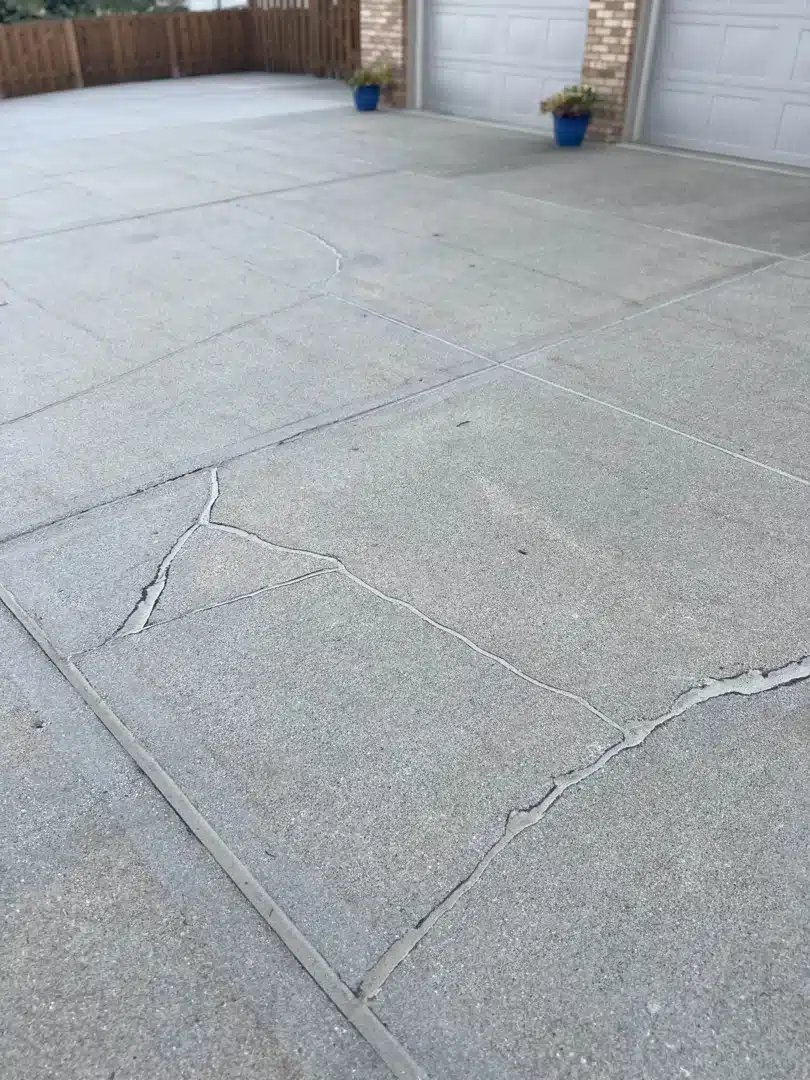
When Cracked Concrete Needs a Professional Repair
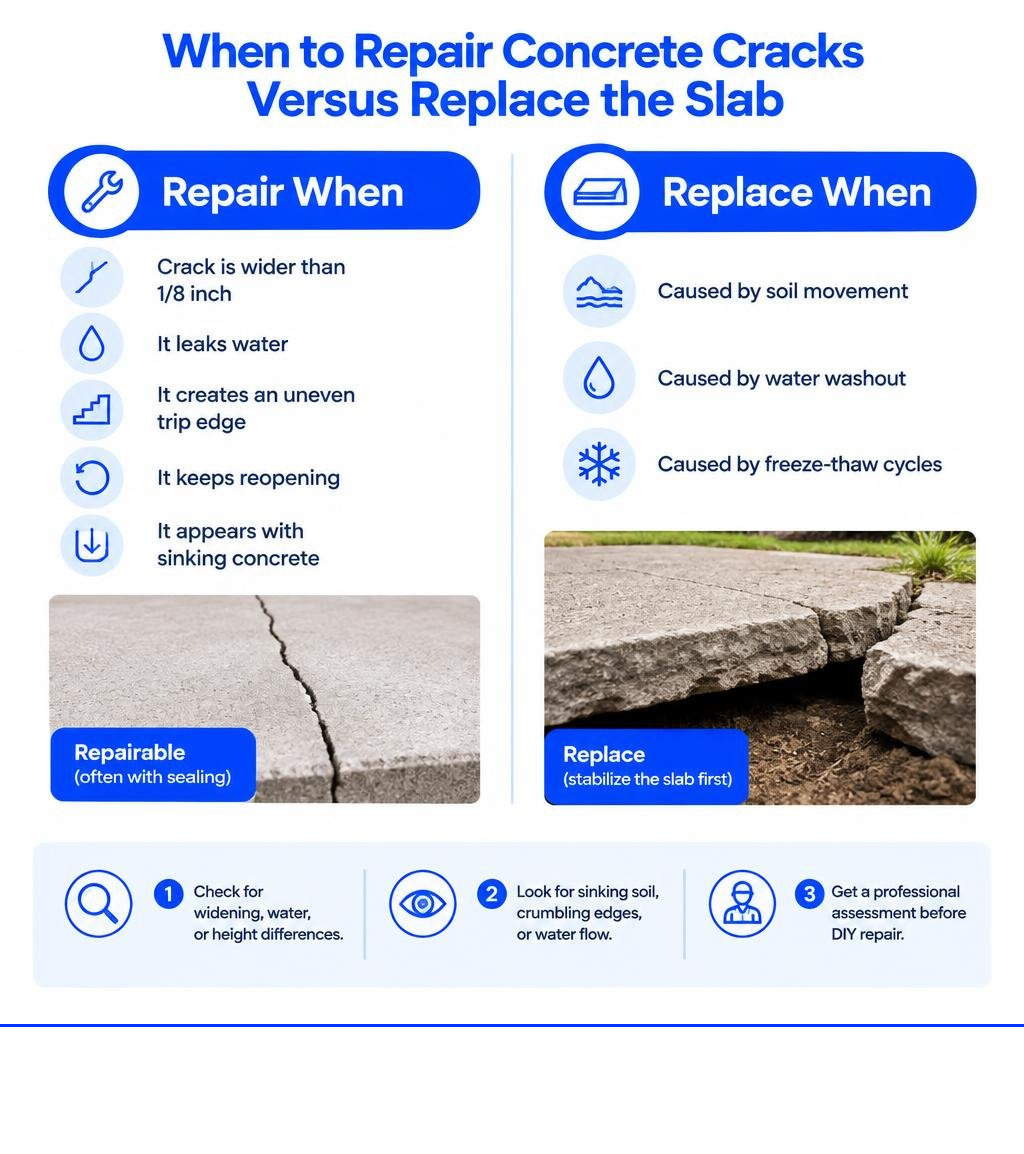
Call a concrete repair professional when a crack is wider than 1/8 inch, leaks water, creates an uneven trip edge, keeps reopening, or appears alongside sinking concrete. Small surface cracks may only need sealing, but cracks caused by soil movement, water washout, or freeze-thaw cycles need the slab stabilized before they are filled. According to the American Concrete Institute, crack evaluation should consider width, movement, and moisture exposure before choosing a repair method.
For homeowners in Northwest Ohio, Southeast Michigan, and Northeast Indiana, the best next step is simple:
- Check whether the crack is widening, holding water, or causing a height difference.
- Look for signs of sinking soil, crumbling edges, or water flowing toward the slab.
- Get a professional assessment before using a DIY filler on an active crack.
Ignoring the problem can let water reach the soil below, wash out support, and turn a manageable crack into a larger repair or replacement project. Professional leveling with polyurethane foam can restore support beneath a sunken slab without major excavation, often for 30% to 50% less than tear-out and replacement.
I am Trey McNamee, owner of FoamWorks Concrete Leveling, with more than two decades of experience in building-material marketing, strategy, and product development, plus a team with over 30 years of combined field experience. In this guide, I will explain how concrete crack repair services identify the real cause of cracking and choose a repair built to last.
Easy concrete crack repair services word list:
Signs You Need Professional Concrete Crack Repair Services

Concrete is exceptionally strong under compression, but it is naturally rigid. Over time, environmental stressors cause visible fractures. Understanding the root causes of concrete damage—from subbase soil washout and tree root expansion to heavy vehicular loads—helps determine whether a crack is merely an aesthetic annoyance or an indicator of structural fatigue.
The industry benchmark for concern is the 1/8-inch threshold. Cracks narrower than 1/8 inch (about the thickness of a nickel) are generally hairline or surface-level shrinkage fractures. Once a crack reaches or exceeds 1/8 inch, it shifts from cosmetic to structural. These larger gaps allow water to bypass the top surface, directly eroding the compacted subgrade beneath the slab.
For both residential walkways and high-traffic commercial properties, uneven slabs create liability risks and tripping hazards. When soil shifts unevenly, sections of the slab drop, resulting in offset edges that catch foot traffic, snowblower blades, and vehicle tires. Addressing these issues early prevents small surface flaws from compounding into widespread slab failure.
Cosmetic Hairline Fractures vs Structural Gaps
Hairline fractures often develop during the initial curing phase as moisture evaporates from the mix. While homeowners can explore fixing concrete cracks at home without breaking the bank for tiny, dormant blemishes, DIY hardware-store caulks often fail on active cracks. Surface-applied pastes do not possess the tensile strength or elasticity to accommodate ongoing thermal expansion and ground movement, frequently flaking away after a single season.
Structural gaps, by contrast, are dynamic. They move as moisture levels fluctuate, during heavy rainstorms, or across seasonal shifts. Slabs that heave upward or drop downward signal load-bearing failure in the shifting subgrade below. Nationwide assessment data shows that patching over a moving gap without stabilizing the supporting soil guarantees that the crack will reopen, often wider than before.
Water Infiltration, Efflorescence, and Foundation Risks
When surface water enters an open fissure, the long-term consequences extend far beyond the concrete itself. Understanding the risks of leaving cracks untreated is essential for safeguarding your property. Water migrating through exterior slabs pools against foundation footings, generating hydrostatic pressure against basement walls.
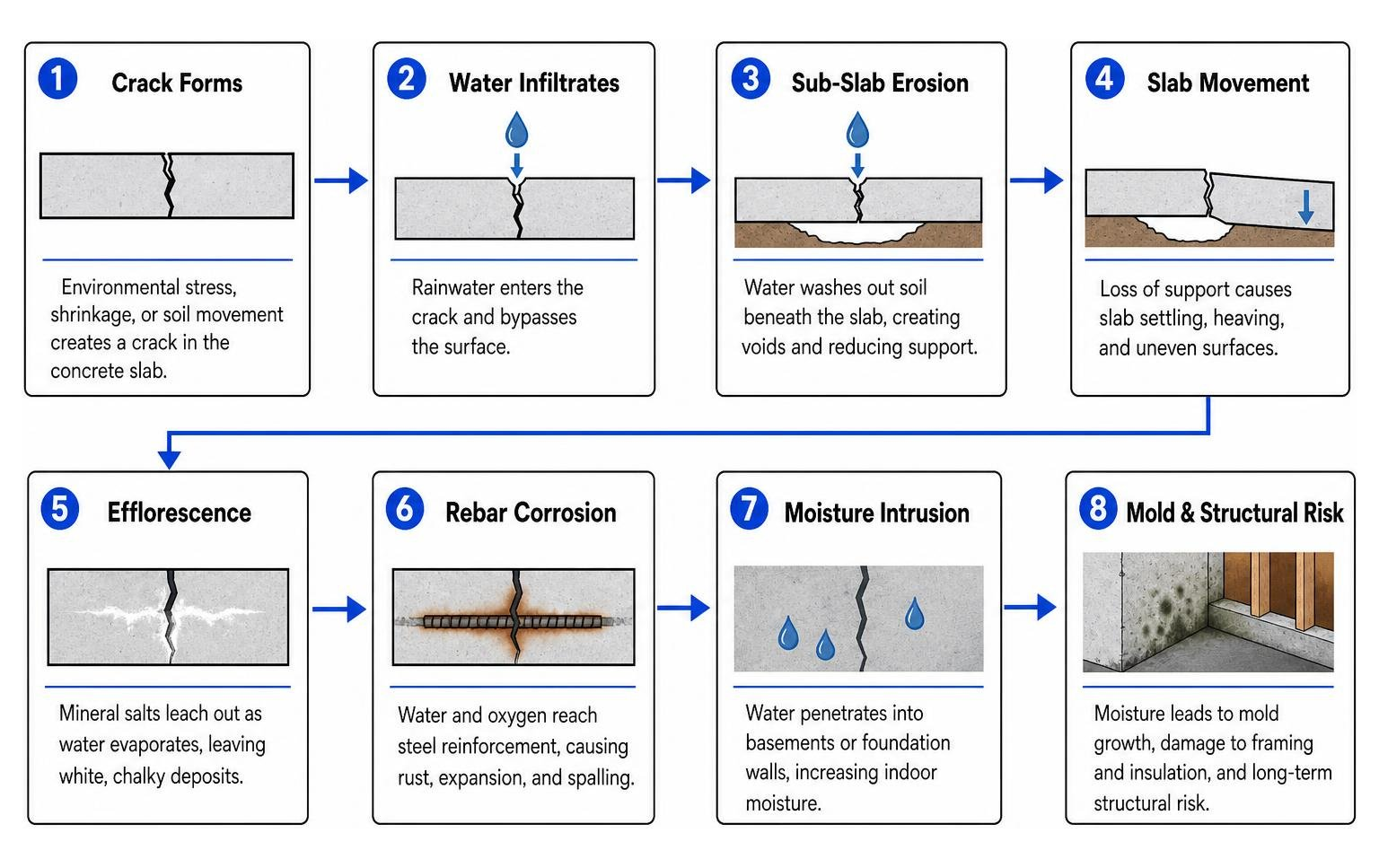
Unchecked moisture introduces several distinct failure mechanisms:
- Efflorescence Deposits: Soluble mineral salts leach out as water evaporates through the porous concrete, leaving a chalky, crumbly white powder on surfaces.
- Internal Rebar Corrosion: Water and oxygen contact embedded steel reinforcement, causing the rebar to rust, expand, and spall the surrounding concrete from within.
- Sub-Slab Soil Washout: Concentrated rainwater channels through cracks, carving out subterranean voids and leaving concrete spans unsupported.
- Indoor Moisture and Mold: Water penetrating basement floors or foundation walls saturates framing and insulation, creating an environment ripe for mold growth.
Advanced Repair Methods: Polyurethane, Epoxy, and Geopolymer Injections

Professional concrete repair services utilize targeted injection systems that treat both the surface blemish and the structural voids beneath. Standard surface patching merely bridges the top millimeter of a gap, but high-pressure and low-pressure injection systems deliver liquid polymers directly into the full depth of the fracture.
Choosing the proper repair material depends on whether the slab requires rigid structural re-bonding, water-stopping flexibility, or deep subbase lifting. Understanding caulking vs sealing concrete explained for homeowners provides clarity on when to bridge an active expansion joint versus when to flood deep micro-voids with structural resins.
Comparing Injection Methods Used by Concrete Crack Repair Services
Modern repair techniques fall into three primary categories: hydrophobic polyurethane injection, high-strength epoxy injection, and geopolymer injection.
Hydrophobic polyurethane expands upon contact with moisture, making it ideal for sealing basement walls, foundation cracks, and exterior joints prone to seasonal movement. Epoxy resins cure to an incredible compressive and tensile strength, welding fractured concrete blocks back together into a monolithic structure. Geopolymer systems, alongside high-density polyurethane foams, are utilized primarily for under-slab lifting and soil densification, providing a lightweight, non-invasive alternative to traditional heavy mudjacking.
| Method | Material Type | Flexibility | Bond Strength | Cure Time | Primary Application |
|---|---|---|---|---|---|
| Polyurethane Injection | Hydrophobic Polymer Foam | High (moves with slab) | Moderate to High | 15–60 Minutes | Water cutoff, active joints, foundation leaks |
| Epoxy Injection | 2-Part Structural Resin | Low (rigid weld) | Extremely High (exceeds concrete) | 4–24 Hours | Load-bearing structural cracks, dry slabs |
| Geopolymer Injection | Inorganic Polymer / Resin | Low to Moderate | High compressive support | 1–3 Hours | Deep soil stabilization, subbase void filling |
Step-by-Step Professional Crack Sealing and Slab Stabilization
Executing a lasting concrete repair follows a rigorous sequence engineered to guarantee mechanical and chemical bonding:
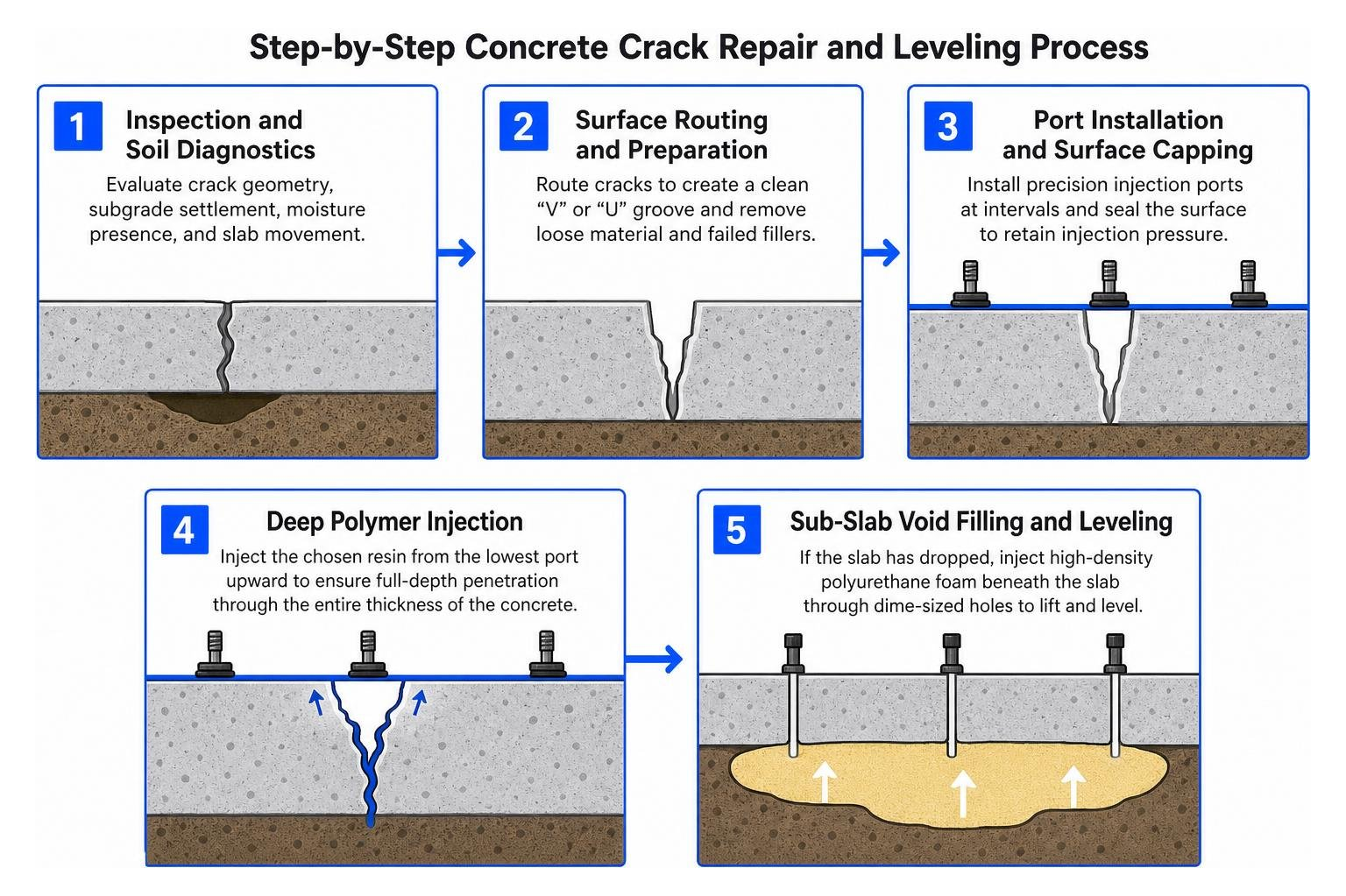
- Inspection and Soil Diagnostics: The technician evaluates crack geometry, subgrade settlement, moisture presence, and slab movement.
- Surface Routing and Preparation: Cracks are mechanically routed using a diamond blade to create a clean “V” or “U” groove, removing loose aggregate, dirt, and failed old fillers.
- Port Installation and Surface Capping: Precision injection ports are bonded along the crack at measured intervals. A temporary surface cap seals the top of the crack to retain injection pressure.
- Deep Polymer Injection: The chosen resin is injected from the lowest port upward, ensuring complete full-depth penetration through the entire thickness of the concrete.
- Sub-Slab Void Filling and Leveling: If the slab has dropped, high-density polyurethane foam is injected beneath the slab through dime-sized holes, lifting it back to a level grade.
- Finishing and Surface Grinding: Injection ports and excess surface caps are ground flush with the slab surface.
- Application of Concrete Sealant Solutions: A penetrating silane-siloxane or polymer seal is applied across the surrounding slab to protect against water penetration, UV degradation, and chemical de-icers.
What to Expect: Costs, Longevity, and Curing Timelines
Homeowners weighing their concrete driveway repair options often discover that polyurethane injection and professional sealing offer massive financial and logistical advantages over complete removal. FoamWorks Concrete Leveling uses polyurethane foam injection to repair sunken or uneven concrete for 30% to 50% less than full tear-out and replacement, helping homeowners save significantly on repair costs. Most repairs are completed in just a few hours, and the surface can be used almost immediately. Because there’s no need for heavy excavation, the process also reduces landscape damage, labor costs, debris removal, and disposal fees that come with replacing concrete.
A concrete slab has a natural operational lifespan of 30 to 50 years before major restoration is warranted. When cracks are addressed promptly using commercial-grade injection polymers, the repair itself lasts between 10 and 25 years, effectively preserving the original investment.
Investment Factors and Transferable Warranties for Concrete Crack Repair Services
The total cost of crack repair and slab leveling varies depending on several site-specific factors:
- Linear Footage and Depth: The overall length and volume of material required to fill the fissures.
- Void Volume Beneath the Slab: The amount of polyurethane foam needed to lift and stabilize settled subsoil.
- Crack Severity and Accessibility: Whether structural carbon-fiber stitching or heavy grinding is required.
- Drainage Corrections: Adding surface routing or downspout redirections to keep water away from the repair area.
Nationwide, crack repair costs typically range from $200 for minor concrete or driveway cracks to $3,500+ for major foundation work involving deep stabilization. Most basement and wall crack injections fall between $400 and $1,200. At FoamWorks Concrete Leveling, we stand firmly behind our workmanship by backing our leveling and repair work with a lifetime warranty. This warranty offers valuable peace of mind that can also enhance property resale value. Requesting a free estimate provides you with a precise, written breakdown customized to your property.
Cure Times and Seasonal Winter Repair Feasibility
Traditional concrete replacement requires days of curing before vehicle traffic is permitted, accompanied by noisy jackhammers and torn-up lawns. Professional polymer injections, by contrast, cure rapidly. Pedestrian foot traffic is usually safe within 30 to 60 minutes, while heavy vehicular parking is permitted within 1 to 4 hours.
A common misconception is that concrete repair must wait until mid-summer. In reality, modern cold-weather formulations and heated injection equipment allow professional repairs to proceed even in winter temperatures down to 14°F (-10°C). With areas across the Midwest experiencing 40 or more freeze-thaw cycles annually, water that seeps into concrete expands by roughly 9% upon freezing. Delaying a repair until spring allows winter freeze-thaw cycles to widen minor hairline fractures into massive structural breaks.
Frequently Asked Questions About Concrete Crack Repair
Can repaired cracks be perfectly color-matched to existing concrete?
While professional repairs dramatically improve appearance and eliminate safety hazards, achieving a 100% invisible match to aged concrete is practically impossible due to decades of natural weathering, UV exposure, and aggregate variations. However, technicians use custom-tinted flexible sealants and broadcast fine silica sand across wet repair surfaces to closely mimic the natural color and texture of surrounding concrete. For a uniform aesthetic across the entire slab, applying a decorative resurfacing overlay or solid penetrating stain after structural crack sealing is an effective option.
What happens if cracked concrete is left unrepaired?
Leaving concrete cracks open allows a continuous cycle of deterioration to take hold. Water enters the crack, washes away subgrade sand and gravel, and creates underground voids. During cold weather, trapped water freezes and expands with tremendous force, breaking away the edges of the crack (spalling) and turning simple fissures into deep potholes. Over time, uneven settlement can stress adjacent building walls, crack foundation footings, and invite burrowing pests, transforming an economical repair into an expensive emergency slab replacement.
How soon can you drive on repaired concrete slabs?
Surfaces repaired with polyurethane foam leveling and rapid-curing joint polymers can support standard passenger vehicles in as little as 1 to 4 hours post-repair. Unlike newly poured wet concrete—which requires a mandatory 7-to-28-day hydration period before accepting heavy loads—polyurethane expansion foam reaches 90% of its ultimate compressive strength within 15 to 30 minutes, allowing you full use of your driveway or garage on the exact same day.
Conclusion
Proactive concrete maintenance protects your home’s curb appeal, eliminates dangerous trip hazards, and safeguards the structural integrity of your property against aggressive freeze-thaw cycles and water erosion. Rather than spending thousands on invasive, messy slab replacement, professional polyurethane leveling and precision polymer sealing deliver permanent, reliable stabilization in a matter of hours.
FoamWorks Concrete Leveling provides dependable, family-owned concrete repair across Northwest Ohio, Southeast Michigan, and Northeast Indiana. With 30+ years of experience, 100% customer satisfaction, and a lifetime warranty on our leveling services, our team fixes the underlying cause of your concrete issues quickly and cleanly. Don’t let seasonal moisture undermine your investment—schedule your cracked concrete repair today and restore your concrete surfaces with confidence.