
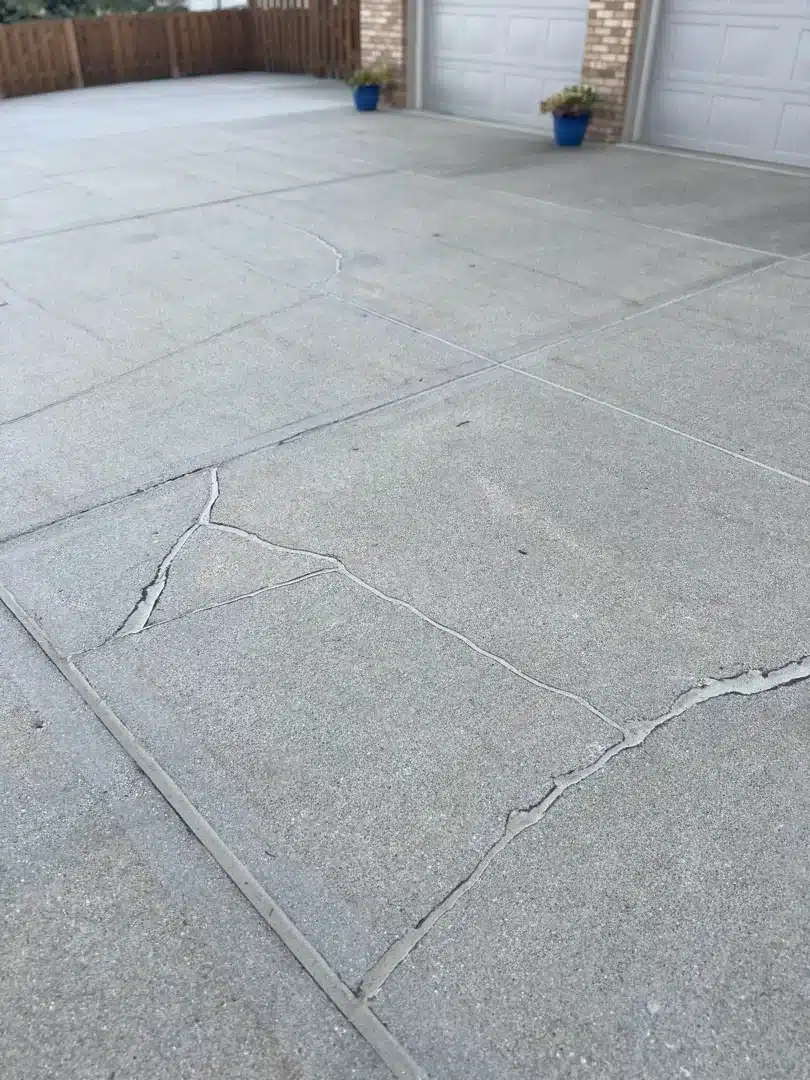
Repair or Replace? Start With the Cause, Not the Crack
For concrete crack repair vs replacement, repair is usually the right choice when cracks are narrow, damage is isolated, and the slab is still level and stable. Replace concrete when cracks are wide or spreading, slabs have heaved or sunk, the base has failed, or repeated patches keep breaking apart.
Use this quick check:
- Repair hairline cracks and stable cracks under about 1/4 inch wide. Seal them early to keep out water.
- Level and repair a sunken but otherwise sound driveway, patio, or walkway. Polyurethane foam injection can lift settled slabs without demolition.
- Replace slabs with major vertical offsets, cracks approaching or exceeding 1/2 inch, widespread crumbling, severe settlement, or unstable soil below.
A crack alone does not always mean your concrete is failing. In Northwest Ohio, Southeast Michigan, and Northeast Indiana, freeze-thaw cycles, water intrusion, soil movement, and vehicle weight can all create cracks or uneven slabs. The key question is whether the concrete has stopped moving – and whether the base beneath it is still doing its job.
At FoamWorks Concrete Leveling, polyurethane foam injection can restore qualifying sunken concrete for 30% to 50% less than tear-out and replacement, often in just a few hours with little disruption to your yard. I am Trey McNamee, owner of FoamWorks, and our team uses decades of combined field experience to help homeowners make a practical concrete crack repair vs replacement decision before they spend money on a patch that will not last.
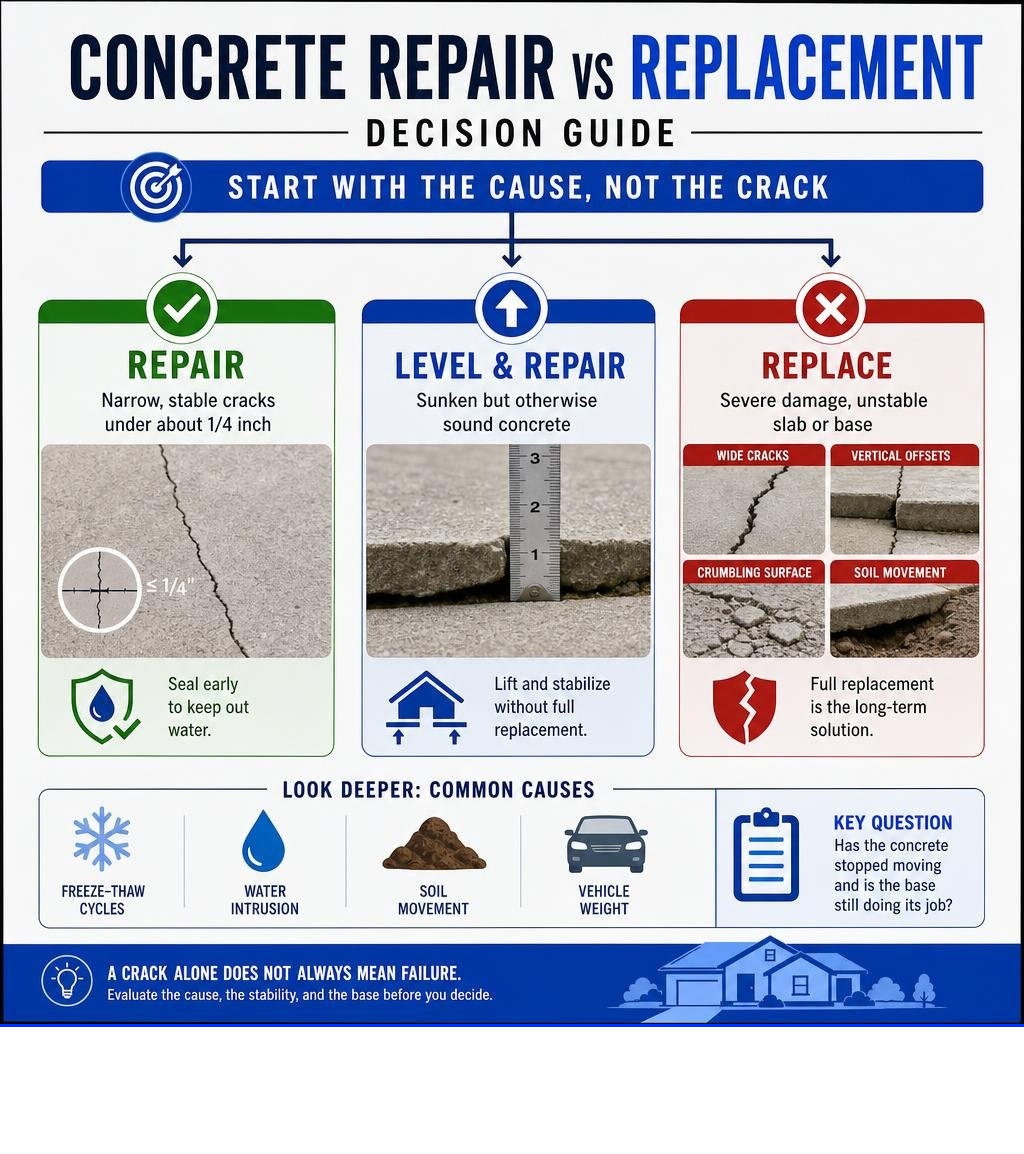
Concrete crack repair vs replacement definitions:
The Decision Matrix: Concrete Crack Repair vs Replacement
Finding a fissure across your driveway or walkway can be frustrating. Over 90% of residential concrete develops some hairline cracking within its first five years. Concrete naturally shrinks as it cures, creating minor surface tension that relieves itself through small breaks.
However, external elements accelerate this wear. In our Midwest climate, seasonal freeze-thaw cycles force moisture beneath the slab to expand, pushing the concrete upward before dropping it back down as temperatures rise. Heavy vehicle loads, poor initial compaction, and moisture intrusion from downspouts erode the underlying soil.
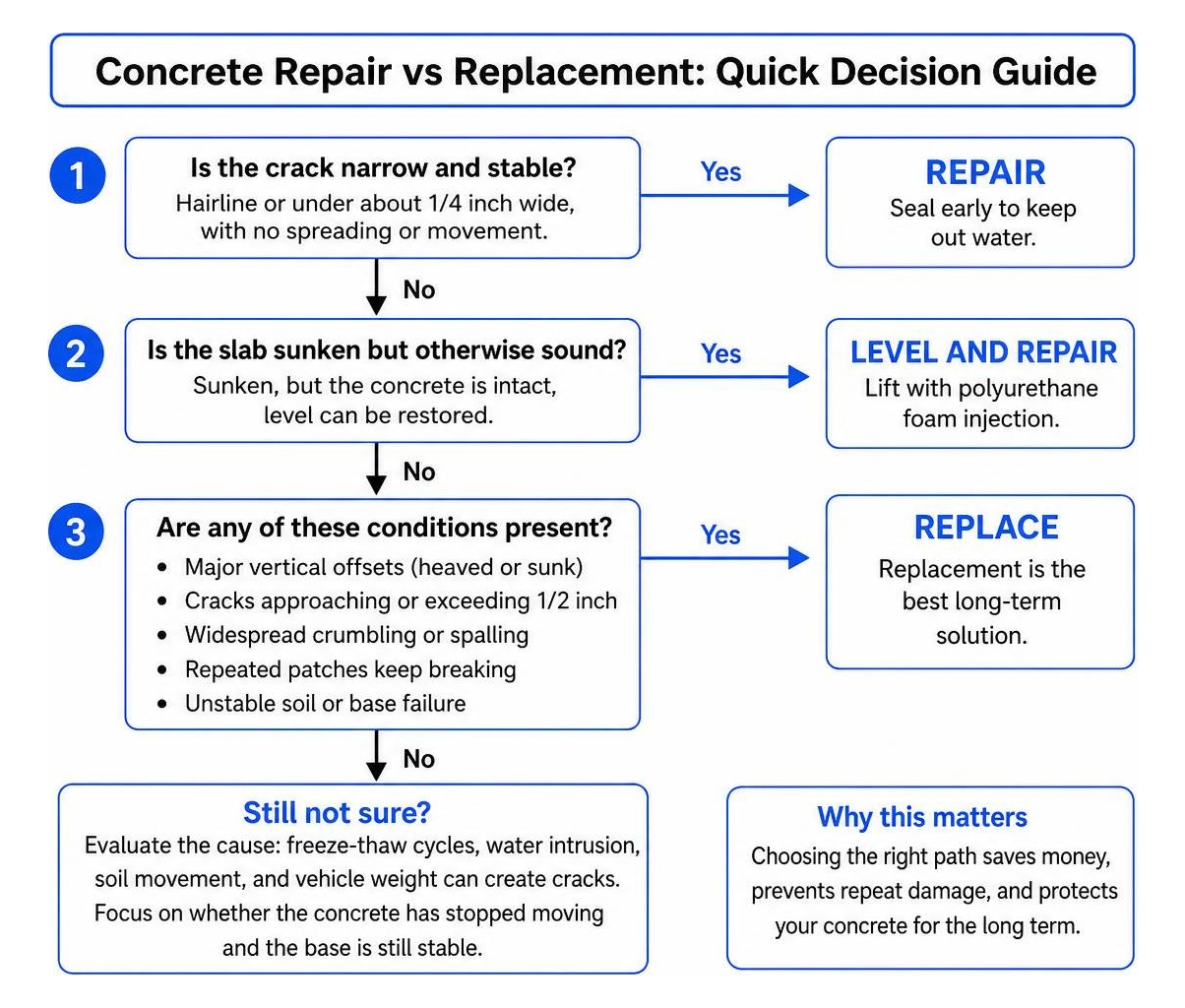
Understanding whether concrete cracks are serious requires diagnosing what is happening underneath the slab rather than simply smoothing over the surface.
Understanding Surface Cracks vs Structural Failures
Not every fracture threatens your foundation or driveway stability:
- Hairline Fractures & Crazing: Fine, web-like surface breaks that rarely extend deeper than the top 1/8 inch. These are cosmetic issues caused by rapid surface drying during the original pour.
- Map Cracking: Shallow intersecting cracks resembling a roadmap. While unsightly, they do not compromise load-bearing capacity if the slab remains firmly supported.
- Structural Fissures: Deep, full-depth fractures that travel entirely through the slab thickness. These fractures allow independent movement between broken segments, leading to slab displacement.
Critical Crack Width and Depth Thresholds
To determine the right course of action, measure the gap with a standard ruler:
- Under 1/4 Inch (Repairable): Narrow, level cracks are prime candidates for sealing or caulking. The base is generally stable, and filling the gap prevents water from worsening the damage.
- 1/4 Inch to 1/2 Inch (Borderline): Requires careful evaluation. If the edges are level, high-performance sealants or injection can bridge the gap. If one side has dropped, leveling may be necessary.
- Exceeding 1/2 Inch or Vertical Offset (Replacement / Heavy Intervention): Gaps wider than 1/2 inch, or slabs with a vertical step-edge greater than 1/2 inch, point to active soil migration or subgrade failure. As outlined in this decision guide for failed slabs, wide breaks with uneven edges often indicate that the sub-base can no longer support the slab.
When Concrete Repair Is the Smart, Cost-Effective Choice
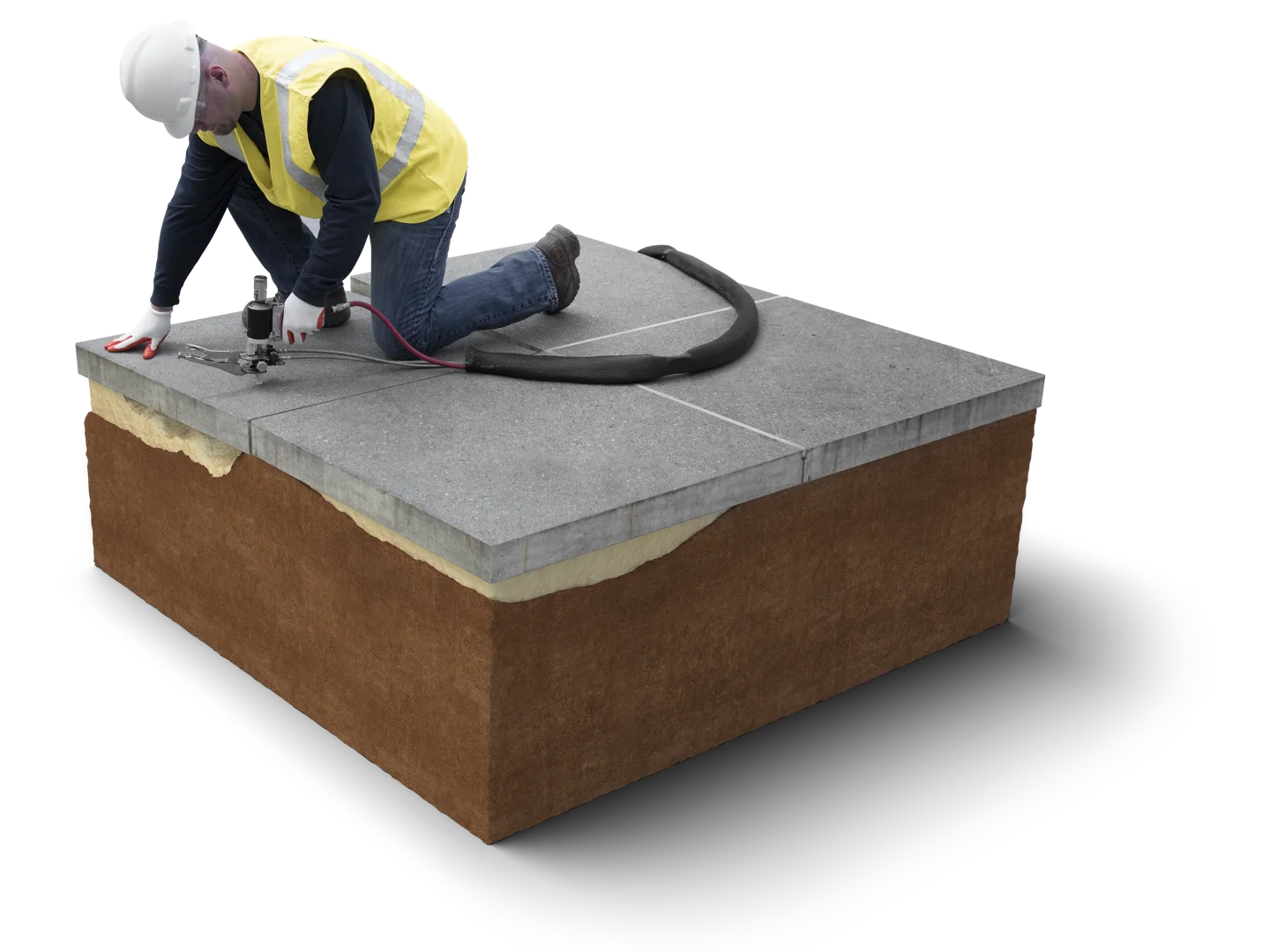
Repair is the most cost-effective path when structural integrity remains intact and less than 25% of the total slab area is affected. Patching or leveling isolated areas avoids the substantial labor and machinery costs associated with complete demolition. Homeowners can explore fast, affordable repair methods that deliver clean results without tearing up the surrounding lawn.
Evaluating Methods for Concrete Crack Repair vs Replacement
Selecting the appropriate repair technique depends on crack movement and depth:
- Elastomeric Caulking & Polyurethane Sealants: Flexible sealants applied along joints and narrow cracks accommodate natural thermal expansion and contraction, preventing water intrusion.
- Epoxy Pressure Injection: Epoxy bonds cracked concrete together, restoring structural strength. This method is common for vertical foundation walls and non-moving load-bearing concrete.
- Targeted Surface Patching: Rigid cementitious patches fill stationary gouges and spalls, though they lack the elasticity needed for active expansion joints.
For widespread wear, scheduling professional concrete repair ensures the root cause is resolved before surface materials are applied.
Resurfacing, Overlays, and Foam Leveling Solutions
When surface spalling is confined to the top 1/4 inch, a polymer-modified overlay can restore a uniform appearance across the entire slab. However, an overlay will not fix an uneven subgrade.
If your slab is sinking, high-density polyurethane concrete leveling provides an efficient alternative to replacement. High-density foam expands underneath the slab, filling hidden voids, consolidating loose soil, and lifting the concrete back to grade. Polyurethane cures within minutes, adds minimal weight to weak soils, and eliminates days of construction downtime.
Clear Indicators That Your Slab Requires Full Replacement
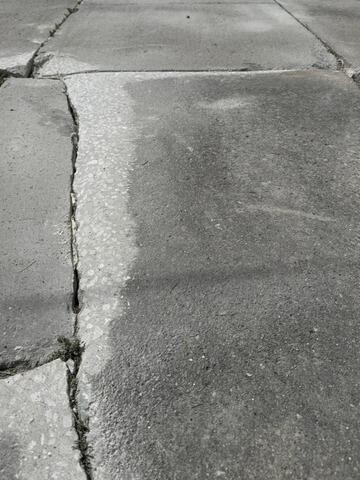
There are scenarios where repairs only delay the inevitable. If you are dealing with deep base erosion, severe frost heaves, or tree roots pushing slabs out of alignment, investing in complete concrete replacement is the more reliable long-term investment.
Severe Subgrade Instability and Widespread Shattering
Full replacement becomes necessary when:
- Subgrade Washout & Voids: Extensive water channeling has washed away the underlying gravel or soil bed, leaving massive unsupported spans.
- Spiderweb & Alligator Cracking: The concrete has shattered into dozens of small, shifting pieces across more than 30% to 40% of the surface.
- Repeated Patch Failures: Past repairs continually pop out, crack, or sink within 1 to 3 years.
- Deep Spalling Exceeding 50%: When more than half the surface concrete has flaked away past the aggregate, the structural integrity of the pour is gone.
Commercial Safety Risks and ADA Compliance Mandates
For commercial facilities, cracked or uneven concrete introduces significant liability risks. Under the Americans with Disabilities Act (ADA), vertical offsets greater than 1/4 inch along accessible routes create non-compliant trip hazards. Municipalities and inspectors can issue fines or mandate immediate reconstruction for shifting walkways and loading docks. In high-traffic commercial environments, full replacement guarantees compliant slope grades and long-term durability.
Cost Breakdown and Long-Term Lifespan Comparison
Evaluating your project requires comparing upfront repair costs against the life-cycle expense of brand-new concrete.
| Solution | Typical Upfront Cost | Expected Lifespan | Disruption & Downtime |
|---|---|---|---|
| Elastomeric Joint / Crack Sealing | $0.50–$1.50/lin. ft. (DIY) / $3–$5/lin. ft. (Pro) | 5 to 10 Years | Minimal (1 to 2 hours) |
| Epoxy Structural Injection | $5 to $15 per linear foot | 10 to 20 Years | Low (Cures in 24 hours) |
| Polymer Resurfacing / Overlay | $3 to $7 per square foot | 8 to 15 Years | Moderate (24 to 48 hours) |
| Polyurethane Foam Leveling | $5 to $10 per square foot | 10+ Years (Matches Slab) | Minimal (Ready in minutes) |
| Full Tear-Out and Replacement | $8 to $21 per square foot total | 25 to 30+ Years | High (Demolition + 7-day cure) |
Note: Driveway replacement in 2026 includes demolition ($2–$6/sq. ft.), sub-base preparation ($1–$3/sq. ft.), and pouring the new slab ($4–$12/sq. ft.). A standard 500-square-foot driveway generally ranges from $4,000 to $10,500.
Applying the 50 Percent Rule to Concrete Crack Repair vs Replacement
A practical industry benchmark is the 50 Percent Rule: if the total cost of comprehensive repairs exceeds 40% to 50% of the cost of full replacement, opt for a new pour. Pouring a fresh slab resets the lifespan clock to 30 years and can protect property value—cracked driveways frequently reduce home buyer offers by $1,000 to $5,000.
Expected Lifespans of Repairs vs New Concrete Slabs
Standard crack fillers generally last 5 to 10 years before requiring reapplication. Quality polymer resurfacing lasts 8 to 15 years, provided the underlying slab does not move. Polyurethane foam injection remains stable indefinitely because the cured foam does not wash out or degrade underground. Reviewing concrete repair case studies can help illustrate how targeted stabilization extends slab utility without full replacement.
Frequently Asked Questions About Concrete Slab Decisions
How long do typical concrete crack repairs last?
Flexible polyurethane sealants and elastomeric fillers last between 5 and 10 years, while structural epoxy injections on stable foundations can last 10 to 20 years. Polyurethane lifting foam does not biodegrade, meaning leveled slabs remain supported for decades as long as surface cracks are kept sealed against moisture intrusion.
How much does it cost to tear out and replace a concrete driveway?
A full driveway replacement typically runs between $8 and $21 per square foot. Demolition and debris disposal cost $2 to $6 per square foot, subgrade correction runs $1 to $3 per square foot, and the new slab pour accounts for $6 to $15 per square foot. Replacing a standard 500-square-foot driveway generally costs between $4,000 and $10,500.
Can cracked concrete be resurfaced instead of replaced?
Yes, but only if the slab is structurally stable and cracks are narrow and non-moving. Resurfacing over active, shifting structural cracks or unaddressed voids will cause “mirror cracking,” where fractures quickly telegraph upward through the new overlay.
Conclusion
Choosing between repairing and replacing your concrete comes down to structural stability, base integrity, and project economics. While extensive subgrade collapse or shattered concrete demands full replacement, minor cracks and settled slabs are often straightforward, cost-effective repair candidates.
FoamWorks Concrete Leveling provides dependable solutions across Northwest Ohio, Southeast Michigan, and Northeast Indiana. Our high-density polyurethane foam lifting restores sunken concrete for 30% to 50% less than the cost of replacement, complete with our lifetime warranty. Contact our team today for a free estimate and discover our proven methods for repairing cracked concrete.