

When Are Concrete Cracks Serious?
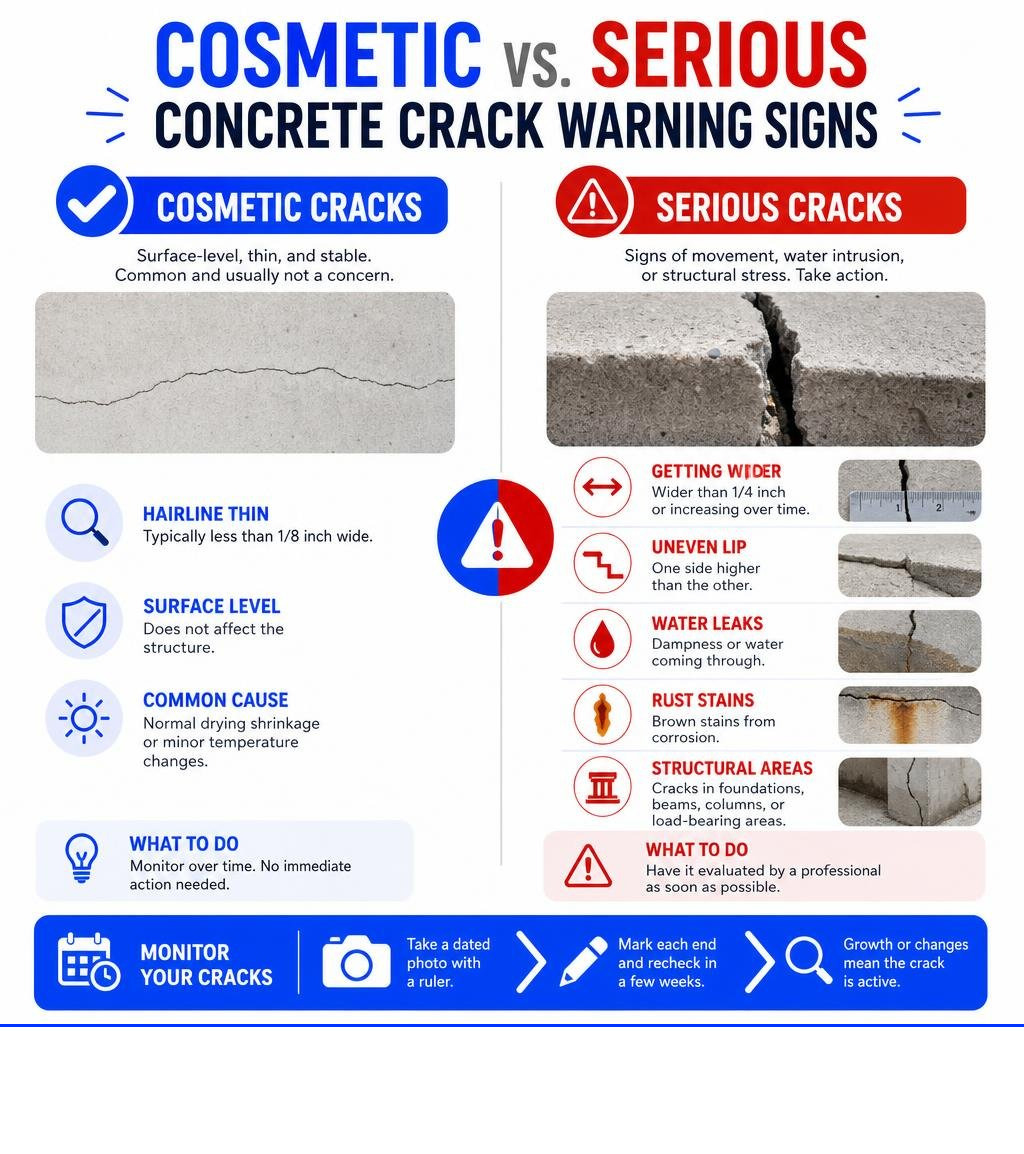
Concrete cracks are serious when they are getting wider, have one side higher than the other, leak water, show rust stains, or appear in a foundation, beam, column, or other load-bearing area. A crack wider than about 1/4 inch needs prompt professional evaluation, but even a smaller crack can be serious if it is moving or displaced.
Check the crack now:
- Measure its widest point and take a dated photo with a ruler.
- Lay a straightedge across it. An uneven lip can mean settling, frost heave, or soil washout.
- Look for dampness, white mineral deposits, crumbling concrete, or brown rust marks.
- Mark each end with pencil and recheck it in a few weeks. Growth means the crack is active.
Hairline surface cracks are often caused by normal drying shrinkage. Concrete is strong under compression but relatively weak in tension, so minor cracking is common. The concern starts when the crack points to movement below the slab, pressure against a foundation wall, or corrosion inside reinforced concrete.
I am Trey McNamee, owner of FoamWorks Concrete Leveling, serving homeowners across Northwest Ohio, Southeast Michigan, and Northeast Indiana. With more than two decades of experience in building-material strategy and product development, I help homeowners understand when are concrete cracks serious and when a sunken slab may be a candidate for leveling rather than replacement.
When are concrete cracks serious definitions:
- how to repair concrete cracks
- Who are the top-rated toledo concrete contractors specializing in foam injection repair?
Warning Signs: When Are Concrete Cracks Serious?
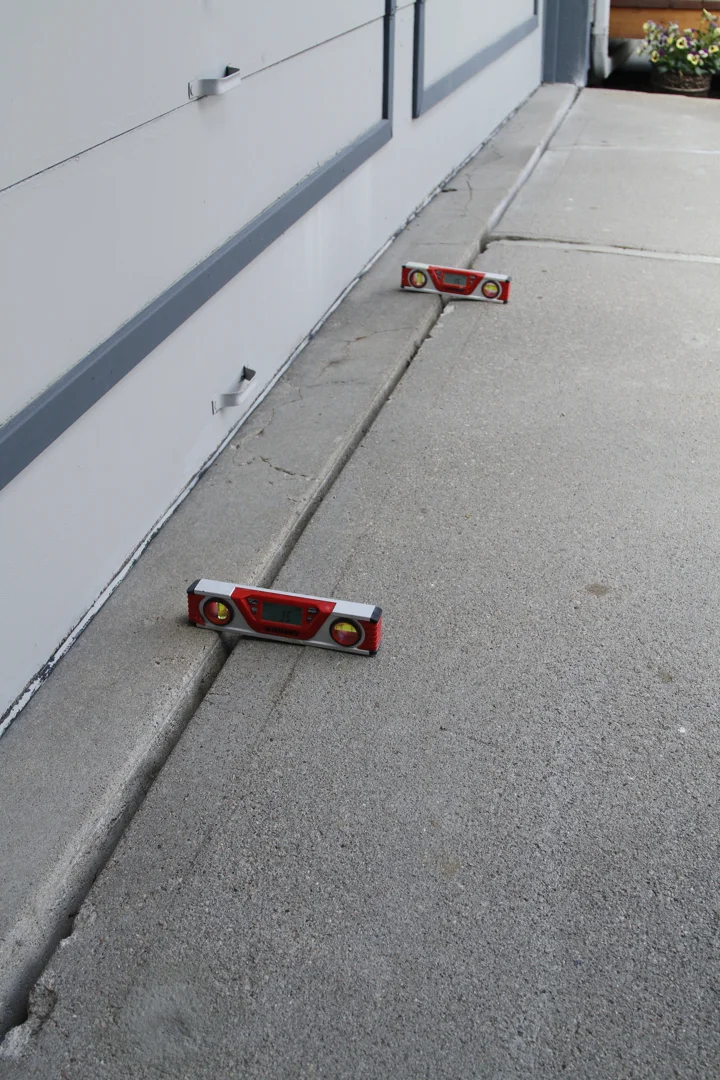
Every concrete slab will experience minor stress over its lifespan. Concrete’s tensile strength is only about 8% to 15% of its compressive strength, which means whenever tensile forces pull on the slab, fractures naturally develop. However, distinguishing between a cosmetic blemish and a dangerous structural failure requires evaluating specific physical indicators.
| Warning Sign | Cosmetic / Non-Structural | Dangerous / Structural Concern |
|---|---|---|
| Crack Width | Less than 1/8 inch (hairline to 3 mm) | Exceeds 1/4 inch (6.35 mm) or widening |
| Edge Alignment | Both sides flush and level | Vertical or lateral displacement (uneven lip) |
| Crack Activity | Dormant (no change over months) | Active (lengthening, widening, seasonal shifting) |
| Moisture / Stains | Completely dry, no discoloration | Active water seepage, efflorescence, rust tracks |
| Location | Mid-slab on flatwork (patios, walkways) | Load-bearing walls, structural columns, beams |
| Associated Damage | None; surrounding concrete intact | Spalling, sticking doors, unlevel interior floors |
Width vs. Displacement: When Are Concrete Cracks Serious?
While crack width is the easiest metric to see, vertical displacement is often the most critical structural indicator. A crack that measures 1/4 inch wide on a flat, even plane may simply be an unsealed shrinkage joint that has opened over time. Conversely, a narrow crack of only 1/8 inch that features a 1/2-inch vertical lip indicates that the underlying soil support has failed.
When one side of a concrete joint or fissure drops below the other, it creates immediate tripping hazards and proves that the concrete slab is settling. This vertical offset is driven by differential settlement, localized soil washout from faulty downspouts, or subgrade erosion. When void spaces form beneath the slab, the concrete can no longer bear weight evenly, leading to progressive structural snapping under load.
Secondary Warning Signs: Moisture, Rebar Rust, and Spalling
Moisture infiltration acts as an aggressive damage multiplier inside cracked concrete. In reinforced concrete, cracks wider than 0.3 mm (about 0.012 inches) allow water, oxygen, and road salts to penetrate directly to the embedded steel rebar.
When internal steel oxidizes, rust occupies 6 to 10 times the volume of the original steel. This massive expansion generates extreme internal bursting pressure, fracturing the concrete from the inside out and causing spalling (flaking or breaking away of surface chunks). Advanced NIST research on concrete degradation demonstrates how moisture ingress accelerates chemical reactions and internal corrosion cycles, turning minor cracks into deep structural compromises that weaken the load capacity of the slab.
The Root Causes of Structural and Non-Structural Concrete Cracks
Understanding why concrete cracks helps you choose the right repair method rather than applying a temporary cosmetic fix over a progressing foundation problem. Concrete distress stems from both initial curing mechanics and external environmental forces. You can learn more about these mechanisms by reviewing the primary crack causes that affect residential flatwork.

Cosmetic Surface Cracks: Shrinkage and Crazing
Not every crack signals structural disaster. As fresh concrete cures, it loses moisture and volume. Standard concrete shrinks roughly 0.05% to 0.06% within its first 28 days—equating to about 5/8 inch of movement across a 100-foot continuous pour.
- Plastic Shrinkage: Occurs within hours of placement when surface evaporation exceeds 1.0 kg/m²/hr due to high winds, low humidity, or direct sun.
- Crazing: A network of very fine, shallow spiderweb cracks on the surface caused by rapid surface drying or over-troweling.
- Crusting: Happens when the top layer stiffens while the underlying base remains wet, resulting in shallow surface fissures.
These shallow imperfections rarely penetrate the full depth of the slab and do not compromise load capacity. Property owners can manage these cosmetic flaws by fixing concrete cracks at home without breaking the bank using flexible, high-grade joint sealants.
Deep Structural Failures: Subgrade Movement and Overload
Deep, through-slab cracks indicate that external forces have exceeded the concrete’s structural limits. In our Midwest service areas across Ohio, Michigan, and Indiana, dynamic weather and heavy clay soils present distinct structural challenges:
- Freeze-Thaw Cycles and Frost Heave: Water expands by approximately 9% when freezing. Moisture saturated beneath unsealed concrete freezes, lifting the slab, and drops it unevenly upon thawing, creating severe shear stress.
- Hydrostatic Pressure: Saturated soil around basement walls exerts intense lateral pressure, producing telltale horizontal cracks along foundation mid-heights.
- Differential Soil Settlement: Inadequately compacted backfill or drying clay causes portions of a footing to sink, creating 45-degree diagonal stair-step cracks that demand targeted residential foundation repair.
- Structural Overloading: Driving heavy equipment, RVs, or delivery trucks over residential slabs designed only for passenger vehicles shears the slab along unsupported subgrade voids.
Diagnostic Protocols: How to Test Active vs. Dormant Cracks
Before specifying any repair material, you must determine whether the crack is dormant (static) or active (moving). Sealing an active crack with a rigid filler will guarantee failure because the continuing movement will simply fracture the patch or rip the adjacent concrete apart.
To assess crack activity over a 30- to 90-day window:
- Pencil Mark Method: Draw a straight pencil line across the crack perpendicular to the fracture and record the date. Mark the exact tips of the crack. Check monthly to see if the line has misaligned or if the fissure has extended beyond your dated tick marks.
- Calibrated Crack Monitors (Tell-Tales): Mount two overlapping acrylic plates with grid crosshairs across the crack using epoxy or screws. These gauges measure lateral and vertical movement down to 0.5 mm, allowing you to track movement across seasons.
- Feeler Gauges and Comparators: Measure the gap at designated points monthly to identify whether seasonal thermal changes or permanent settlement are driving the movement.
For detailed industry benchmarks on permissible gap tolerances across different structures, consult a comprehensive crack standards guide.
When Are Concrete Cracks Serious Enough to Call a Structural Engineer?
While a qualified concrete repair contractor handles flatwork leveling, void filling, and surface injection, certain critical red flags require an independent evaluation from a licensed structural engineer:
- Horizontal cracks appearing along below-grade concrete or block basement walls.
- Inward wall bowing or lateral deflection exceeding 1 inch under soil pressure.
- 45-degree diagonal fissures propagating from door and window frames alongside sticking doors or unlevel floors.
- Visible shifting in primary load-bearing columns, bridge piers, or structural grade beams.
A residential structural engineering assessment typically costs between $300 and $600 for an on-site evaluation and written diagnostic report. To understand when engineering oversight is legally or structurally mandated, review this resource on when to call a structural engineer for concrete cracks. Conversely, when dealing with standard flatwork cracking or sinking driveway slabs, you can reference this guidance on when to call a concrete contractor.
Engineered Solutions: From Polyurethane Leveling to Structural Repair
Fixing cracked concrete successfully requires matching the repair technique to the root cause of the distress. Addressing surface symptoms while ignoring subgrade voids or structural movement will lead to recurring damage.
Professional repair methods include:
- High-Density Polyurethane Foam Injection: Lifting sunken slabs and compacting weak subbase soil through small 5/8-inch ports.
- Targeted Epoxy Pressure Injection: Welding structural cracks shut to restore original tensile strength in dormant concrete elements.
- Hydrophilic Polyurethane Resin Injection: Sealing active, water-bearing foundation cracks by reacting with moisture to form a flexible, watertight gasket.
- Carbon Fiber Stitching and Strapping: Reinforcing bowing basement walls and tying fractured slabs together with high-tensile composite straps.
- Full Slab Replacement: Demolishing and repouring concrete when fragmentation exceeds 50% of the surface area.
Targeted Crack Sealing and Injection
When cracks are dormant and load transfer must be restored, pressure-injected structural epoxies penetrate deep into the cross-section, bonding the concrete faces with a strength that exceeds the concrete itself. For active water leaks in retaining walls or basements, low-viscosity hydrophilic resins expand upon contact with water, creating an impenetrable barrier against hydrostatic pressure. Property owners seeking lasting structural integrity should always opt for professional concrete repair rather than temporary hardware-store caulk.
Slab Leveling and Void Filling
When cracked concrete has settled or dropped, the most effective modern remedy is high-density polyurethane foam injection (polyjacking). At FoamWorks Concrete Leveling, we drill small 5/8-inch holes—about the size of a dime—into the settled slab and inject an expanding structural polymer beneath the concrete.
As the two-part polymer expands, it flows into subgrade voids, densifies weak underlying soil, and hydraulically lifts the sunken slab back into alignment with surrounding sections. FoamWorks Concrete Leveling uses polyurethane foam injection to repair sunken or uneven concrete for 30% to 50% less than full tear-out and replacement, helping homeowners save significantly on repair costs. Most repairs are completed in just a few hours, and the surface can be used almost immediately. Because there’s no need for heavy excavation, the process also reduces landscape damage, labor costs, debris removal, and disposal fees that come with replacing concrete. We provide free estimates to see how much you can save.
Frequently Asked Questions About Concrete Crack Severity
How wide does a concrete crack have to be before it is dangerous?
In load-bearing or structural elements, cracks exceeding 1/4 inch (6.35 mm) represent a serious concern because the concrete section has lost continuity. However, in aggressive outdoor environments, cracks wider than 0.3 mm (about 1/80 inch) can allow moisture and deicing salts to reach steel reinforcement, initiating internal corrosion. Any crack exhibiting vertical edge displacement is serious regardless of its width.
Can a cracked concrete ceiling or pool indicate a structural hazard?
Yes. Cracks in elevated slabs or swimming pools present distinct structural risks. A crack in an overhead slab allows moisture to corrode load-bearing steel reinforcement, creating safety hazards detailed in our guide on water leaks in a concrete ceiling. In swimming pools, shifting subgrades can snap structural shells, requiring specialized techniques for repairing structural cracks in pools to prevent uncontrolled water loss and ground washout.
How much does professional concrete crack assessment and repair cost?
Costs depend heavily on the severity of the damage:
- Initial Structural Engineer Assessment: Typically $300 to $600 for a residential evaluation.
- Targeted Epoxy or Polyurethane Crack Injection: Usually ranges from $300 to $800 per crack line.
- Polyurethane Foam Leveling: Generally runs 30% to 50% less than the cost of slab replacement.
- Full Slab Replacement: Averages $8 to $15+ per square foot, plus demolition and landscaping restoration fees.
Because repair costs escalate exponentially when minor settling progresses into major structural failure, early intervention is always the most economical choice.
Conclusion
Minor hairline shrinkage marks are a natural part of curing concrete, but active cracks, offset edges, rebar rust stains, and settling slabs should never be ignored. Leaving structural cracks unaddressed allows water infiltration, freeze-thaw damage, and soil erosion to turn manageable repairs into expensive replacements.
If you are dealing with sunken, uneven, or fractured concrete slabs across Northwest Ohio, Southeast Michigan, or Northeast Indiana, our family-owned team at FoamWorks Concrete Leveling is here to help. Backed by over 30 years of experience, we provide fast, non-invasive polyurethane foam leveling, crack sealing, and subgrade stabilization protected by a lifetime warranty and a 100% customer satisfaction guarantee.
Don’t wait for minor damage to turn into a foundation crisis. Explore our expert cracked concrete solutions or contact FoamWorks Concrete Leveling today to schedule your free estimate!